
IFC Premier Certificate Practice Exam
$69.00
- Buy to unlock unlimited access to all Quiz questions and Answers in this Quiz.
- After purchase you can print a PDF of the whole quiz at any point. The PDF will contain the questions and the correct answers.
About this Exam
The International Firestop Council (IFC) Premier Certificate is the highest level of recognition offered to professionals dedicated to the critical discipline of passive fire protection. This prestigious designation validates an individual's comprehensive understanding of firestop systems, applicable building codes, inspection methodologies, and plan review processes. It is specifically designed for Special Inspectors, Code Officials, Plan Reviewers, Architects, Engineers, and leading contractors who need to demonstrate authoritative expertise in protecting building joints, penetrations, and perimeter barriers. Earning the Premier Certificate signifies that you are a recognized industry expert capable of ensuring life-safety compliance in complex construction projects.
Ready to test your knowledge?
Buy Now to Access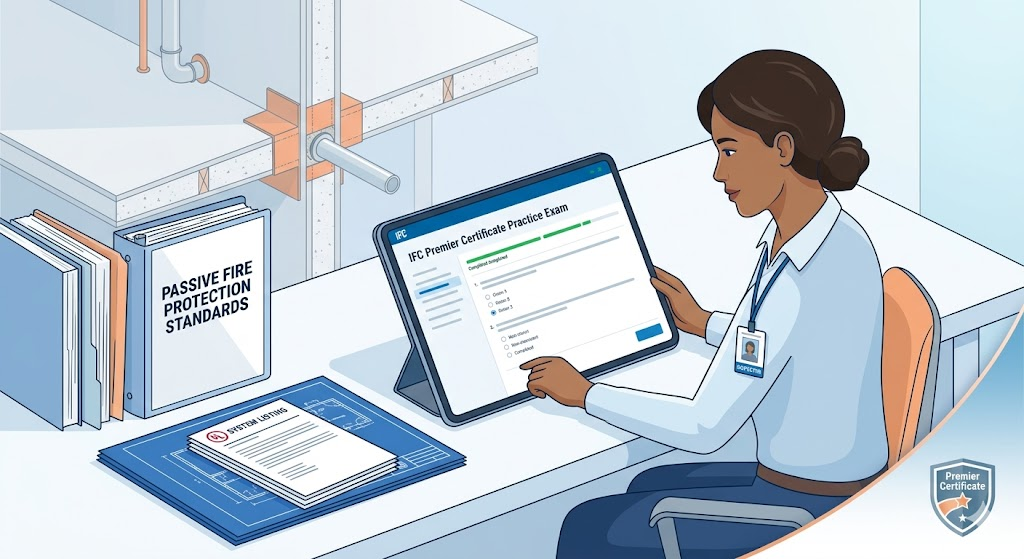
Additional Information
What the Course Entails and Exam Details
This certification requires candidates to master a detailed syllabus covering the technical aspects of passive fire containment. You will need to demonstrate deep knowledge of current International Building Code (IBC) requirements relating to fire resistance, including Chapter 7. The curriculum focuses heavily on understanding the different types of firestop systems (through-penetration, membrane penetration, joints, and perimeter) and how they are classified. It also covers fire test standards, such as ASTM E814 and UL 1479, and the critical importance of reading and interpreting Underwriters Laboratories (UL) or other certified system listings. Additionally, you must master installation best practices, common installation errors to avoid, and the precise responsibilities of a Special Inspector during the construction phase.
What to Expect in the Final Exam
The final certification exam is a rigorous assessment designed to test your ability to apply technical knowledge to real-world scenarios. The exam is typically delivered in a closed-book, multiple-choice format, requiring candidates to quickly retrieve and synthesize information. You must be prepared to answer 100 challenging questions within a strict 3-hour time limit. To successfully earn the Premier designation, you must achieve a passing score of 80% or higher, reflecting the standard of excellence required for this certificate. While online, the exam is strictly proctored, ensuring the integrity and value of the credential.
How to Study and Exam Centers
Preparation is paramount, and a strategic study plan centered on official materials is essential.
Actionable Study Strategies:
Utilize Official IFC Materials: Begin by thoroughly reviewing the complete IFC training curriculum, including video modules, technical documents, and whitepapers provided upon registration.
Master the UL Listings: A significant portion of the exam tests your ability to identify the correct UL listed system for specific wall/floor assemblies and penetration types. You must know how to navigate the online UL database.
Take Multiple Practice Exams: Engaging with reliable practice exams is the most effective way to build stamina for the 3-hour test, identify knowledge gaps, and become comfortable with the scenario-based nature of the questions.
Focus on Calculation Questions: Do not ignore math-related questions. Practice calculating necessary system parameters based on annular space and penetrant size.
Exam Centers and How to Register:
The exam is primarily administered through a secure online testing portal. You can take the exam from the comfort of your home or office, provided your environment meets the strict proctoring requirements, which usually include a functioning webcam and microphone. Registration and payment are handled directly through the International Firestop Council website. Upon completion of the required training courses, you will be given access to schedule your proctored exam session. Occasionally, the IFC may offer in-person testing options during major industry conferences or workshops, but online proctoring is the standard delivery method.
Job Opportunities from the Course
Earning the IFC Premier Certificate significantly enhances your resume and opens doors to highly responsible roles within the construction and safety sectors.
Specific Job Titles and Career Paths Unlocked:
Firestop Special Inspector: A high-demand niche requiring certified inspectors to verify installations match approved plans for jurisdictional compliance.
Code Enforcement Official / Building Inspector: Local authorities value this certification for personnel responsible for inspecting and approving passive fire protection systems.
Fire Marshal / Deputy Fire Marshal: An advanced credential demonstrating technical expertise necessary for fire prevention and code adherence.
Construction Quality Assurance (QA) / Quality Control (QC) Manager: Vital for large contractors managing risk and ensuring life-safety compliance on site.
Passive Fire Protection Consultant: A specialized career path providing expert advice to architectural and engineering firms during the design phase.
Plan Reviewer: The certificate validates the expertise needed to meticulously review architectural drawings and specifications for firestop adequacy before construction begins.
Project Engineer / Field Engineer (Life Safety Focus): An excellent differentiator for engineers working on high-rise or healthcare projects where fire compliance is heavily scrutinized.
Frequently Asked Questions
Reviews
5.0
Based on 0 reviews
Leave a Review
No reviews yet. Be the first to review!