
IFC Premier Firestop Certification Practice Test
$69.00
- Buy to unlock unlimited access to all Quiz questions and Answers in this Quiz.
- After purchase you can print a PDF of the whole quiz at any point. The PDF will contain the questions and the correct answers.
About this Exam
The International Firestop Council (IFC) Premier Firestop Certification is a distinguished credential that validates a professional's specialized knowledge in passive fire protection. This certification is crucial for ensuring the proper design, installation, and inspection of firestop systems in buildings, which is essential for life safety. It is designed for construction industry professionals, building and fire safety inspectors, engineers, architects, and anyone involved in the critical work of preventing the spread of fire, smoke, and gases through fire-rated barriers.
Earning this certification demonstrates deep understanding and commitment to fire safety standards, building codes, and industry best practices. Our IFC Premier Firestop Certification Practice Exam is a meticulously developed tool to help you prepare effectively. It allows you to test your knowledge, identify areas for improvement, and build the confidence needed to succeed in the final exam, ensuring you are thoroughly equipped for this important professional milestone.
Ready to test your knowledge?
Buy Now to Access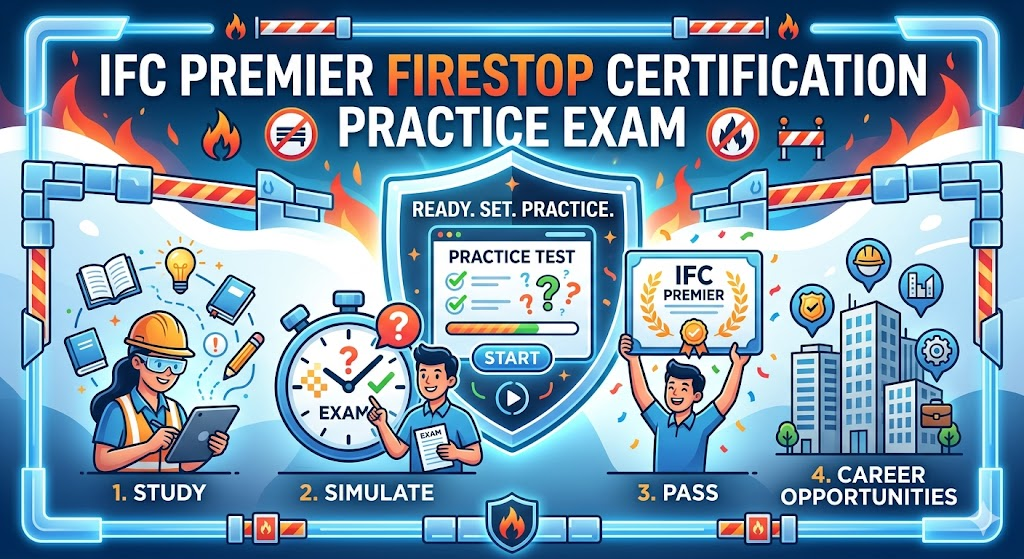
Additional Information
What the Course Entails and Exam Details
The path to the IFC Premier Firestop Certification typically involves a comprehensive, self-paced, online training course offered directly by the International Firestop Council. The associated final exam and our practice test cover a broad spectrum of critical topics:
Passive Fire Protection Fundamentals: Understanding the principles of fire containment.
Building Code Requirements: Deep dives into the International Building Code (IBC) and other relevant codes regarding fire resistance, penetrations, and joints.
Firestop Materials and Systems: Detailed knowledge of various product types (sealants, putties, collars, boards, wraps) and their specific applications.
Listed Systems and UL Standards: The importance of using tested and approved firestop systems and understanding test standards like those from Underwriters Laboratories (UL).
Installation Techniques: Step-by-step procedures for correct and code-compliant installations.
Common Installation Errors: Recognizing typical mistakes made in the field and their consequences.
Inspection Protocols: Procedures for visual, destructive, and non-destructive inspections, and essential documentation.
Engineering Judgments (EJs): Guidelines for addressing non-standard scenarios with engineered solutions.
For current syllabus details, access the official IFC website and the associated training modules.
What to Expect in the Final Exam
While exact structure can evolve, candidates preparing for the IFC Premier Firestop Certification exam can generally anticipate:
Format: A specified number of multiple-choice questions designed to assess comprehensive understanding of the training material and industry standards.
Passing Score: The IFC Premier Firestop Certification maintains a high professional standard. Expect a significant passing score requirement, often around 80% or higher, reflecting mastery.
Time Limit: A specified duration will be allocated for the exam, necessitating efficient test-taking and focused concentration. Be sure to verify current time limits on the official IFC certification portal before your exam.
Rules: The exam is typically administered through the official IFC online portal, often as the final step after completing the self-paced training modules. Check the latest guidelines for proctoring requirements, potential open-book status, and necessary technology upon scheduling.
How to Study and Exam Centers
Preparation is key to succeeding. Utilize these effective strategies and understand the exam delivery:
Study Strategies:
Thoroughly Review Official Materials: Dedicate significant time to the complete IFC training modules, videos, and study guides. They are your primary source.
Dig into Building Codes: Become familiar with the relevant sections of the International Building Code (IBC), NFPA standards, and any local codes and amendments. Make detailed notes and understand the "why" behind each code.
Practice Consistently: Use our specialized IFC Premier Firestop Certification Practice Exam and other credible practice questions. Review explanations for both correct and incorrect answers.
Hands-on/Real-world Observation: If possible, observe or safely participate in real firestop installations and inspections to apply theoretical knowledge practically.
Use Flashcards: Create flashcards for critical terms, code sections, product types, common errors, and standard installation techniques.
Join Study Groups/Forums: Collaborate with other industry professionals, sharing knowledge and discussing complex scenarios.
Exam Centers:
The vast majority of candidates take the final IFC Premier Firestop Certification exam directly through the official International Firestop Council’s online platform. The system is generally designed to be completed online from any suitable location, often as the direct progression after finishing the required training. Ensure you have a stable internet connection and meet any specified technical requirements. Always check the official IFC website upon registration to confirm current proctoring procedures (online or otherwise), potential special requirements, or any changes to exam delivery.
Job Opportunities from the Course
Earning the IFC Premier Firestop Certification unlocks diverse career opportunities in the construction, safety, and engineering sectors. Professionals often pursue roles such as:
Firestop Inspector: Critically assess firestop installations for code compliance and quality control.
Fire Safety Consultant: Provide expert advice on passive fire protection design and implementation.
Passive Fire Protection Manager: Manage overall fire protection programs within construction projects or facilities.
Construction Project Manager (Specializing in Fire Safety): Ensure seamless integration and compliance of firestop systems in construction projects.
Building Code Official/Inspector: Professionally evaluate building plans and inspect projects for fire and life safety requirements.
Technical Sales Specialist (Firestop Products): Utilize technical knowledge to sell appropriate firestop systems for diverse applications.
Advanced Firestop Installer/Team Lead: Perform and lead complex installations to the highest quality standards.
Architect/Engineer (Specialization): Enhance design and engineering capabilities with a deep specialization in passive fire protection compliance.
Frequently Asked Questions
Reviews
5.0
Based on 0 reviews
Leave a Review
No reviews yet. Be the first to review!