
IFSTA Introduction to Fire Service Practice Test
$69.00
- Buy to unlock unlimited access to all Quiz questions and Answers in this Quiz.
- After purchase you can print a PDF of the whole quiz at any point. The PDF will contain the questions and the correct answers.
About this Exam
The IFSTA Introduction to Fire Service Practice Test is an essential preparatory tool designed for aspiring firefighters and emergency responders beginning their journey in the fire service.
It serves as a preliminary gateway, helping candidates assess their foundational knowledge before facing formal entry-level examinations.
This practice test is specifically tailored for individuals who are enrolled in introductory fire science courses, recruit academies, or those who are self-studying to meet the minimum training standards required by their jurisdiction.
By simulating the actual testing environment, it builds confidence, identifies knowledge gaps, and provides a clear benchmark for readiness.
Ready to test your knowledge?
Buy Now to Access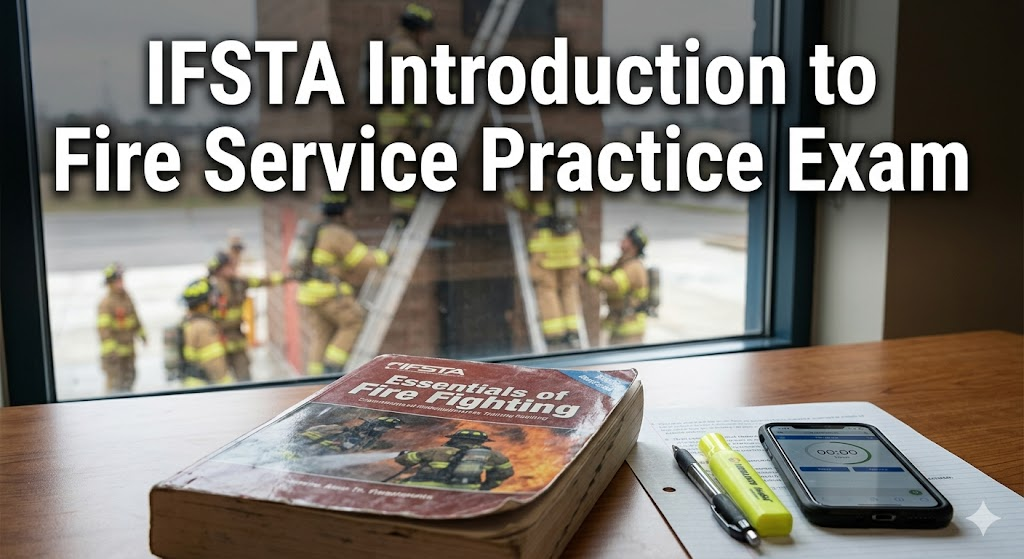
Additional Information
What the Course Entails and Exam Details
This examination is typically based on the widely recognized curriculum established by the International Fire Service Training Association (IFSTA), notably the foundational chapters of the Essentials of Fire Fighting manual.
It covers a broad spectrum of core competencies crucial for a rookie firefighter.
Key syllabus areas include fire service history and organization, ensuring candidates understand the heritage and structure of their future profession.
Safety is paramount, so the course entails thorough coverage of personal protective equipment (PPE), self-contained breathing apparatus (SCBA), and safe operating practices on the fireground.
Fundamental technical knowledge is also a major focus, encompassing fire behavior and dynamics, the various types of building construction, and the proper use of essential fire service hand and power tools.
Additionally, candidates are introduced to the core concepts of fire suppression tactics, ground ladders, and the basic principles of fire ventilation.
What to Expect in the Final Exam
While the exact final exam format can vary significantly depending on whether it is administered by a specific state, a local department, or a college fire science program, the "Introduction to Fire Service" test is typically a structured written examination.
You can expect the core of the test to be composed of multiple-choice questions designed to assess cognitive retention of the IFSTA material.
A passing score is generally set at 70% or higher, reflecting the need for a strong grasp of the material before moving to practical skills training.
Time limits are usually generous, allowing candidates standard exam conditions (typically one to two hours) to complete around 50 to 100 questions.
Some introductory programs might combine this written test with a preliminary practical evaluation of basic skills, such as properly donning PPE within a specified time limit, though this is less common for a purely "Introductory" test.
How to Study and Exam Centers
Effective preparation requires a structured approach centered on the core IFSTA text.
You should dedicate significant time to active reading of the required chapters, highlighting key definitions, processes, and safety protocols.
Utilizing flashcards for terminology and creating summary outlines for each chapter are proven actionable study strategies.
Because this exam assesses the base of your knowledge, repetitive practice using validated IFSTA study guides and online practice portals is highly recommended to become comfortable with the question style and manage your time effectively.
Regarding exam locations, this introductory test is rarely administered at commercial centers like Pearson VUE. Instead, you will most likely take the exam within your local community.
It is frequently hosted at authorized state fire academies, regional training hubs, college fire science testing facilities, or even directly within a hiring fire department’s headquarters during a recruit onboarding process.
You must check with your specific program coordinator or department training officer for exact registration links or physical center details.
Job Opportunities from the Course
Successfully mastering the Introduction to Fire Service material is the first mandatory step towards a rewarding career in the emergency services.
This knowledge base unlocks several professional pathways, particularly when combined with the next level of training (Firefighter I & II).
Primary job opportunities include becoming a Municipal Firefighter, working for city or town departments.
You could also pursue a career as a County Firefighter, often covering larger, semi-rural jurisdictions.
Additionally, this certification path leads to specialized roles such as an Industrial Firefighter, protecting private complexes, airports, or manufacturing facilities.
Other vital career paths include becoming a Volunteer Firefighter within your local community or working as a Federal Firefighter on military bases or for federal land management agencies.
Frequently Asked Questions
Reviews
5.0
Based on 0 reviews
Leave a Review
No reviews yet. Be the first to review!