
IGCSE C10 Chemistry Practice Test
$69.00
- Buy to unlock unlimited access to all Quiz questions and Answers in this Quiz.
- After purchase you can print a PDF of the whole quiz at any point. The PDF will contain the questions and the correct answers.
About this Exam
The IGCSE C10 Chemistry Practice Test is a tailored study tool designed for secondary school students, typically ages 14-16, who are in the midst of their IGCSE Chemistry course. This test is specifically focused on the material designated as "C10," which can represent a particular unit, topic, or subset of skills depending on your specific exam board (such as Cambridge (0620 or 0971), Edexcel, etc.) and your school's curriculum structure.
The practice test is not a final qualification in itself, but rather a vital preparatory resource. Its primary purpose is to help you:
Assess your knowledge: Gauge your understanding of the specific C10 chemistry topics you’ve been studying.
Identify areas of weakness: Find out which concepts still confuse you so you can focus your revision.
Build confidence: Get a feel for exam-style questions and the timing you might face in a similar, more formal, internal test or within the final IGCSE exam papers.
Practice question types: Familiarize yourself with how questions are phrased and what examiners are looking for in this specific part of the chemistry syllabus.
Think of it as a comprehensive training run before a race – it lets you test your speed, endurance, and technique, ensuring you’re better prepared for the final, more challenging event. This guide will walk you through how to use this practice test effectively and what to expect on the journey towards your final IGCSE success.
Ready to test your knowledge?
Buy Now to Access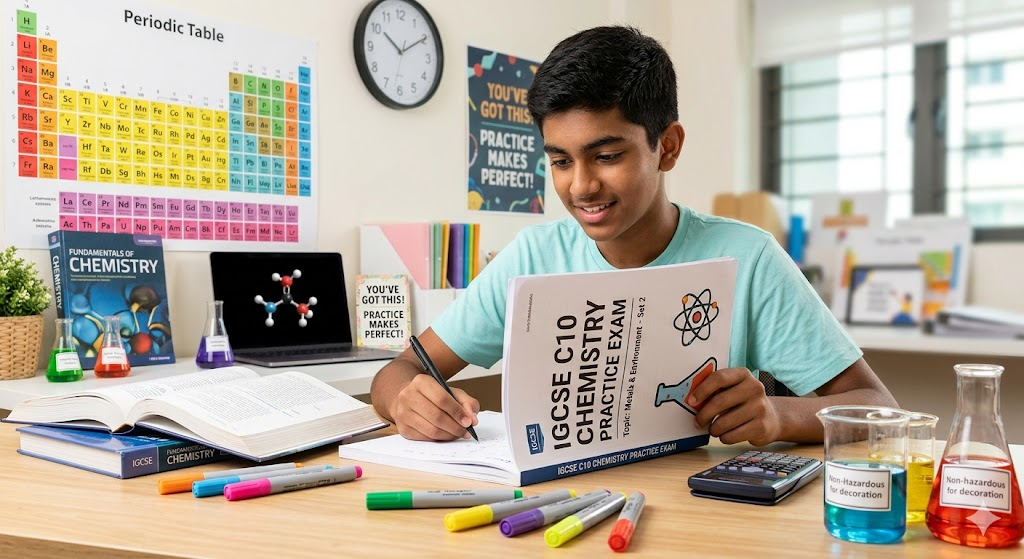
Additional Information
What the Course Entails and Exam Details
As "C10" is often an internal reference or a non-standard designation, the exact content covered in this specific practice test will depend entirely on the sources you are using for your test or the unit your school has defined as C10. However, common "C10" topic types in IGCSE Chemistry often focus on foundational or key analytical concepts, such as:
Metals and the Reactivity Series: Understanding the properties of metals, their reactions, extraction methods, and practical investigations related to their reactivity.
Calculations in Chemistry: Quantitative aspects, including moles, concentrations, stoichiometric calculations, and reaction rates.
Chemical Analysis and Experimental Techniques: Focus on practical skills, common lab apparatus, specific chemical tests, and separation methods. Note: Sometimes C10 might refer to another specific substantive chapter entirely, like organic chemistry in some contexts, so always verify your course's specific designation.
Regardless of the specific C10 topic, the practice test will likely cover:
Core Definitions and Concepts: Testing your fundamental understanding.
Simple Calculations: Appling mathematical skills to chemistry problems.
Interpreting Data: Analyzing graphs, tables, and experimental results.
Describing Reactions and Processes: Posing questions that require explanations of chemical changes.
The practice test will typically have details such as:
Questions: A variety of question formats, including multiple-choice, short answer, and potentially some structured, problem-solving questions.
Time Limit: A specific duration (e.g., 45 minutes to 1 hour), allowing you to practice managing your time.
Marking Scheme: Providing answers and often guidance on how marks are allocated, which is crucial for understanding exam criteria.
Practicing for a specific unit test like C10 directly helps you master a defined portion of your chemistry course, preparing you piece by piece for your school internal assessments and, ultimately, for success across the full breadth of the final IGCSE exams.
What to Expect in the Final Exam
While you are preparing for this practice test, it’s important to understand the bigger picture: the final IGCSE Chemistry exam that your practice is leading towards. The final, official IGCSE Chemistry exam for which this practice is part of your journey consists of multiple components, usually taken over a period of weeks.
While exact paper details vary between exam boards, you can generally expect:
Paper 1 / Paper 2: Multiple Choice: A timed exam (often 45 minutes) with approximately 40 questions covering the entire syllabus. This requires quick recall and understanding across all topics, including the content covered in your C10 practice.
Paper 3 / Paper 4: Structured & Extended Questions (Theory): A longer exam (often 1 hour 15 minutes to 1 hour 30 minutes) featuring multi-part, detailed questions. You will need to write definitions, explain processes, perform more complex calculations, and apply knowledge to new situations. Content from your C10 topics will likely be featured in these papers.
Paper 5 or Paper 6: Practical or Alternative to Practical: These assess your understanding of practical work. Paper 5 involves actually conducting experiments in a lab (not always offered in all settings). Paper 6 is a written alternative, featuring questions based on experimental set-ups, data analysis, and practical reasoning. The analytical skills and techniques from your C10 practice and laboratory work are directly tested here.
You will typically be awarded grades from A* to G (or 9-1 for some curriculums), with pass grades generally considered to be in the A*-C or 9-4 range, depending on your school’s requirements for progression. Each paper contributes a certain percentage to your final overall grade. Your diligent work on specific unit practices, such as for C10, is a foundational step in your preparation for all these diverse final exam papers.
How to Study and Exam Centers
How to Study for the C10 Practice Test and the Final IGCSE
Active Recall is Key: Don't just re-read notes. Cover them and try to write down everything you remember about key definitions, calculations, or processes related to your C10 topics. Use flashcards or study apps for key terms and facts. Spaced repetition is critical for long-term memory.
Master the Practice Test: Take the IGCSE C10 Chemistry Practice Test as a realistic practice session. Complete it under timed conditions without referring to your notes.
Analyze Your Performance: Once complete, check your answers against the mark scheme carefully. Focus not just on what you got wrong, but why you got it wrong. Was it a fundamental misunderstanding, a careless mistake, or did you misinterpret the question? This is your personalized study plan.
Review and Target Weaknesses: Dedicate focused revision time to the areas you struggled with in the practice test. Go back to your textbook, notes, or use online resources for further explanation and practice questions specifically on those topics.
Practice with Past Papers: As you progress beyond this unit practice, move on to completing full past IGCSE Chemistry papers (for the full course). Pay close attention to timing, mark schemes, and common question types across all topics. The official syllabus guide is your roadmap to success; know what is expected!
Get Practical Experience: If you are taking the actual practical paper (Paper 5), practice laboratory skills, follow instructions precisely, and understand the logic behind common experimental procedures. If you are taking Paper 6 (Alternative to Practical), ensure you can interpret lab diagrams, analyze experimental data, and answer questions logically based on simulated experiments.
Where to Take the C10 Practice and Final IGCSE Exams
Practice Tests: The C10 Practice Test itself can be taken from various sources.
Online Portals & Apps: Numerous websites and apps offer practice questions and simulated tests.
Schools & Tutors: Your teachers or tutors may provide these tests to assess your progress.
Self-study Resources: Many study guides include practice tests within their pages or as downloadable material.
Authorized School/Center Internal Assessments: Schools often organize internal unit tests or mocks as part of their regular course structure.
Final IGCSE Exams: The official final IGCSE exams must be taken at an authorized examination center registered with the relevant exam board (Cambridge, Edexcel, etc.).
Your School: In most cases, candidates take their final IGCSE exams at their own school or educational institution, which is typically a registered center.
British Council Centers: Private candidates, or students from schools not registered as centers, can take IGCSE exams at British Council centers in many countries.
Other Registered Local Examination Centers: Some countries have designated local centers where private candidates can register to take their IGCSE exams.
Registration for final exams is handled through your center, so always inquire well in advance to understand key dates, fees, and procedures.
Job Opportunities from the Course
A strong result in IGCSE Chemistry, built upon consistent practice in unit assessments like the C10 test, is not just a qualification – it’s a crucial stepping stone. It demonstrates fundamental scientific literacy, analytical thinking, and problem-solving skills that are highly valued in many entry-level and progressive career paths. While not typically a direct qualification for complex professional roles on its own, it forms the bedrock for further education (A-Levels, IB, vocational courses) and can open doors to opportunities such as:
Laboratory Assistant: Providing essential support to scientists and technicians in research, quality control, or educational labs.
Quality Control Technician: Testing products to ensure they meet quality and safety standards in manufacturing (food, pharmaceuticals, chemicals).
Pharmacy Assistant/Technician (entry-level): Assisting pharmacists with non-clinical tasks in retail or hospital pharmacies.
Environmental Field Assistant: Helping with sample collection and basic data recording for environmental studies and consulting.
Health & Safety Assistant: Supporting the implementation and monitoring of health and safety protocols in various industrial or corporate settings.
Technical Sales Support: Assisting sales teams with technical product information, often in scientific or chemical supply companies.
Production Technician: Operating machinery and following chemical processes in manufacturing environments.
Clinical Trials Assistant (starting role): Providing administrative and practical support for clinical research studies.
Tutor/Teaching Assistant (entry level/voluntary): Assisting with science education at lower levels, often while pursuing further studies.
Ultimately, your success in IGCSE Chemistry is the essential first step towards university degrees and careers in diverse and rewarding fields including Medicine, Pharmacy, Chemical Engineering, Dentistry, Veterinary Science, Biochemistry, Environmental Science, Materials Science, and much more. It shows you have the foundation, the skills, and the dedication – including thorough practice for key areas like C10 – required to embark on these demanding scientific and professional journeys.
Frequently Asked Questions
Reviews
5.0
Based on 0 reviews
Leave a Review
No reviews yet. Be the first to review!