
IGCSE Computer Science Practice Test
$69.00
- Buy to unlock unlimited access to all Quiz questions and Answers in this Quiz.
- After purchase you can print a PDF of the whole quiz at any point. The PDF will contain the questions and the correct answers.
About this Exam
The International General Certificate of Secondary Education (IGCSE) in Computer Science is a globally recognized qualification typically taken by students aged 14 to 16, often as part of their secondary education. This course is designed to provide a foundational understanding of the principles of computer science, equipping students with essential computational thinking, analytical, and critical thinking skills. It is highly beneficial for students who intend to pursue further studies in Science, Technology, Engineering, or Mathematics (STEM) fields, and offers a robust starting point for anyone interested in the rapidly evolving digital world. A dedicated practice exam is an invaluable tool for reinforcing knowledge and building confidence before the final assessment.
Ready to test your knowledge?
Buy Now to Access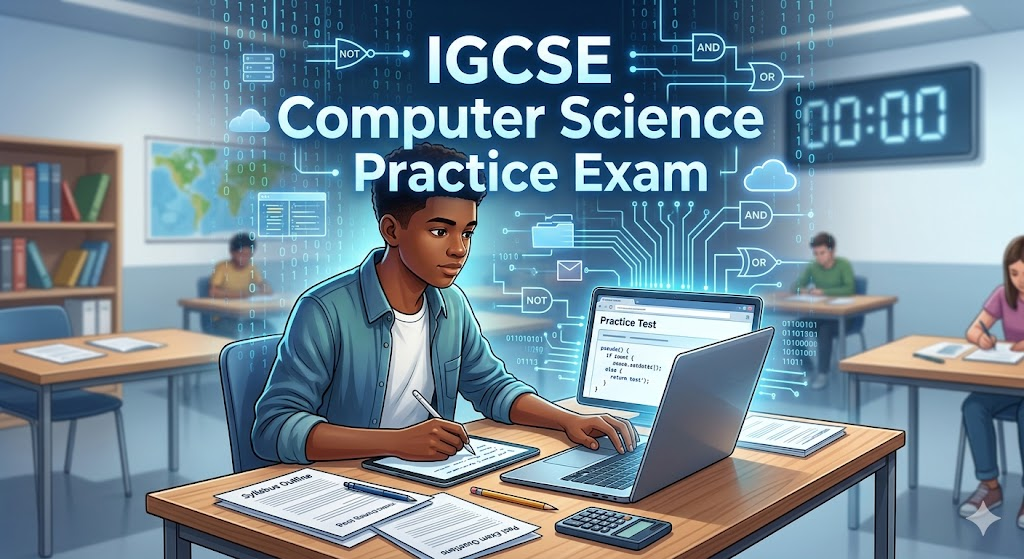
Additional Information
What the Course Entails and Exam Details
The comprehensive IGCSE Computer Science curriculum covers a broad range of fundamental topics. Key syllabus areas include data representation (such as binary and hexadecimal systems), communication and internet technologies, hardware and software components, logic gates, and security considerations. Significantly, there is a strong emphasis on computational thinking, problem-solving using algorithms, and practical programming skills (frequently utilizing languages like Python, Java, or pseudocode, depending on the specific exam board, such as Cambridge Assessment International Education - CIE or Pearson Edexcel). Students learn to design, implement, test, and refine programs to solve specific problems.
The structure of the final assessment generally consists of multiple components, typically involving separate papers that focus on theoretical knowledge and practical application. For instance, common exam formats might include one written paper consisting of structured questions and another practical paper that tests algorithmic design and programming capabilities under timed conditions. Total exam time varies, often ranging from 1.5 to 2 hours per paper, depending on the exam board and level.
What to Expect in the Final Exam
In the final IGCSE Computer Science exam, students can anticipate a variety of question types designed to assess different skills. Written papers usually include multiple-choice questions, short-answer questions, and longer structured questions requiring more detailed explanations, diagram interpretation, and pseudocode analysis. Practical papers require the candidate to demonstrate their programming proficiency by solving specific computational problems, often by writing, debugging, and testing actual code or pseudocode solutions.
The grading system typically ranges from Grade 9 (the highest) to Grade 1 for newer systems, or A* to G for older systems, with specific thresholds determining each grade. There isn't usually a single "passing score" percentages, but rather candidates aim for higher grades to satisfy educational requirements for progression. Common exam rules forbid external resources like textbooks or unauthorized digital devices; however, simple calculators with restricted functions are often permitted, and relevant programming reference materials may be provided for certain components. It is crucial to be familiar with the precise rules of your specific exam board.
How to Study and Exam Centers
Effective preparation for the IGCSE Computer Science exam demands a proactive and structured approach. Actively practice with past exam papers; this is perhaps the single most effective way to understand the types of questions, expected answering formats, and time management requirements. Master computational thinking and practical programming. Regularly write, debug, and trace code, starting with pseudocode and then moving to a programming language like Python, implementing common algorithms and data structures. Deepen your understanding of theoretical concepts using high-quality revision notes, mind maps, and educational videos, ensuring you can explain principles clearly. Active recall and spaced repetition techniques are highly beneficial for memorization.
Core general IGCSE exams, including Computer Science written papers, are generally not taken online through portals like Pearson VUE, despite common misconceptions about online certifications. Instead, they are typically administered in person at accredited schools and registered exam centers. To find a physical location to sit the exam, you should primarily consult the website of the relevant examining board (e.g., CIE, Edexcel) for a directory of authorized centers in your region, or liaise with your school or a trusted local educational institution like the British Council for guidance on registration and exam venues. Always verify specific details and official registration processes directly through the examining body and authorized centers. Pearson VUE and similar portals are generally associated with distinct professional or technical IT certifications, not the core international academic IGCSE qualification.
Job Opportunities from the Course
While an IGCSE is foundational and further education (such as A-levels, International Baccalaureate, diplomas, and eventually university degrees) is typically required for most professional career paths in computer science, this qualification marks a significant first step. Successfully completing this course and subsequent education can unlock numerous career opportunities in the vibrant tech sector, including:
Junior Programmer / Entry-Level Software Developer
IT Support Technician / Desktop Support
Web Developer (Entry-Level / Junior)
Data Analyst (Entry-Level)
Cybersecurity Assistant / Junior Analyst
Junior Network Administrator
Quality Assurance (QA) Tester
Each of these roles represents an entry point or a pathway toward more advanced and specialized careers as you gain experience and higher-level qualifications. The skills developed—such as analytical thinking, problem-solving, and foundational coding—are highly transferable and valued across diverse industries.
Frequently Asked Questions
Reviews
5.0
Based on 0 reviews
Leave a Review
No reviews yet. Be the first to review!