
IGCSE Economics Practice Test
$69.00
- Buy to unlock unlimited access to all Quiz questions and Answers in this Quiz.
- After purchase you can print a PDF of the whole quiz at any point. The PDF will contain the questions and the correct answers.
About this Exam
The Cambridge IGCSE Economics syllabus is an internationally recognized qualification designed to introduce students to the foundational principles of economic theory.
This specific practice test focuses entirely on Section 2, which covers "The Allocation of Resources."
It is tailored specifically for high school students, homeschooled learners, and independent candidates preparing for their Cambridge Assessment International Education (CIE) examinations.
By mastering this section, students gain a clear understanding of how markets operate, how prices are determined, and why market systems sometimes fail.
This practice exam serves as a critical diagnostic tool to evaluate a student's readiness before they sit for the actual, high-stakes papers.
Ready to test your knowledge?
Buy Now to Access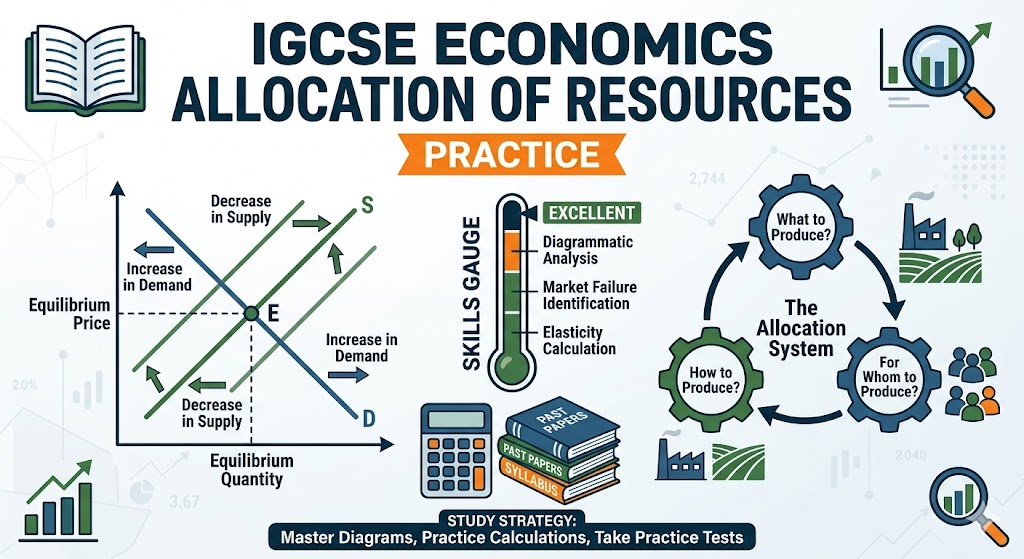
Additional Information
What the Course Entails and Exam Details
Section 2 of the CIE IGCSE Economics syllabus forms the core of microeconomic theory and carries substantial weight in the final examination.
The course covers the microeconomic decision-making processes of consumers, producers, and governments.
Students will dive deeply into the principles of demand and supply, learning how to construct and analyze market equilibrium diagrams.
Key topics include the price mechanism, price elasticity of demand (PED), and price elasticity of supply (PES).
Furthermore, the syllabus explores the concept of market efficiency, examining both market economic systems and mixed economic systems.
A significant portion of this module is dedicated to market failure, looking closely at external costs, external benefits, and various methods of government intervention.
What to Expect in the Final Exam
The ultimate CIE IGCSE Economics assessment (Syllabus Code 0455) is divided into two distinct components.
Paper 1 consists of 30 multiple-choice questions to be completed within 45 minutes, accounting for 30% of the total grade.
Paper 2 is a structured written examination lasting 2 hours and 15 minutes, which makes up the remaining 70% of the qualification.
Questions relating to Section 2 appear heavily across both papers, demanding both quick recollection for multiple-choice items and detailed data analysis for structured responses.
While there is no single official passing score due to varying grade boundaries each year, achieving a secure C grade or higher typically requires solid performance on Section 2 concepts.
Students are strictly prohibited from using unauthorized study aids, but the use of a standard electronic calculator is fully permitted during both papers.
How to Study and Exam Centers
Achieving a top grade requires a strategic approach that balances conceptual review with active retrieval practice.
Students should begin by drawing and labeling demand and supply diagrams repeatedly until the visual mechanics become second nature.
Practicing calculation formulas for PED and PES is also vital, as numerical application questions frequently appear on the test.
Utilizing topical past papers and taking timed practice exams helps build the pacing required for the real test environment.
When you are ready to sit for the official examination, you must register through an approved Cambridge examination center.
These centers are typically local authorized international schools, British Council offices, or registered private education centers.
It is important to note that the CIE IGCSE Economics exam cannot be taken completely online; students must attend a physical center to ensure standardized test security.
Job Opportunities from the Course
While the IGCSE is an introductory qualification, mastering economic foundations opens up a wide array of prestigious academic and career pathways.
Success in this course lays the mandatory groundwork for Advanced Level (A-Level) Economics, International Baccalaureate (IB) programs, and university degrees.
Understanding resource allocation is highly beneficial for a variety of future professional roles:
Junior Economic Research Analyst – Assisting in data collection and market trend interpretation.
Business Development Assistant – Helping firms analyze consumer demand and pricing strategies.
Policy Advisory Clerk – Supporting local administrative bodies in analyzing market interventions and public goods.
Data Analyst Associate – Utilizing structural insights to interpret market behaviors and corporate supply chain patterns.
Financial Services Representative – Applying foundational market principles to guide introductory consumer banking decisions.
Frequently Asked Questions
Reviews
5.0
Based on 0 reviews
Leave a Review
No reviews yet. Be the first to review!