
iGCSE History – Germany Practice Test
$69.00
- Buy to unlock unlimited access to all Quiz questions and Answers in this Quiz.
- After purchase you can print a PDF of the whole quiz at any point. The PDF will contain the questions and the correct answers.
About this Exam
Are you preparing for your iGCSE History exam focusing on the history of Germany? This qualification is highly respected globally and is designed for international secondary students aiming to demonstrate high-level analytical and critical thinking skills. This comprehensive practice guide is structured specifically for students taking the depth study on Germany, typically covering the turbulent and pivotal period between 1918 and 1945.
Ready to test your knowledge?
Buy Now to Access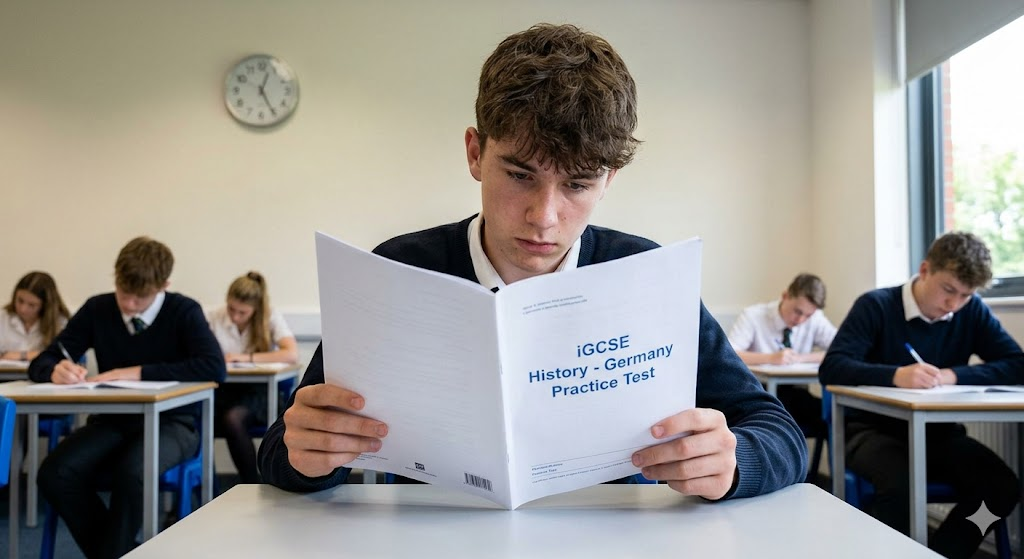
Additional Information
What the Course Entails and Exam Details
The core curriculum explores the complex factors that shaped modern Germany during the early 20th century. You must gain a deep understanding of the failures of the Weimar Republic and the reasons why democracy struggled following World War I. The syllabus covers the rise of Adolf Hitler and the Nazi Party, analyzing their methods of consolidation through propaganda, terror, and economic policy. Furthermore, students must evaluate the impact of Nazi rule on German society, including changes for women, youth, workers, and minority groups. You will develop critical academic skills, including source analysis, interpretation of historical viewpoints, and structured essay writing to evaluate cause and consequence.
What to Expect in the Final Exam
The final iGCSE History examination typically consists of multiple written papers rather than simple multiple-choice formats. You should expect a mixture of structured questions that require detailed factual recall, source-based questions demanding analysis of primary and secondary documents, and long-form analytical essays. While specific formats vary slightly between exam boards like Cambridge (CAIE) or Edexcel, papers generally run for 1.5 to 2 hours. High grades (usually on a 9-1 or A*-G scale) are awarded for the ability to construct clear, argued, and evidence-supported historical explanations rather than a simple minimum "passing score."
How to Study and Exam Centers
Study Strategies: Consistent and focused revision is key to success. You should master the art of source interpretation, practicing how to identify bias, purpose, and reliability in historical documents. Use past papers extensively to familiarize yourself with the question structures and time constraints. Create detailed timelines for the Weimar and Nazi periods to grasp the critical chronology of events. Mastering specific essay structures, ensuring you always include point, evidence, explanation, and analysis, is crucial for securing high marks.
Exam Centers: Because the iGCSE is a standardized qualification, exams must be taken at physical, authorized testing centers under strict invigilation. Students currently enrolled in international schools or recognized secondary schools usually register and take their exams on site. Private candidates, home-schoolers, or independent learners must find an approved examination center, such as a local British Council office or an authorized private school, that accepts external candidates.
Job Opportunities from the Course
A strong grade in iGCSE History is not just an academic achievement; it is a foundational step that opens doors to rigorous higher education and a wide array of prestigious career paths. It proves your ability to analyze complex data, formulate persuasive arguments, and understand global historical context. This qualification unlocks access to advanced studies, such as A-Levels or the International Baccalaureate (IB), particularly in subjects like History, Law, Government, and Politics. Future career opportunities for individuals with these developed analytical skills include:
Solicitor or Barrister
Journalist or Foreign Correspondent
Secondary School History Teacher
Archivist or Records Manager
Museum Curator or Heritage Manager
Political Analyst or Researcher
Diplomat or Civil Service Officer
Public Relations Specialist
Frequently Asked Questions
Reviews
5.0
Based on 0 reviews
Leave a Review
No reviews yet. Be the first to review!