
IGCSE Organic Chemistry Practice Test
$69.00
- Buy to unlock unlimited access to all Quiz questions and Answers in this Quiz.
- After purchase you can print a PDF of the whole quiz at any point. The PDF will contain the questions and the correct answers.
About this Exam
Welcome to your comprehensive study guide for the IGCSE Organic Chemistry component! This crucial part of your chemistry studies delves into the fascinating world of carbon-based compounds, exploring their structure, properties, and reactions. The International General Certificate of Secondary Education (IGCSE) is a globally recognized high school qualification, and mastering organic chemistry is often a key indicator of readiness for advanced scientific studies and eventual related career paths. This guide is specifically designed to help students confidently prepare for and excel in the organic chemistry sections of their upcoming IGCSE exams. It provides an overview, detailed breakdown, essential study tips, and information on further educational and career opportunities. Consider this your roadmap to success in one of chemistry’s most diverse and dynamic fields.
Ready to test your knowledge?
Buy Now to Access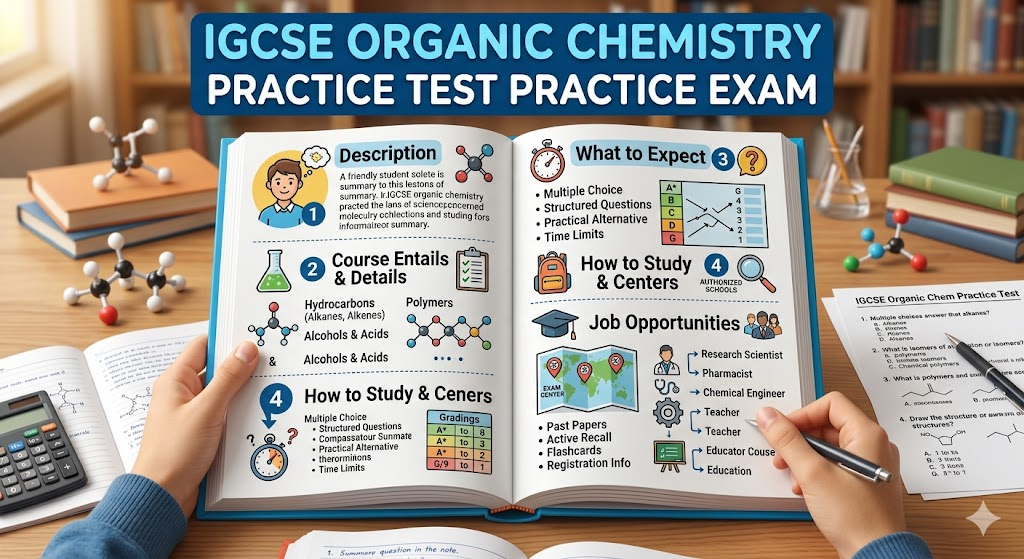
Additional Information
What the Course Entails and Exam Details
The IGCSE Organic Chemistry course (usually a substantial component of a wider IGCSE Chemistry syllabus) builds on fundamental chemical principles, focusing specifically on:
Introduction to Organic Chemistry: Understanding homologous series, general formulas, functional groups, and how to name (IUPAC nomenclature) and represent organic compounds using molecular, structural, and displayed formulas.
Hydrocarbons: Detailed study of alkanes and alkenes, including their sources (crude oil, fractional distillation), properties, and reaction types (combustion, substitution, addition). Understanding the distinction between saturated and unsaturated molecules.
Alcohols & Carboxylic Acids: Explaining the structure and reactions of key compounds like ethanol (production via fermentation and hydration) and ethanoic acid, as well as the formation of esters (Extended syllabus).
Polymers: Differentiating between addition polymerisation (e.g., poly(ethene)) and condensation polymerisation (e.g., nylon/Terylene in the Extended syllabus), alongside related environmental concerns regarding plastic disposal.
Isomerism: For those on the Extended syllabus, understanding and identifying structural isomers.
It's vital to remember that specific syllabus content and exam details can vary significantly between different international exam boards, such as Cambridge (CAIE), Pearson Edexcel, and Oxford AQA. Always consult your specific school's or exam board's current official syllabus to ensure you are covering the correct material for your particular exam year and tier (e.g., Core vs. Extended). The details provided here are illustrative of common IGCSE structures.
What to Expect in the Final Exam
You won't typically sit a standalone "Organic Chemistry" exam paper. Instead, your organic chemistry knowledge will be assessed as part of the overall IGCSE Chemistry assessment, which usually consists of multiple papers testing knowledge, understanding, handling of information, problem-solving, and experimental skills:
Exam Structure: Most IGCSE Chemistry assessments comprise multiple components:
Paper 1 or 2 (Multiple Choice): A timed paper consisting of multiple-choice questions covering the whole syllabus, including organic chemistry.
Paper 3 or 4 (Theory/Structured Questions): Longer papers with structured and free-response questions, often including significant sections dedicated to organic chemistry concepts, reactions, and mechanisms.
Paper 5 (Practical Test) or Paper 6 (Alternative to Practical): Assessing experimental skills. Organic chemistry experiments, such as functional group tests or simple preparations, can feature or be the basis of questions here.
Passing Requirements: IGCSEs are graded, not just pass/fail. The typical grading scale ranges from A* (highest) to G, or a numerical 9 (highest) to 1 scale. There isn't a single 'passing score' as such, but your combined performance across all papers determines your final grade. Universities and employers typically consider grades C/4 or above as good passes. Again, verify the precise grading system with your exam board.
Time Limits: Each paper will have a specific time limit, ranging from roughly 45 minutes to over 2 hours depending on the component. Effective time management is key.
Rules: Standard examination rules apply. These include restrictions on certain materials, strict timings, and regulations regarding calculators and other permitted equipment. Specific details will be provided by your school or exam center.
How to Study and Exam Centers
Effective preparation is essential for success in IGCSE Organic Chemistry. Here are some actionable study strategies:
Utilize Past Papers & Mark Schemes: This is arguably the most effective study method. Actively practice with past IGCSE Chemistry papers, specifically focusing on the organic questions. Use the official mark schemes to understand exactly what examiners are looking for. Practice under timed conditions to simulate the real exam.
Master the Basics & Use Active Recall: Organic chemistry is sequential. Ensure you have a rock-solid understanding of bonding, molecular representations, and simple reaction types. Regularly quiz yourself (active recall) on definitions, general formulas, functional groups, and key reactions/conditions, rather than just passively reading notes.
Create Visual Aids & Use Flashcards: Make colorful diagrams of molecules, reaction pathways, and functional groups. Use flashcards for key terms, reaction formulas, and experimental tests. Use 3D molecular models or digital simulations to help visualize structures and isomers.
Understand the "Why" and "How": Don't just memorize reactions. Focus on the mechanisms (where covered) and the underlying principles – why do certain reactions occur under specific conditions? How do structures relate to properties?
Study the Syllabus & Practice Drawing: Keep a copy of your specific exam board's syllabus and check off topics as you master them. Actively practice drawing molecular, structural, and displayed formulas – don't assume you can do it without practice!
Exam Centers and Registration:
IGCSE exams are high-stakes external assessments. You cannot simply register on a practice website for the actual final exam.
Find Authorized Schools: The vast majority of students take IGCSE exams at their registered school. Most schools that offer the IGCSE curriculum are official examination centers.
Authorized Public Exam Centers (British Council & Others): For private candidates, homeschoolers, or those whose schools do not facilitate IGCSE exams, specialized exam centers and organizations like the British Council often manage registrations and host the exams.
How to Take the Exam: You must register in advance through an authorized center, usually months before the exam session (which commonly occurs in May/June or October/November). Check the official website of your chosen exam board (e.g., Cambridge, Edexcel) for lists of registered centers in your region and specific registration procedures and deadlines for private candidates. Always follow the official process.
Job Opportunities from the Course
While an IGCSE in Chemistry (which includes Organic Chemistry) isn't a final qualification that directly unlocks professional roles, it is a critical and inspiring first step. Excelling in IGCSE Chemistry opens the door to essential further education (A-Levels, IB, or a foundation year) and eventual higher education (a university degree) in a wide range of inspiring scientific and professional fields. Mastering foundational organic chemistry skills can eventually lead to a diverse and rewarding career. Here is a clear list of potential future career paths and illustrative job titles that foundational chemistry knowledge is essential for:
Academic and Industrial Research: Future path via degrees and PhDs.
Research Scientist
Laboratory Manager
University Professor
Pharmaceuticals and Medicine: Future path via related degrees (Pharmacy, Medicine, Biomedical Science).
Pharmacist
Medical Doctor
Dentist
Pharmaceutical Scientist / Drug Developer
Biomedical Researcher
Chemical Engineering and Industry: Future path via Chemical Engineering or Industrial Chemistry degrees.
Chemical Engineer
Process Engineer
Industrial Chemist
Materials Scientist
Environmental Science and Sustainability: Future path via Environmental Science or Green Chemistry degrees.
Environmental Scientist / Consultant
Sustainability Specialist
Pollution Control Officer
Forensic Science: Future path via Forensic Science or Chemistry degrees.
Forensic Scientist
Analytical Chemist (Forensics)
Food and Beverage Industry: Future path via Food Science or Chemistry degrees.
Food Scientist / Technologist
Flavorist / Sensory Scientist
Healthcare and Clinical Science: Future path via Clinical Science or Biochemistry degrees.
Clinical Scientist
Toxicologist
Education and Science Communication: Future path via Chemistry and Education degrees or professional experience.
Chemistry Teacher (High School / College)
Science Writer / Communicator
Outreach Coordinator
Remember, every great scientific career starts with mastering the fundamentals. Your IGCSE Organic Chemistry studies are a brilliant foundation for a future full of possibility in the science and innovation sectors. Good luck with your studies and your exams!
Frequently Asked Questions
Reviews
5.0
Based on 0 reviews
Leave a Review
No reviews yet. Be the first to review!