
IGCSE Population Case Studies Practice Test
$69.00
- Buy to unlock unlimited access to all Quiz questions and Answers in this Quiz.
- After purchase you can print a PDF of the whole quiz at any point. The PDF will contain the questions and the correct answers.
About this Exam
Welcome to your essential study resource for the IGCSE Population Case Studies Practice Test. This practice exam is expertly designed to provide a targeted and comprehensive simulation of the core "Population" component of the IGCSE Geography syllabus. The actual IGCSE is a highly globally-recognised international qualification for students, typically aged 14 to 16. Within the Geography curriculum, the Population unit and its real-world case studies form a crucial and significant area of assessment. This practice test is specifically designed for students preparing for their final IGCSE Geography exams, helping you to refine your theoretical knowledge, apply key concepts to diverse real-world situations, and master the standard examination question types. Our guide aims to empower you with the confidence and skills required to excel in this essential part of your qualification path.
Ready to test your knowledge?
Buy Now to Access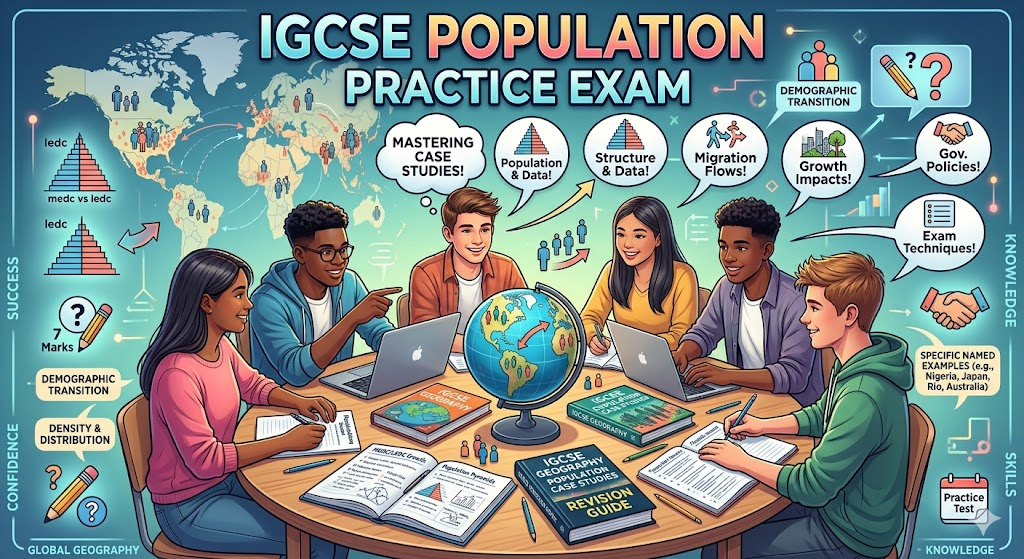
Additional Information
What the Course Entails and Exam Details
This IGCSE Population Case Studies Practice Test is not a complete course in itself, but rather a vital preparatory tool mirroring the key content and exam style of the population component within an IGCSE Geography course. The broader Geography syllabus thoroughly covers a range of essential human and physical geography themes. The specific "Population" unit, on which this practice test focuses, typically entails detailed study of:
Population Dynamics: Understanding world population growth patterns, natural change (the balance between birth rates and death rates), and the factors that influence these rates, including the 5 stages of the Demographic Transition Model.
Population Distribution and Density: Analyzing how and why population is spread across the globe and within specific areas, exploring the physical (e.g., relief, climate, soil, water) and human (e.g., economic, social, political) factors that cause densely and sparsely populated regions.
Population Structure: Interpreting population pyramids to understand the age and sex composition of different countries and analyzing the implications of youthful or ageing populations.
Migration: Distinguishing between different types of migration (internal, international, voluntary, forced), understanding push and pull factors, and evaluating the causes and effects on both the source and receiving countries/regions.
Population and Development: Examining the concepts of overpopulation and underpopulation, optimum population, the relationship between population size and resources, and food production challenges.
Population Policies: Analyzing how governments manage population through pro-natal or anti-natal policies.
Crucial Case Studies: This is a hallmark of the IGCSE. Students must study named, real-world examples in depth, applying all the above concepts to specific contexts. The practice test will heavily assess your ability to use evidence from diverse case studies, such as:
Rapid Population Growth: For instance, a country with a high natural increase like Nigeria or The Gambia.
Low/Ageing Population: E.g., Japan or Germany, exploring the issues and policy responses.
High Population Density: Examples could include a crowded city (like Mumbai or Rio de Janeiro) or small island nations.
Sparse Population: E.g., Australia or the Amazon Rainforest, analyzing the challenges and advantages.
A Major Migration Route: E.g., the specific instance of Mexico to the US or the Syrian refugee crisis.
The practice test itself mimics standard exam question formats (see section 3), covering a representative sample of these topics and heavily featuring questions that require detailed references to your studied case studies, often requiring data and specific factual recall.
What to Expect in the Final Exam
While the exact structure can vary slightly by examination board (such as Cambridge IGCSE or Pearson Edexcel International GCSE), the final IGCSE Geography exam usually consists of two or three separate papers taken under strict, supervised conditions:
Format: Standard structure often includes a large thematic paper (Paper 1), a geographical skills paper (Paper 2), and sometimes a third component (Paper 3 or 4) which could be coursework, or an alternative to coursework focused on fieldwork and practical skills.
The "Population" unit is primarily assessed within the major thematic paper (Paper 1 - Geographical Themes). This component typically features a mix of structured question types:
Multiple-Choice (less frequent for larger questions, but possible).
Short-Answer Questions: To test quick recall of terms, concepts, and basic data.
Data and Map Interpretation: Using population pyramids, graphs, charts, and sometimes maps to answer questions.
Structured, Extended Response Questions: This is where you apply your in-depth knowledge of case studies. These questions (typically 7 marks or more) are designed to assess your ability to use named case study evidence effectively. Expect to be asked to "explain," "evaluate," "compare," or "describe with reference to a named example." You must provide specific, accurate details to secure higher marks.
Passing Score: IGCSEs are graded on a scale, with standard results ranging from A* to G (though some boards use a numerical 9-1 scale). While there is no single "passing score" as you receive a grade regardless of performance, achieving a good pass grade (generally considered C or 4 and above for proceed further with higher education) is the goal. For the practice test, aim for high scores and understanding rather than a precise grade.
Time Limits: Each paper will have a fixed duration, typically ranging from 1 hour 30 minutes to 1 hour 45 minutes for Paper 1. Time management is crucial in ensuring you answer all structured questions fully.
Specific Rules: Standard closed-book rules apply: no outside notes or mobile phones, specified stationery, and potentially specific calculator models allowed for data interpretation. Ensure you understand all instructions and label your diagrams and case studies clearly. This practice test preparation will directly help you handle these conditions in the real exam for the population component.
How to Study and Exam Centers
Actionable Study Strategies:
Know Your Syllabus Inside Out: Review your exam board’s specific syllabus. Identify the key themes, terms, theories, and the required variety and depth of case studies you must prepare.
In-Depth Case Study Preparation is Non-Negotiable: Create a detailed profile/file for each of your required case studies. For each example, ensure you can answer the who, what, where, when, why, and how:
Causes: What factors lead to the condition (e.g., rapid growth, migration)? (Detailed facts and figures!)
Effects/Impacts: What are the consequences (positive/negative) for people, the economy, and the environment?
Management/Policies: How are governments, organisations, or communities responding to the situation?
Data: Include specific, memorable statistics (population numbers, density, growth rates, dates, key names, locations). The IGCSE Population Case Studies Practice Test specifically rewards detailed and accurate case study use.
Use Active Recall & Spaced Repetition: Don’t just read. Make flashcards for key terms (e.g., birth rate, death rate, natural increase, migration types, Demographic Transition Model stages), crucial dates, and case study details. Test yourself regularly.
Practice on Past Papers: This is perhaps the single most effective technique. Download standard IGCSE past exam papers (Cambridge/Edexcel/etc.) specifically looking for population questions. Practice the whole paper structure, ensuring you manage your time. Use the corresponding mark schemes to understand exactly how points are awarded, especially for extended case study questions. The IGCSE Population Case Studies Practice Test you are preparing for is a crucial part of this practice step.
Review the Practice Test Feedback: Treat this practice test like the real thing. Answer it honestly, score it using the provided materials (if available/applicable), or ask your teacher for feedback. Focus heavily on areas where you lost marks or lacked case study detail. Use this experience to reinforce your learning and fine-tune your approach for the actual final exam.
Create Mind Maps and Diagrams: Visually represent concepts like the Demographic Transition Model, causes/effects of migration, or specific population pyramid structures. Mind maps are also great for connecting case study details to theoretical points.
Teach and Collaborate: Explaining concepts and case studies to a study partner or in a group is a powerful way to solidify your own understanding. Peer study can also introduce you to different case study examples or study methods.
Exam Centers and Practice Portals:
Finding Information and Practice:
Official Exam Board Websites: The main resources are the websites of the large IGCSE examination boards, primarily:
Cambridge Assessment International Education (Cambridge IGCSE): Offers comprehensive past papers, syllabus details, revision guides, and official course information.
Pearson Edexcel (Pearson Edexcel International GCSE): Also provides extensive past papers, course specifications, and learning materials on their portal.
School Resources and Online Learning Platforms: Many schools offer dedicated revision materials, past paper access, and structured support for IGCSE students. Look for authorised revision guides in textbooks or reliable educational websites and forums.
Where and How to Take the Final Exam:
The real final IGCSE exam is almost always taken in person at an authorised examination centre under strictly proctored conditions. For most students, this is their own school or college if it is an authorised centre.
Private candidates (students studying outside a regular school or whose school doesn’t offer IGCSE) can often take their exams at registered British Council centres or other accredited international centres around the world.
You will need to register through your school or the chosen external centre well in advance, pay entry fees, and receive a statement of entry details including times and dates. The IGCSE Population Case Studies Practice Test provides practice, not a pathway to taking the exam itself. Its purpose is purely for skill development and exam preparation. Be clear on the difference between practice methods and the actual formal examination registration process.
Job Opportunities from the Course
A strong performance in IGCSE Geography, especially the foundational understanding of population dynamics, skills, and application of case studies, establishes a valuable skill set. The ability to analyse complex data, understand global trends, communicate effectively through structured arguments, and appreciate diverse cultures and geographical contexts is highly transferable. While this course itself does not directly unlock an immediate career, the knowledge and skills can lead to rewarding paths (typically requiring further study such as A-Levels, IB, and often a university degree) such as:
Urban/Town Planner: Shaping the future of cities, balancing infrastructure, housing, and services for growing and changing populations.
Demographer: Analysing population statistics and patterns to understand trends, forecast changes, and inform policy.
Environmental Consultant: Assessing human impact, managing resources, and advising on sustainability, all of which are deeply connected to population issues.
GIS Specialist (Geographic Information Systems): Using digital maps and data to visually analyse spatial relationships, with applications from logistics to urban planning.
Sustainability Officer: Helping organizations operate more responsibly, considering social, economic, and environmental factors linked to a global population.
Market Researcher: Understanding consumers and predicting trends based on demographic data and spatial analysis.
International Development Worker: Address global issues of poverty, resource access, and population challenges in diverse regions.
Cartographer: Designing maps, now often utilising advanced technology and data.
Teacher (Geography): Inspiring the next generation to understand the world and its people.
Research Analyst: Applying data analysis and research skills to various fields from business to social policy.
Social Scientist: Using analytical skills to study society, including demographic patterns and issues.
The dedication to in-depth case study learning and critical application prepared by the IGCSE Population Case Studies Practice Test and the broader IGCSE course provides a solid foundation that is highly attractive to a range of future career and education opportunities.
Frequently Asked Questions
Reviews
5.0
Based on 0 reviews
Leave a Review
No reviews yet. Be the first to review!