
IICL Dry Van Practice Exam
$69.00
- Buy to unlock unlimited access to all Quiz questions and Answers in this Quiz.
- After purchase you can print a PDF of the whole quiz at any point. The PDF will contain the questions and the correct answers.
About this Exam
This comprehensive guide is your roadmap to success on the IICL Dry Van Inspector Certification Examination. The IICL (Institute of International Container Lessors) certification is a globally recognized standard, validating your expertise in inspecting dry van shipping containers according to established international guidelines. Achieving this certification demonstrates your competency and commitment to maintaining container quality and safety across the logistics and intermodal transport industry. It is designed for container inspectors, depot personnel, repair technicians, and anyone seeking to advance their career in container management and logistics.
Ready to test your knowledge?
Buy Now to Access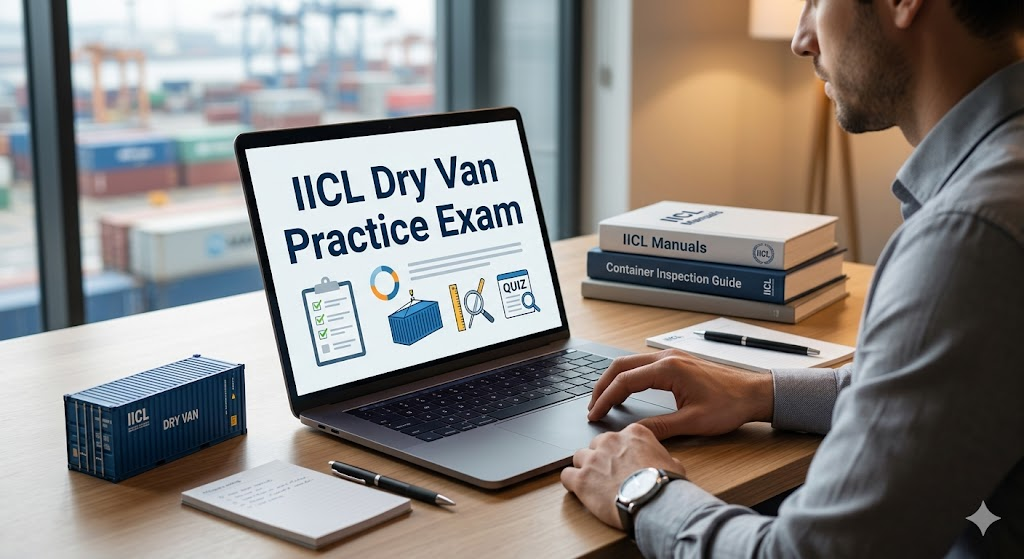
Additional Information
What the Course Entails and Exam Details
The IICL Dry Van Inspector certification program focuses on providing a deep understanding of the technical specifications, inspection procedures, and repair standards for dry van containers. The associated training (often self-study) and the final exam rigorously cover:
Container Terminology and Components: Master the precise language and structure of a dry van container.
IICL Inspection Standards: Gain expertise in IICL-6 (or the most current edition) and other relevant IICL publications, which are the core of the exam.
Damage Types and Causes: Learn to identify and classify various types of container damage, wear, and tear.
Measurement and Assessment: Develop skills in accurately measuring damage and determining if it exceeds acceptable limits based on IICL criteria.
Repair Recommendations: Understand how to determine the appropriate repair method and assess the quality of completed repairs.
CSC (Convention for Safe Containers) Regulations: Familiarize yourself with international safety regulations and the role of the safety plate.
What to Expect in the Final Exam
The final IICL Dry Van Inspector examination is a comprehensive test of your knowledge and practical understanding. Be prepared for:
Format: The exam typically consists of multiple-choice questions. These questions are designed to test not just factual recall, but your ability to apply IICL standards to real-world scenarios, often involving diagrams and technical descriptions.
Time Limit: The exam is timed, typically giving you a set window (e.g., around 2 hours) to complete all questions. Efficiency and accuracy are key.
Passing Score: IICL sets a minimum passing score, which is typically high to ensure a strong level of competence among certified inspectors (often around 70-80%).
Specific Rules: This is a closed-book exam. You are expected to have a deep internal understanding of the standards. The use of any reference materials or electronic devices is strictly prohibited during the test.
How to Study and Exam Centers
Preparation is paramount for the IICL Dry Van exam. Here is a strategy for success:
Deep Dive into IICL Publications: Study guides are not enough. Purchase and meticulously study the latest IICL manuals, including IICL-6 and repair manuals. They are your primary text.
Utilize a Practice Exam: Engaging with a structured practice exam, like this one, is crucial. It helps you become familiar with the questioning style, test-taking pacing, and identifies specific areas where your knowledge may be lacking.
Focus on Diagrams: Pay close attention to visual information, damage criteria charts, and repair examples in your study materials, as the final exam relies heavily on these.
Form Study Groups: Collaborating with colleagues or finding study partners can provide diverse perspectives and help you talk through complex scenarios.
Register for the Exam: The IICL exam is administered globally. You must register through the official IICL website.
Choose a Testing Center: IICL utilizes a network of authorized testing centers globally. These can be physical locations, such as computer-based testing centers (like Pearson VUE, if applicable, though typically IICL uses its own network or proctored online exams). You will select your preferred location or method during the registration process.
Job Opportunities from the Course
Obtaining the IICL Dry Van Inspector Certification unlocks significant career opportunities within the global logistics and transportation sector. Here are a few career paths:
Container Inspector / Depot Inspector
Maintenance and Repair (M&R) Coordinator
Terminal / Depot Supervisor or Manager
Quality Assurance Specialist
Fleet Manager (Container Leasing and Shipping Lines)
Marine Surveyor
This guide provides a foundational overview, but always refer to the official IICL website, current test bulletins, and resources for the most precise, up-to-date, and officially mandated details for your particular exam year and location. Good luck!
Frequently Asked Questions
Reviews
5.0
Based on 0 reviews
Leave a Review
No reviews yet. Be the first to review!