
IICRC Applied Structural Drying Practice Exam
$69.00
- Buy to unlock unlimited access to all Quiz questions and Answers in this Quiz.
- After purchase you can print a PDF of the whole quiz at any point. The PDF will contain the questions and the correct answers.
About this Exam
The IICRC Applied Structural Drying (ASD) certification is a vital credential for restoration professionals focusing on efficient and effective water damage mitigation. This program goes beyond basic water removal, providing advanced, hands-on training in the science of drying. Students learn how to manage complex drying projects, protect structural integrity, and prevent secondary damage, such as mold growth. The course is designed for individuals with prior experience in water restoration, particularly those holding the IICRC Water Damage Restoration Technician (WRT) certification, seeking to elevate their expertise and career prospects. It is the premier practical application course in the industry.
Ready to test your knowledge?
Buy Now to Access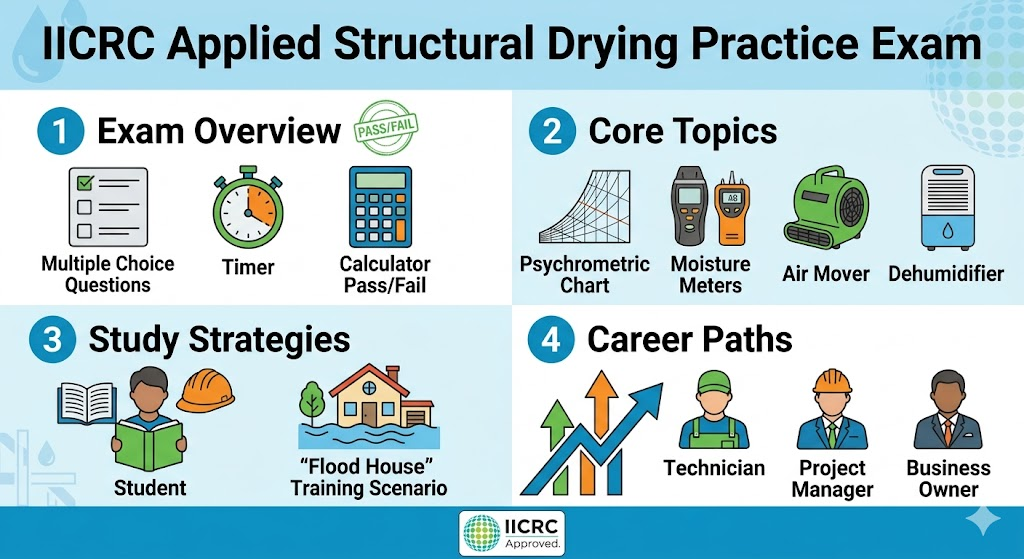
Additional Information
What the Course Entails and Exam Details
The IICRC Applied Structural Drying course is a rigorous, typically four-day, in-person training that provides an immersive experience. It takes place in a controlled "flood house" environment, allowing students to dry a fully furnished structure from start to finish. The comprehensive curriculum covers critical areas of drying science and practical application, ensuring a full understanding of the process.
Key topics and skills covered in the course include:
Psychrometrics: Mastering the science of drying, including humidity, temperature, airflow, and vapor pressure.
Moisture Detection and Monitoring: Learning to use professional tools such as moisture meters, sensors, and infrared cameras to accurately track moisture content.
Equipment Calculation Formulas: Understanding how to calculate the precise number of air movers and dehumidifiers needed for any given structure and water loss category.
Categories of Water: Identifying the source and contamination levels of water (Category 1, 2, and 3) and applying appropriate mitigation strategies.
Classes of Water Loss: Evaluating the evaporation load based on the type and amount of wet materials (Class 1, 2, 3, and 4).
Microbiological Factors: Using antimicrobials and understanding containment protocols to prevent cross-contamination.
Standard of Care (IICRC S500): Applying the established industry standards for professional water damage restoration throughout the project.
Project Documentation: Learning to create accurate and detailed documentation required by insurance adjusters and for project management.
The course culminates in an official IICRC certification exam, which tests the student's comprehension and ability to apply these concepts and calculations.
What to Expect in the Final Exam
The IICRC Applied Structural Drying final exam is a closed-book, multiple-choice test. It is administered on the last day of the in-person course. Because the course is "applied," a significant portion of the questions are designed to assess your ability to solve practical problems and use the formulas you learned.
Here are the specific details of the exam format:
Question Type: Multiple-choice.
Number of Questions: Varies (e.g., around 100).
Time Limit: Typically 2 hours.
Passing Score: IICRC exams require a minimum scaled score of 500 to pass (on a scale of 200-800). This roughly translates to answering 75% of the questions correctly.
Allowed Materials: The exam is closed-book and closed-notes, with the crucial exception that a psychrometric chart and specified formula sheets are provided for use.
Retest Policy: Candidates who do not pass have up to two opportunities to retest within 45 days of their initial exam date. A fee applies to each retest.
How to Study and Exam Centers
Success on the ASD exam depends heavily on engaging fully with the course and its hands-on components. Because the exam has a strong practical focus, you cannot pass on theory alone.
Effective study strategies include:
Active Participation: Take detailed notes during the course, ask questions, and engage in all "flood house" exercises. The hands-on extraction, equipment setup, and monitoring are your best practice.
Master the Formulas: Dedicate significant time to understanding and memorizing the equipment calculation formulas. Practice calculating scenarios from the course materials.
Review IICRC S500: Familiarize yourself with the core sections of the IICRC S500 Standard for Professional Water Damage Restoration, as the exam is based on this standard.
Practice with Psychrometrics: Get comfortable with the psychrometric chart. Understand the relationships between temperature, relative humidity, dew point, and grain depression.
Utilize Official Resources: Use any study guides, quizzes, or practice questions provided by your IICRC-approved instructor or school.
Exam Centers: The IICRC Applied Structural Drying exam is unique in that it is not taken at an external, third-party testing center like Pearson VUE. It is administered on-site at the IICRC-approved training facility where you complete the four-day course. Online versions of the course and exam are not available due to the required "applied" hands-on component.
Job Opportunities from the Course
The IICRC Applied Structural Drying certification is a powerful career accelerator, unlocking higher-level positions and significant earning potential within the restoration industry. Many companies prefer or require this advanced certification for their lead technical and leadership roles.
The ASD certification directly supports the following career paths and job titles:
Water Damage Restoration Lead Technician
Restoration Crew Chief
Applied Structural Drying Specialist
Water Mitigation Supervisor
Restoration Project Manager
Restoration Foreman
Emergency Services Lead Technician
Mitigation Department Manager
IICRC-Certified Mitigation Instructor (with further requirements)
Independent Restoration Consultant
Frequently Asked Questions
Reviews
5.0
Based on 0 reviews
Leave a Review
No reviews yet. Be the first to review!