
IICRC Commercial Drying Specialist (CDS) Practice Test
$69.00
- Buy to unlock unlimited access to all Quiz questions and Answers in this Quiz.
- After purchase you can print a PDF of the whole quiz at any point. The PDF will contain the questions and the correct answers.
About this Exam
The IICRC Commercial Drying Specialist (CDS) certification is an advanced credential designed for experienced restoration professionals who wish to demonstrate mastery in handling large, complex water damage incidents in commercial, industrial, and institutional properties. Building upon the knowledge and skills acquired through the Water Restoration Technician (WRT) certification (which is a mandatory prerequisite), the CDS certification equips individuals with the expertise needed to effectively assess damage, manage intricate drying projects, and implement technical methods to restore commercial structures efficiently and effectively, minimizing potential financial impacts and business interruptions for clients. This certification is ideal for experienced technicians, project managers, estimators, and owner/managers looking to expand their knowledge of commercial construction and advanced drying practices.
Ready to test your knowledge?
Buy Now to Access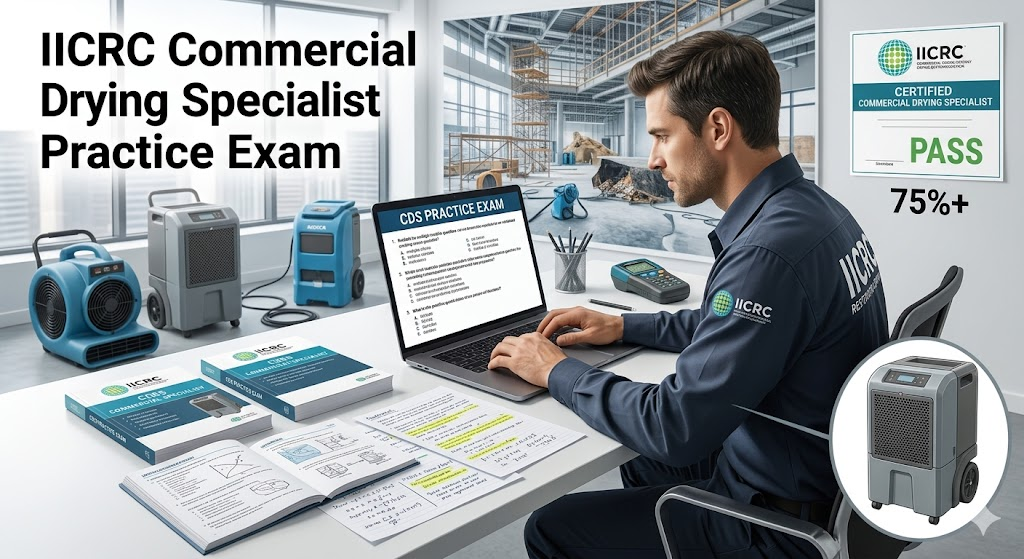
Additional Information
What the Course Entails and Exam Details
The path to achieving CDS certification involves completing an intensive, typically 4-day (approximately 28-hour) IICRC-approved training course. This advanced program goes beyond basic water damage principles and delves deeply into the unique challenges associated with commercial structures and large-loss scenarios.
Core topics covered in the CDS course and assessed in the culmination exam include:
Commercial Building Anatomy and Analysis: Understanding the specific structural components, construction materials, and inherent challenges unique to commercial and industrial buildings.
Large-Scale Psychrometry: Applying principles of psychrometry (the study of moisture and air) to effectively manage humidity and optimize drying within significantly larger air volumes and diverse commercial mechanical systems.
Commercial Mechanical Systems: Gaining insights into complex HVAC, plumbing, and electrical systems common in commercial properties and how they interact with drying processes.
Hazard Assessments and Safety Protocols: Identifying and mitigating significant safety risks present on commercial sites, including high voltage electricity, confined spaces, and hazardous materials.
Workflow and Process Administration for Large Loss: Managing intricate logistics, coordinating teams, documenting processes, and administering projects with heightened complexity and stakeholder communication.
Specialized Technical Drying Methods: Applying advanced techniques for efficiently drying diverse materials found in commercial settings, such as concrete, hardwood flooring systems, structural steel, and specialized contents.
Hands-on Training: Practical, real-world instruction using heavy-duty commercial drying equipment, large desiccant dehumidifiers, generators, and specialized moisture measurement tools.
The CDS course naturally leads to the final certification examination, which evaluates comprehension of these sophisticated concepts and the practical application of advanced drying procedures.
What to Expect in the Final Exam
After dedicating substantial time to comprehensive training, candidates face the CDS final examination, which is a critical step towards certification. To help ease test anxiety and focus preparation efforts, here’s what can generally be expected:
Exam Format: The CDS exam is a rigorously proctored, typically multiple-choice assessment. The questions are designed to test not only recall of key concepts but also critical thinking and application in diverse commercial drying scenarios.
Passing Score Requirement: Candidates must achieve a score of 75% or greater to pass the exam and qualify for certification. This high threshold underscores the expertise required for this advanced designation.
Time Limits: Every IICRC certification exam has a specific time allotment, which will be clearly communicated by the instructor or testing administrator at the time of the course or when scheduling the online exam. Students are generally provided sufficient time, typically standard 1.5 - 2 hours, but time management remains essential.
Specific Rules: The examination is typically closed-book, and strict proctoring standards are upheld to maintain integrity. For in-person courses, the exam is often administered directly after the course concludes. Live-stream participants typically take the exam online through an authorized IICRC exam portal, usually with a generous window (e.g., up to 45 days) to complete it. Retest opportunities are available for candidates who do not pass on their first attempt, typically allowing two additional attempts within a specified timeframe (e.g., 45 days) for an associated fee. It is mandatory to attend the entire 4-day course to be eligible to sit for the CDS exam.
Exam Fee: There is a separate IICRC exam fee, typically around $80, which is handled directly with the IICRC and is not included in the initial course registration cost. Candidates should ensure they are registered for the exam and prepared for payment.
By understanding the format and requirements, students can enter the exam with greater confidence, well-prepared to demonstrate their expertise.
How to Study and Exam Centers
Successfully passing the CDS exam demands diligent preparation. Combine active participation during the course with focused individual study.
Actionable Study Strategies:
Diligent Note-Taking: Capture key concepts, equations, equipment specifications, and practical tips throughout the intense 4-day course. Revisit your notes regularly.
Review All Course Materials: Thoroughly study the comprehensive workbooks, reference materials, standard operating procedures, handouts, and any specific study guides provided by your instructor or the training school. Don’t just read; critically engage with the content.
Focus on Understanding, Not just Memorization: Ensure you deeply understand fundamental principles, particularly psychrometry, the science of drying, and the 'why' behind specific methods. Practical application questions frequently assess comprehension over simple recall.
Utilize Practice Tests and Sample Questions: Seek out official IICRC practice tests or reliable third-party resources that offer simulated exam experiences. Use these to identify knowledge gaps, practice time management, and become familiar with the structure and wording of questions. Treat each practice attempt as a learning opportunity.
Review Key Calculations and Standards: Practice relevant formulas for moisture calculations, air changes, and equipment capacity, particularly within the context of larger commercial spaces. Ensure you are familiar with current industry standards and best practices, as the exam is likely to reference these.
Group Study or Discussion: Collaborate with classmates to discuss challenging topics, review case studies, and quiz each other on key concepts. Explaining ideas to others reinforces your own understanding.
Dedicate Focused Study Time: Create a realistic study schedule leading up to your exam, breaking down the material into manageable sections and allocating dedicated, distraction-free time each day for review. Consistency is key.
Get Sufficient Rest: Prioritize sleep before your course, study sessions, and especially the final exam. A well-rested mind performs significantly better.
Exam Centers and Delivery:
Immediately Following In-Person Courses: For students who attend a physical, in-person CDS training course, the written examination is typically administered at the training facility on the final day, immediately following the conclusion of instruction. Students complete the exam on-site using a standard scantron or written format, with proctoring by the instructor or designated staff.
Online via Authorized Portal after Live-Stream Courses: If you complete the CDS course via an official IICRC live-stream (online with a live instructor), the examination process is typically online. After the course concludes, you will likely register for the exam and take it within a specified window (often up to 45 days from course completion) through an authorized, secured IICRC exam portal from any location with a reliable internet connection and appropriate computer requirements. Ensure you understand and meet all online testing rules and system checks.
Students should check with their specific IICRC-approved school for precise details on how and where the actual exam for their course session will be administered, including registration procedures and any associated logistics. Always refer to official IICRC information for the most accurate and up-to-date guidance on testing policies and available retest options.
Job Opportunities from the Course
Earning the IICRC Commercial Drying Specialist (CDS) certification opens doors to a wider array of rewarding and well-compensated career paths within the dynamic restoration industry. This advanced credential signifies high expertise, making you a highly desirable candidate for roles with greater responsibility, complexity, and leadership opportunities.
Specific job titles and career paths this certification unlocks include:
Restoration Project Manager (Commercial/Large Loss): Directly overseeing and managing complex commercial and industrial water damage restoration projects, ensuring technical excellence, budget compliance, safety adherence, and clear stakeholder communication from assessment to successful completion.
Estimator (Commercial Restoration): Specializing in accurately assessing damage and developing comprehensive, competitive, and technically sound estimates for large-scale commercial drying and restoration projects, demonstrating depth of understanding for insurance adjusters and property owners.
Restoration Operations Manager: Taking on a broader leadership role within a restoration firm, supervising and optimizing the operations of restoration teams, equipment, logistics, and resource allocation, particularly for diverse and simultaneous commercial projects.
Lead Technician / Crew Chief (Advanced/Commercial): Leading specialized teams on-site during intricate commercial drying projects, applying advanced technical knowledge to ensure efficiency, quality control, and safety performance while guiding and training less experienced technicians.
Specialized Drying Specialist: Focusing on specialized applications within large restoration companies or as an independent consultant, expert in niche drying areas such as hardwood, concrete, or contents within significant commercial structures.
Restoration Company Owner/Manager: For ambitious professionals, this advanced certification provides critical technical knowledge and credibility to successfully start, manage, and grow their own restoration company, confidently bidding on and executing lucrative commercial and industrial projects.
Training and Quality Assurance Roles: Experienced CDS professionals can transition into internal training positions within larger restoration companies, or contribute to quality assurance processes, developing standard procedures, ensuring compliance, and mentoring staff.
Insurance Adjuster (Niche Focus): Understanding complex drying and structural issues can be invaluable for insurance adjusters, allowing for more precise claim evaluation and management in commercial large loss scenarios.
The demand for skilled and certified professionals in commercial and industrial drying remains strong and is often underserved. Large restoration firms, property management companies, insurance carriers, and corporate entities actively seek individuals with advanced certifications like CDS to confidently handle their significant property losses and minimize business disruption. With dedication and experience, the CDS designation significantly enhances earning potential and career longevity, positioning individuals for continued growth and leadership roles in this fulfilling and essential field. Be encouraging and proactive in leveraging this accomplishment to advance your professional journey!
Proper spacing between paragraphs and sentences for easy reading and copying. Double spaced between paragraphs and distinct blocks. Have good spaces between sentences as well for better readibility. Double spacing between paragraphs makes it really easy to read and copy. Proper paragraph structure with spaces is important for professional looking document.
Frequently Asked Questions
Reviews
5.0
Based on 0 reviews
Leave a Review
No reviews yet. Be the first to review!