
IICRC Fire and Smoke Restoration Technician (FSRT) Practice Exam
$69.00
- Buy to unlock unlimited access to all Quiz questions and Answers in this Quiz.
- After purchase you can print a PDF of the whole quiz at any point. The PDF will contain the questions and the correct answers.
About this Exam
The IICRC Fire and Smoke Restoration Technician (FSRT) certification is a globally recognized credential designed for professionals in the property restoration industry.
This comprehensive certification teaches technicians the technical skills and safety protocols required to assess, clean, and restore properties damaged by fire and smoke.
It is specifically tailored for restoration technicians, cleaning professionals, project managers, and insurance adjusters who want to elevate their expertise and provide top-tier service to clients experiencing devastating property losses.
By earning this certification, you demonstrate to employers and property owners that you possess the advanced knowledge needed to handle complex fire damage scenarios safely and effectively.
Ready to test your knowledge?
Buy Now to Access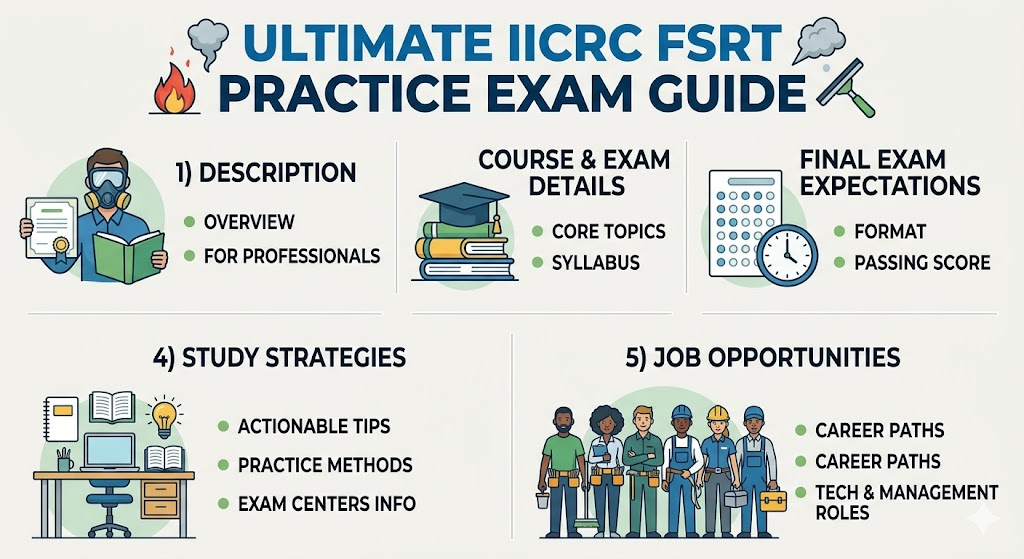
Additional Information
What the Course Entails and Exam Details
The FSRT course curriculum is deeply detailed, covering the entire spectrum of fire and smoke damage restoration.
Students will first learn about the behavior of fire, including how different materials burn and the distinct types of smoke and soot residues they leave behind.
The syllabus heavily emphasizes structural cleaning techniques, teaching technicians how to safely clean wood, drywall, concrete, and various hard surfaces.
Additionally, the course covers the intricate process of contents cleaning, guiding students on how to restore personal belongings, upholstery, and electronics.
You will also explore advanced odor control methodologies, including the use of thermal foggers, ozone generators, and hydroxyls.
Finally, the course outlines critical health and safety regulations, ensuring technicians know how to use personal protective equipment (PPE) and protect both themselves and the building’s occupants.
What to Expect in the Final Exam
To achieve your FSRT certification, you must pass a comprehensive final exam that tests your understanding of the course material and IICRC standards.
The exam consists entirely of multiple-choice questions, typically featuring around 150 to 160 questions designed to test both factual knowledge and situational decision-making.
To pass, candidates are required to achieve a minimum score of 75%.
The testing window is strictly timed, generally allowing you up to three hours to complete the assessment.
The exam is a closed-book test, meaning you cannot refer to any notes, study guides, or manuals while taking it, which highlights the importance of thorough preparation and deep comprehension of the material.
How to Study and Exam Centers
Success on the FSRT exam requires a strategic and disciplined approach to studying.
Begin by thoroughly reviewing the official IICRC manuals and any course materials provided by your approved training instructor.
Taking practice exams is one of the most effective ways to familiarize yourself with the question formats and identify areas where you need further review.
Create flashcards for key terms, chemical applications, and standard operating procedures to help memorize critical details.
When it comes time to take the exam, you have a couple of convenient options.
Many candidates take the test online via the IICRC’s authorized remote proctoring platform, which allows you to test from the comfort of your home or office, provided you have a webcam and a secure testing environment.
Alternatively, you can take the exam in person at an official IICRC-approved training school immediately following the completion of your in-person instructional course.
Job Opportunities from the Course
Achieving the FSRT certification opens the door to a wide variety of rewarding and high-demand career paths within the restoration and insurance industries.
Fire Damage Restoration Technician: You will serve as the boots on the ground, actively cleaning and restoring structures and contents post-fire.
Restoration Project Manager: This role involves overseeing entire restoration jobs, coordinating technicians, managing budgets, and communicating directly with property owners and adjusters.
Restoration Estimator: In this position, you will assess fire damage, write detailed scopes of work, and generate accurate cost estimates using industry-standard software like Xactimate.
Contents Restoration Specialist: You will specialize exclusively in the triage, cleaning, deodorization, and safe storage of personal property salvaged from fire-damaged homes.
Insurance Adjuster: With deep knowledge of proper restoration protocols, you can work for insurance carriers to evaluate claims, ensuring that restoration scopes are accurate and necessary.
Frequently Asked Questions
Reviews
5.0
Based on 0 reviews
Leave a Review
No reviews yet. Be the first to review!