
IICRC Odor Control Technician (OCT) Practice Exam
$69.00
- Buy to unlock unlimited access to all Quiz questions and Answers in this Quiz.
- After purchase you can print a PDF of the whole quiz at any point. The PDF will contain the questions and the correct answers.
About this Exam
The IICRC Odor Control Technician (OCT) certification is a specialized designation designed for cleaning and restoration professionals.
This course provides a technical foundation in the science of olfaction (smell), the origins of various odors, and the definitive methodologies for their complete removal from real-world restoration environments.
It is ideal for technicians working on projects involving fire and smoke damage, water damage with microbial growth, trauma scene cleanup, or stubborn bio-contaminants like pet urine.
By becoming an IICRC Certified OCT, you demonstrate to employers and clients that you possess the advanced, scientific knowledge required to tackle the most challenging and sensitive odor issues effectively.
This certification is often recognized as a pivotal step toward achieving higher master-level designations within the IICRC’s restoration tracks.
Ready to test your knowledge?
Buy Now to Access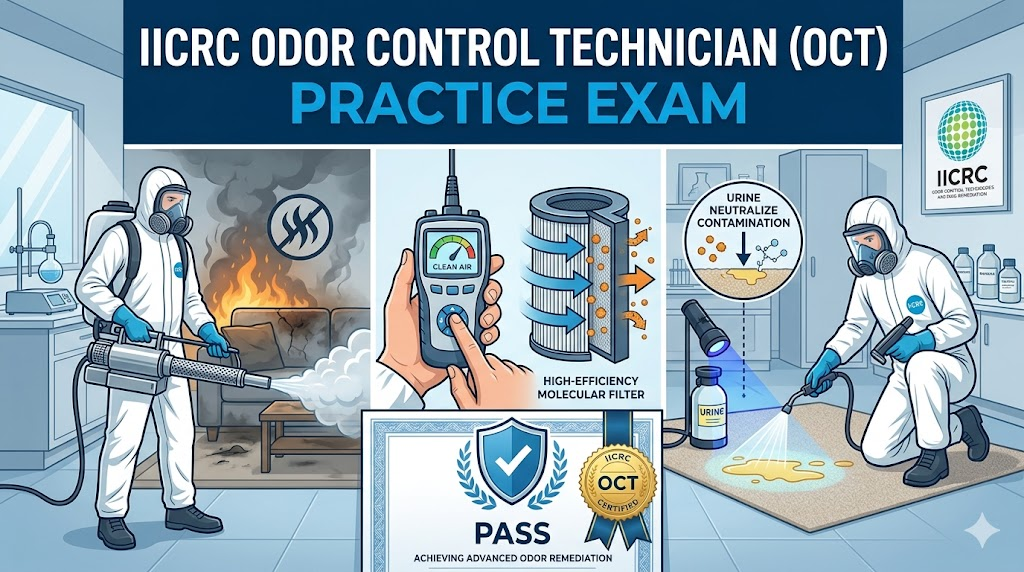
Additional Information
What the Course Entails and Exam Details
An approved IICRC OCT course is a comprehensive, typically one-day program that equips you with both theoretical understanding and practical application skills.
The curriculum is rigorously structured and encompasses a wide range of essential topics, including:
Olfaction and the Science of Odor: Understanding how the human olfactory system functions, how odors are perceived, and the fundamental principles of odor psychology.
Odor Sources and Classification: Learning to identify and classify the primary sources of odors encountered on restoration sites, including biological sources (decomposition, urine, sewage, mold), combustion sources (fire, smoke, soot), and chemical sources (fuel, volatile organic chemicals).
Odor Detection and Assessment: Mastering the process of accurately detecting and evaluating the intensity and nature of odors. This includes performing thorough inspections and utilizing advanced detection equipment.
Theory of Odor Control: A detailed exploration of the foundational theories and stages of odor removal: (1) Removing the source, (2) Cleaning affected surfaces, (3) Utilizing appropriate deodorization agents to neutralize or pair with remaining molecules, and (4) Sealing surfaces when necessary.
Deodorization Equipment and Systems: Hands-on training on the selection, safe operation, and maintenance of specialized equipment such as thermal foggers, ultra-low volume (ULV) foggers, ozone generators, hydroxyl generators, and air filtration systems with activated carbon.
Chemical Options and Application: In-depth knowledge of the various chemical deodorizers available—masking agents, pairing agents, holistic neutralizers, enzymes, and specialized chemical solutions—and the proper application methods for each to achieve maximum efficacy while prioritizing safety.
Health and Safety Protocols: Essential training on personal protective equipment (PPE), understanding Safety Data Sheets (SDS), and managing the potential risks associated with odor sources and deodorization chemicals.
Client Communication: Strategies for effectively communicating the odor remediation process, managing client expectations, and explaining the limitations of deodorization techniques in specific scenarios.
The course must be completed in full to be eligible for the IICRC OCT exam.
What to Expect in the Final Exam
The IICRC Odor Control Technician final exam is a comprehensive assessment of your knowledge.
You should prepare for a closed-book and closed-notes examination environment.
The current exam format consists of 100 multiple-choice questions that cover all areas of the OCT syllabus.
To pass the exam and earn your certification, you must achieve a score of 75% or higher.
If you take the OCT course in person, the exam is typically administered on the last day of the class.
For students completing the course via a live-stream or online platform, you will have a specific window—currently up to 45 days after completing the course—to take the exam.
In this scenario, the exam is administered through the official IICRC online exam portal.
The exam fee, paid directly to the IICRC, is $80 for each attempt.
Candidates who do not pass have up to two opportunities to retest, with a requirement to register and complete the retest within 45 days of their previous attempt.
If a student fails their third attempt, they are required to re-enroll and retake the complete OCT certification course before being eligible to take the exam again.
For online exams, preliminary results are provided quickly, but the official IICRC certification and physical certificate can take 4-6 weeks to arrive.
How to Study and Exam Centers
Successfully passing the IICRC OCT exam requires a focused study strategy. Here are actionable steps to ensure you are fully prepared:
Actively Participate in an Approved IICRC OCT Course: This is the most crucial step. Attendance is required, and the course is explicitly designed to teach you the content of the exam.
Utilize All Course Materials: Pay close attention during the lectures, take detailed notes, and thoroughly review all workbooks, study guides, and reference materials provided by your approved instructor and school. These are your primary study resources.
Focus on Key Terms and Definitions: The exam will test your understanding of technical terms, chemical types, and safety protocols. Flashcards are highly effective for memorizing these essential concepts.
Understand the 'Why' and 'How' of Equipment: Don't just learn what equipment does; understand the underlying science. Know when a thermal fogger is preferable to a hydroxyl generator, how ozone works at a molecular level, and the safety precautions for each device.
Practice with Example Questions: Leverage any study questions, quizzes, or practice exam materials provided in your course guide. These will give you insight into the style and complexity of the questions on the actual test.
Form Study Groups: Collaborating with colleagues who are also preparing for the exam can help reinforce concepts and uncover new insights through discussion.
The IICRC Odor Control Technician exam is not accessible as a standalone test; you must take an approved course to be eligible.
Once you have completed the course, there are two main ways to take the exam:
On-Site After an In-Person Course: Your approved school will facilitate the exam on the final day of the physical class.
Via the Official IICRC Online Exam Portal: If you took an online or live-stream course, you will receive instructions on how to register and access the IICRC's secure online testing environment. Please note that online exams cannot be completed using tablets, iPads, or other smart devices; a desktop or laptop computer is required.
The IICRC does not typically utilize external third-party testing centers like Pearson VUE for its initial technician-level exams, relying instead on its approved instructors and internal online proctoring systems to maintain exam security.
Job Opportunities from the Course
Earning the IICRC Odor Control Technician certification significantly enhances your career trajectory and value in the cleaning and restoration industry. It unlocks specialized roles and opens doors to a diverse range of career paths.
Graduates and certified professionals often advance to the following job titles:
Odor Control Technician (Specialist role within restoration firms)
Fire and Smoke Restoration Technician
Biological Remediation Technician
Restoration Project Manager
Contents Processing Technician
Trauma and Crime Scene Cleanup Specialist
Carpet Cleaning Technician (Handling advanced odor issues)
Commercial Building Maintenance Supervisor
Quality Control Inspector for restoration projects
Lead Restoration Technician
The IICRC OCT certification, particularly when paired with other designations like Water Damage Restoration Technician (WRT) and Fire & Smoke Restoration Technician (FSRT), is a critical component for those seeking to become recognized as a Master Fire and Smoke Restorer, signifying a top-tier level of expertise within the field.
Frequently Asked Questions
Reviews
5.0
Based on 0 reviews
Leave a Review
No reviews yet. Be the first to review!