
ILEA Emergency Vehicle Operations (EVO) Practice Test
$69.00
- Buy to unlock unlimited access to all Quiz questions and Answers in this Quiz.
- After purchase you can print a PDF of the whole quiz at any point. The PDF will contain the questions and the correct answers.
About this Exam
The Emergency Vehicle Operations (EVO) certification is a foundational program overseen by entities like the Indiana Law Enforcement Academy (ILEA) and similar state POST (Peace Officer Standards and Training) boards. It is designed specifically for law enforcement recruits, seasoned officers, and emergency responders who are required to operate emergency vehicles in the course of their duties. The primary objective of the EVO course and exam is to ensure that personnel possess the advanced driving knowledge, practical skills, and sound judgment necessary to operate these vehicles safely, legally, and effectively under the unique stressors of emergency responses and high-risk maneuvers. The program focuses on protecting the public, the operator, and equipment while achieving critical public safety missions.
Ready to test your knowledge?
Buy Now to Access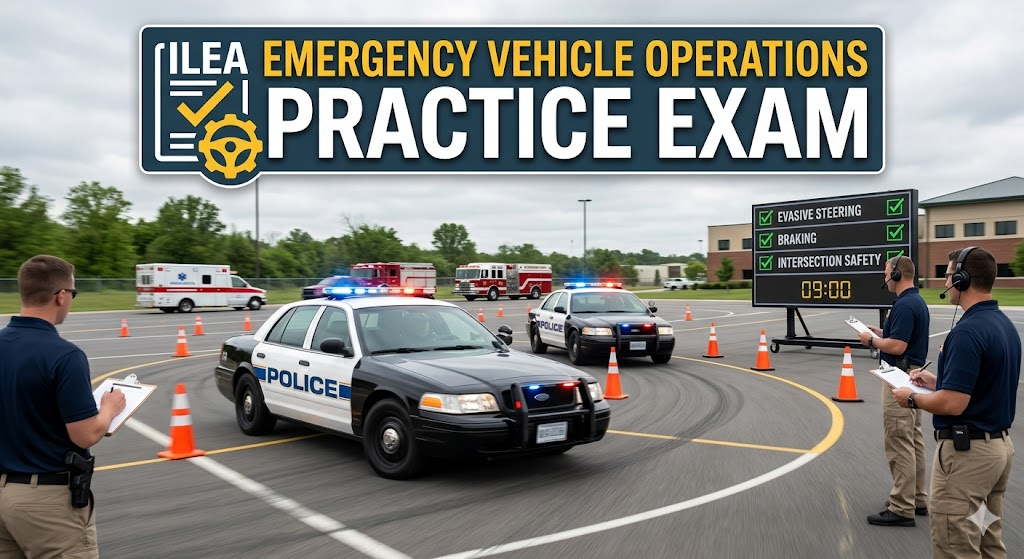
Additional Information
What the Course Ent entails and Exam Details
The EVO curriculum is a demanding mix of classroom learning and practical driving applications. Candidates can expect to cover a diverse array of topics, which often form the basis of the final written and practical examinations:
Legal & Liability Issues: Extensive instruction on state statutes regarding emergency vehicle operation, pursuit policies, negligence, and departmental guidelines. Understanding "due regard" is a core concept.
Defensive Driving Principles: High-level strategies for accident avoidance, traffic awareness, visual skills, and collision prevention. Key techniques include maintaining adequate safe zones, visual scanning, and intersection management.
Vehicle Dynamics: In-depth knowledge of how a vehicle functions under stress. This includes understanding weight transfer, traction, braking systems, tire adhesion, suspension characteristics, and how different drivetrains handle various scenarios.
Emergency Response Protocols: Proper and safe procedures for responding to emergency calls, using warning devices (siren and lights), and communicating effectively during critical incidents.
Pursuit Tactics: Comprehensive instruction on pursuit strategies, decision-making (initiation, continuation, termination), legal constraints, risk assessment, and tactical roles during pursuits.
Human Factors: The significant impact of physical and emotional factors, such as fatigue, stress, emotion, and confidence levels, on the operator's judgment and driving performance. The concept of never driving beyond 85% of one's ability is often highlighted.
The course typically culminates in both a written knowledge-based exam and a final practical skills evaluation on a controlled track, both of which require mastery of the topics listed above to achieve certification.
What to Expect in the Final Exam
The final EVO assessment is typically divided into two key components, and both must be successfully passed to earn the certification:
Part I: Cognitive Written Exam
Format: Usually a multiple-choice exam, but may include some true/false or scenario-based questions.
Focus: Assess understanding of theoretical knowledge, including legal scenarios, pursuit policy decision-making, defensive driving principles, and vehicle dynamic concepts.
Scoring: Candidates are typically required to achieve a passing score set by the academy or regulating board. Self-correction: While the prompt asks for passing scores and time limits, they vary by institution and tier. I can state general expectations and emphasize checking locally. Candidates are advised to check with their local training academy or relevant state POST board for specific time limits and passing score requirements.
Rules: Standard testing protocols apply, which usually prohibit the use of materials or collaboration during the exam.
Part II: Psychomotor Skills Assessment (Practical Driving)
Format: An on-track, behind-the-wheel driving course evaluated by certified instructors.
Focus: Assess a candidate's ability to demonstrate advanced vehicle control through specific maneuvers. These evaluations often prioritize safety, precision, and adherence to safe driving practices over pure speed, although timed elements may be included.
Exercises: Common practical evaluations include:
Serpentine/Cone Course: Maneuvering around cones at various speeds.
Evasive Steering: Reacting to obstacles and changing lanes quickly and safely.
Braking Techniques: Proper application of anti-lock brakes and controlled stopping in a specified distance.
Skid Control and Recovery: Understanding how to recognize and correct for understeer or oversteer.
Controlled Intersections: Clearing intersections safely under simulated emergency conditions.
High-Speed or Pursuit-Style Simulation: Demonstrating controlled driving under increased stress and varying speeds on a closed course.
Rules: Stringent safety rules are strictly enforced. Deviations, visual or safety violations (such as knocking over a key cone, losing vehicle control, or driving recklessly), can result in point deductions or an immediate failure. Instructors often prioritize the candidate’s demonstration of safety consciousness and control above all else. Self-correction: I should reinforce that safety is a critical part, potentially referencing instructor recertification with no grace period as a practical implication of high safety standards, and indicating where specific rules should be sourced. For specific, up-to-date practical test protocols, candidates must consult their academy directly, as instructor recertifications, like those within the ILEA ACADIS portal system, illustrate that ongoing standards are high and specific.
How to Study and Exam Centers
How to Study Effectively
Master Official Materials: Utilize all provided manuals, study guides, and lecture notes as your primary resource. Focus heavily on legal requirements, pursuit guidelines, and key defensive principles (like SIPDE - Search, Identify, Predict, Decide, Execute).
Utilize Practice Resources: Use practice exams, such as this ILEA Emergency Vehicle Operations Practice Exam, to identify knowledge gaps, familiarize yourself with question formats, and reinforce core concepts. Repeated practice with legal scenarios is especially beneficial.
Visualization and Mental Rehearsal: Review the practical driving exercises and visualize yourself executing them safely and with control. Break down each maneuver into key steps: entry, apex, and exit for turns; braking points; and steering inputs.
Prioritize Pursuit Policy & Legal Rules: Understanding your state and departmental pursuit policies and legal restrictions is crucial for both parts of the exam. Quiz yourself regularly on when pursuits are justified and under what conditions they must be terminated.
Develop Key Driver Attitudes: Focus on the six elements of defensive driving: Attitude, Knowledge, Attentiveness, Foresight, Judgment, and Skill.
Seek Instructor Feedback: During practice sessions, actively seek detailed feedback from certified EVO instructors. They can identify subtle weaknesses in both your understanding and your practical skills.
Exam Centers and Portals
Authorized Academies: The primary EVO certification course and the corresponding final exams (both written and practical) are typically administered directly by or under the direct supervision of accredited law enforcement academies or state POST training centers. This includes state-level academies, such as the Indiana Law Enforcement Academy (ILEA) in Plainfield, as well as approved regional and departmental academies certified to deliver the specific curriculum.
Physical Training Tracks: Due to the extensive psychomotor driving component, both the training and the final practical evaluation must be conducted at physical locations with appropriate driving courses and specialized training vehicles.
Online Portals & In-Service: For annual in-service training and refresher courses, some theoretical components or re-certifications can sometimes be managed or delivered online. ILEA, as an example, uses its ACADIS portal for course registration, payment, and managing instructor certifications and re-certifications. However, the initial primary EVO certification and basic training almost always require physical attendance for the extensive in-person driving instruction and final assessment.
Always confirm with your employing agency, the academy you are attending, or the regulating state POST entity for the most current information regarding exam formats, specific rules, required study materials, and the location of your designated training and testing center. They can provide essential details on everything from passing scores to the specific practical course diagrams and evaluation criteria.
Job Opportunities from the Course
Successfully completing the EVO course and earning this vital certification is not only a job prerequisite for many but also opens up crucial career paths and specialization opportunities in the fields of law enforcement and public safety, including:
Police Officer (at the municipal, county, state, or federal level)
Deputy Sheriff
State Trooper / Highway Patrol Officer
Arson Investigator (especially with corresponding Tier I training)
Correctional Officer (specifically for roles involving transport of inmates or operations)
School Resource Officer
Dispatch Center Manager or Shift Supervisor (some advanced roles indicate an ILEA background and instructor certifications)
Security Officer (especially for specialized roles or those in sensitive environments requiring certified law enforcement skills)
Tactical Operations Team Member (where enhanced driving skills are necessary)
EVO Instructor (with significant experience and further specialized instructor training)
Any Sworn Position Requiring Emergency Response or High-Risk Vehicle Operation
This certification fundamentally signifies that you possess the advanced skills and sound judgment needed to operate an emergency vehicle safely and legally, which is essential for almost all facets of field-based law enforcement and public safety roles.
Frequently Asked Questions
Reviews
5.0
Based on 0 reviews
Leave a Review
No reviews yet. Be the first to review!