
Illinois Advanced Technician Firefighter Practice Exam
$69.00
- Buy to unlock unlimited access to all Quiz questions and Answers in this Quiz.
- After purchase you can print a PDF of the whole quiz at any point. The PDF will contain the questions and the correct answers.
About this Exam
The Illinois Advanced Technician Firefighter (often referred to as ATFF or formerly Firefighter III in some context) is a prestigious, high-level certification designed for experienced fire service professionals seeking to elevate their expertise and advance their careers. This credential, administered by the Illinois Office of the State Fire Marshal (OSFM), goes far beyond basic firefighting principles. It validates a firefighter's comprehensive understanding of complex fire ground operations, specialized technical skills, strategy and tactics, hazardous materials response at an advanced level, technical rescue disciplines, and leadership in challenging environments. The ATFF is a pivotal step for firefighters aspiring to roles like company officer, specialist, or instructor, showcasing a commitment to professional growth and mastery.
Ready to test your knowledge?
Buy Now to Access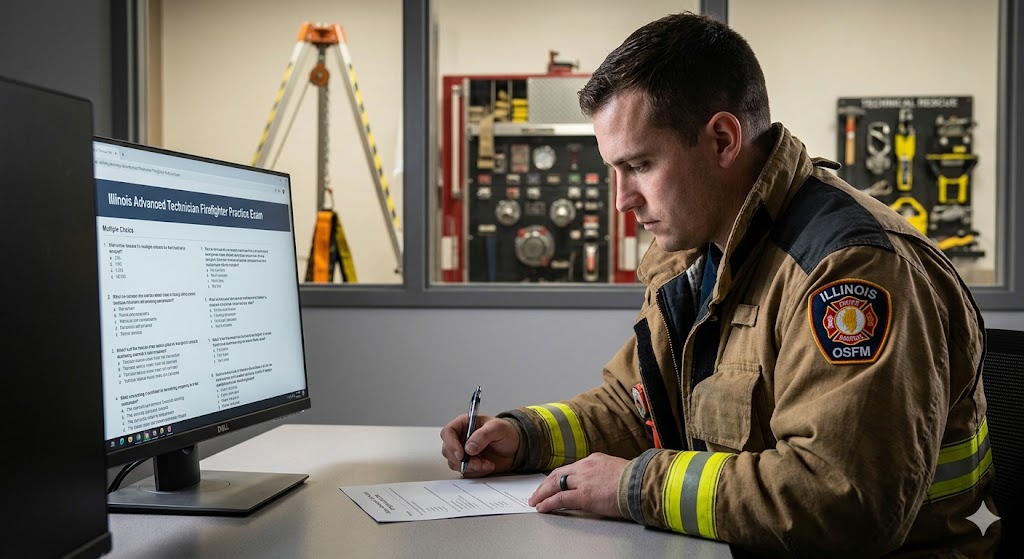
Additional Information
What the Course Entails and Exam Details
The comprehensive course curriculum that precedes the exam provides in-depth training across various critical areas. While specific course structures may vary by training academy (such as the Illinois Fire Service Institute or other approved fire departments), the content aligns with National Fire Protection Association (NFPA) standards, often NFPA 1001 for Fire Fighter II and then branching into specific specialized standards for technical fields. Typical core areas include advanced fire behavior, comprehensive incident command system (ICS) application, strategy and tactics for complex multi-alarm incidents, building construction analysis for fire tactical decisions, advanced engine and truck company operations, high-angle, trench, and confined space rescue operations, hazardous materials technician-level knowledge, fire prevention and public education, and mentoring/training methodologies for junior members. The examination process ensures candidates possess both theoretical knowledge and practical proficiency in these diverse domains.
What to Expect in the Final Exam
The final evaluation for the Advanced Technician Firefighter certification generally consists of two distinct components: a rigorous written examination and a demanding practical skills evaluation. The Written Examination is often a comprehensive, multiple-choice test that covers the entire breadth of the curriculum. It typically includes 100 or more questions, with a specific time limit (e.g., 2-3 hours). Candidates must achieve a passing score, usually 70% or higher, to demonstrate knowledge of codes, standards, procedures, and tactical concepts. The Practical Skills Evaluation is a hands-on assessment conducted in a controlled training environment. Evaluators judge competence in demonstrating essential technical skills, which might include simulated technical rescues, advanced fire control techniques, incident command scenarios, ventilation strategies, and vehicle extrication. Candidates are tested on safety, accuracy, teamwork, and communication. The specific formats and requirements are determined by the OSFM and may evolve.
How to Study and Exam Centers
Achieving success on the ATFF exam requires diligent and strategic preparation. Effective study methods include a thorough review of all course materials, textbooks (particularly those based on NFPA standards), and official curriculum. Many students find success by creating focused study guides, utilizing flashcards for key terms and procedures, forming study groups for discussion and knowledge-sharing, and, crucially, taking multiple practice tests to identify knowledge gaps and build exam confidence. Consistent, repeated review is essential for long-term retention. For the Written Exam, the Illinois OSFM utilizes a secure online testing portal (Fire Certification Information System - FCIS) for some exams, allowing for remote proctoring or administration at designated sites. Additionally, numerous physical testing centers are located at community colleges, fire academies, and state fire marshal regional offices across Illinois. The Practical Skills Evaluation is typically held at authorized state training academies or designated fire department training facilities that provide the necessary specialized props and controlled environments. Candidates must register for both written and practical exams through their department's training officer or the official OSFM process, ensuring they select convenient locations and dates.
Job Opportunities from the Course
Earning the Advanced Technician Firefighter certification significantly enhances a firefighter's career prospects and leadership potential. The credential demonstrates mastery of advanced technical skills and a dedication to safety and excellence, opening doors to various specialized and advancement opportunities within fire departments and associated fields. Graduates can progress into impactful roles such as:
Special Operations Firefighter (including Technical Rescue, Hazardous Materials Response, Water Rescue)
Fire Engine or Truck Company Officer (Lieutenant, Captain)
Fire Inspector and Fire Prevention Specialist
Fire Training Instructor or Academy Educator
Fire Investigator
Battalion Chief (with continued experience and additional officer-level certifications)
Hazardous Materials Manager or Coordinator (in public or private sectors)
Technical Rescue Specialist/Instructor
Safety Officer in private industry or government organizations
Emergency Management Professional
Frequently Asked Questions
Reviews
5.0
Based on 0 reviews
Leave a Review
No reviews yet. Be the first to review!