
Illinois Class D Water License Practice Exam
$69.00
- Buy to unlock unlimited access to all Quiz questions and Answers in this Quiz.
- After purchase you can print a PDF of the whole quiz at any point. The PDF will contain the questions and the correct answers.
About this Exam
The Illinois Class D Water License is an essential entry-level certification for aspiring water supply operators.
This credential is specifically designed for professionals who want to operate small public water supplies or specific non-community distribution systems across the state.
Earning this license proves you possess the foundational knowledge required to ensure safe, clean, and reliable drinking water for your community.
It is the perfect starting point for anyone looking to build a rewarding, long-term career in public health, municipal services, and environmental protection.
Ready to test your knowledge?
Buy Now to Access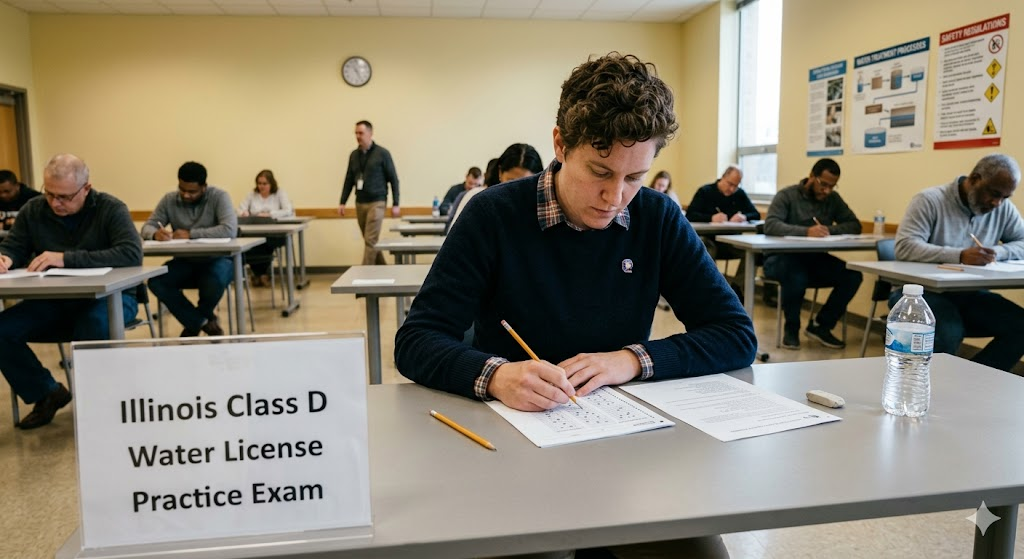
Additional Information
What the Course Entails and Exam Details
Preparing for the Illinois Class D Water License requires a solid understanding of basic water operations and state environmental regulations.
The core syllabus primarily covers the safe operation, maintenance, and monitoring of small water systems.
Key topics of study include well operations, basic water treatment processes, and the mechanical components of distribution systems like pumps and valves.
You will also need to master essential applied math, workplace safety protocols, and the specific compliance rules enforced by the Illinois Environmental Protection Agency (IEPA).
Additional educational focus is placed on chemical feeding, chlorination procedures, and routine water quality sampling techniques.
What to Expect in the Final Exam
Knowing exactly what to expect on test day is crucial to managing anxiety and setting yourself up for success.
The Illinois Class D Water License final exam is a closed-book, multiple-choice test administered directly by the state.
You will typically face around 50 questions that test both your theoretical knowledge and your practical, on-the-job problem-solving skills.
To pass the exam and earn your certification, candidates must achieve a minimum passing score of 70 percent.
Test-takers are usually given a strict time limit, often around two hours, to carefully read and complete the assessment.
Be sure to bring a standard, non-programmable calculator with you, as it is strictly required to solve the mandatory math and volume calculation questions.
How to Study and Exam Centers
Effective preparation starts with utilizing a high-quality Illinois Class D Water License practice exam to identify your current weak areas.
Create a consistent daily study schedule that focuses heavily on water math, system troubleshooting, and memorizing IEPA regulations.
Using flashcards is an incredibly helpful strategy for memorizing chemical dosages, conversion factors, and common industry terminology.
When you are fully prepared to take the test, you will need to schedule your session formally through the Illinois EPA.
Exams are typically held at designated IEPA regional offices or authorized community college testing centers located throughout the state.
Always verify your specific exam location, date, and required identification materials through the official IEPA operator certification online portal.
Job Opportunities from the Course
Achieving your Class D certification opens the door to several stable and well-paying municipal and private sector roles.
You will be highly qualified for the position of Entry-Level Water Treatment Operator, where you will manage daily plant operations and monitor water quality.
Another common career path is working as a Distribution System Technician, focusing on the repair and maintenance of pipes, valves, and water mains.
Many small towns and rural water districts frequently hire Class D operators as Public Works Utility Workers to oversee their localized water supplies.
Additionally, you can secure roles as a Water Quality Sampler or a Maintenance Mechanic for small community subdivisions.
Ultimately, this license serves as a valuable stepping stone to higher-level certifications, paving the way for future promotions to Lead Plant Operator or Water Superintendent.
Frequently Asked Questions
Reviews
5.0
Based on 0 reviews
Leave a Review
No reviews yet. Be the first to review!