
Illinois Fire Service Vehicle Operator (FSVO) Practice Test
$69.00
- Buy to unlock unlimited access to all Quiz questions and Answers in this Quiz.
- After purchase you can print a PDF of the whole quiz at any point. The PDF will contain the questions and the correct answers.
About this Exam
The Illinois Fire Service Vehicle Operator (FSVO) certification is a vital credential for anyone tasked with the immense responsibility of operating emergency apparatus within the state. Administered by the Office of the State Fire Marshal (OSFM) and often delivered through organizations like the Illinois Fire Service Institute (IFSI), this program sets the benchmark for safety, knowledge, and skill in the operation of non-pump and non-aerial vehicles. It is designed specifically for firefighters, emergency medical service personnel, and other fire service members who need to safely navigate everything from small utility vehicles and command cars to ambulances and support trucks. The ultimate goal is to reduce accidents, protect the public, and ensure the safety of emergency responders traveling to and from incidents.
Ready to test your knowledge?
Buy Now to Access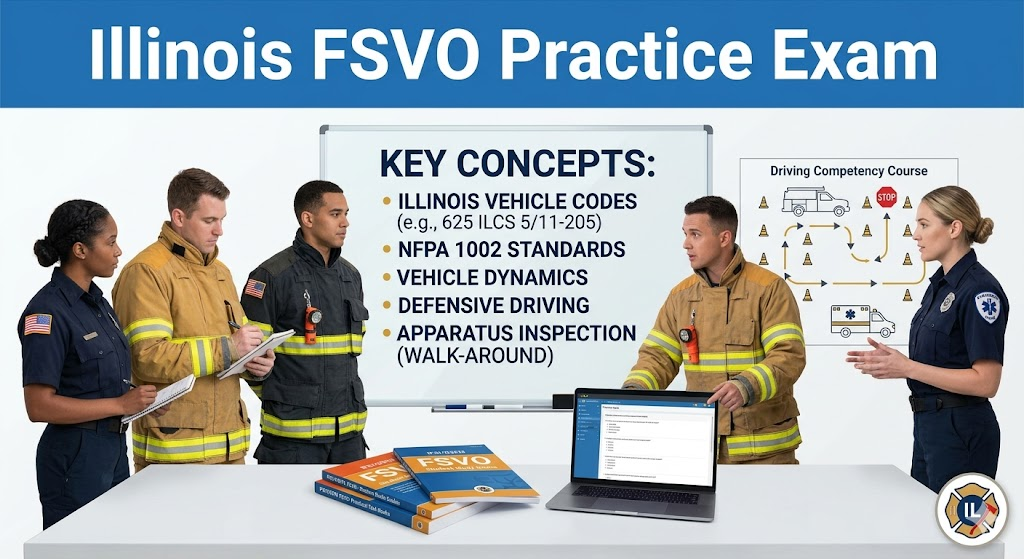
Additional Information
What the Course Entails and Exam Details
The FSVO course is typically a comprehensive 8-hour program that blends classroom instruction with practical, hands-on training. It provides a foundational understanding of the vehicle’s characteristics and the unique legal and ethical responsibilities of the emergency vehicle operator. The curriculum is based on the professional qualifications outlined in NFPA 1002 and covers a robust set of core topics.
Students can expect a standard minimum of 8 hours of classroom instruction. During this phase, they will dive deep into:
Understanding legal liabilities and the specific Illinois vehicle codes that apply to emergency vehicle operation, including 625 ILCS 5/11-205 regarding exemptions.
The principles of defensive driving and risk management, which are crucial for navigating high-stress and unpredictable traffic environments.
Vehicle dynamics and physics, including weight distribution, braking distances, centrifugal force, and how they affect the handling of different types of apparatus.
A strong focus on safety and attitude, addressing the mental preparedness and decision-making skills needed behind the wheel.
Record keeping, understanding the importance of maintenance, training, and operational records.
Identifying the regulatory agencies and standards that impact their daily operations, such as NFPA 1500.
The training transitions from theory to practice with a standardized competency course. This allows operators to practice precision driving maneuvers, smooth braking, and vehicle familiarization under a controlled environment where speeds are limited, typically to 15 mph.
What to Expect in the Final Exam
Upon completion of the FSVO course, candidates are required to pass a comprehensive evaluation process to achieve state certification. This evaluation consists of two main parts: a written knowledge exam and a practical skills demonstration.
The Written Exam: This part of the examination assesses your understanding of the theoretical concepts covered in the classroom and study materials.
Format: The exam typically consists of multiple-choice questions.
Content: Questions will cover the 4 goals of the FSVO program, Illinois laws, defensive driving techniques, vehicle maintenance, and emergency response procedures.
Passing Score: To pass the written exam and move forward in the certification process, you are generally required to achieve a score of 70% or better.
The Practical Skills Demonstration: This portion of the exam puts your hands-on skills to the test, validating your ability to safely handle a fire service vehicle. It includes two primary evaluations:
Apparatus Inspection: You will perform a full, standardized walk-around inspection to demonstrate proficiency in identifying critical components and ensuring operational readiness, often following the "circle" or "walk-around" method.
Driving Competency Course: While on a designated, safe course, you will demonstrate your ability to maneuver a vehicle precisely. You’ll perform tasks such as braking smoothly, knowing the position of your front and rear wheels, and navigating cones at specified speeds to show mastery of vehicle control.
How to Study and Exam Centers
Preparation for the FSVO exam requires a combination of self-study and practical application. Leverage every resource available to you to ensure success.
Actionable Study Strategies:
Master the Study Guides: Actively use the official Office of the State Fire Marshal (OSFM) and Illinois Fire Service Institute (IFSI) study guides. They outline the precise objectives and reference materials you need.
Practice with Purpose: Don't just read about driving; review the criteria in your FSVO INITIAL CERTIFICATION PRACTICAL TASK BOOK. Practice your walk-around inspections on multiple vehicles until it is a habit, and mentally rehearse the driving course.
Take Practice Tests: Use authentic or verified Illinois Fire Service Vehicle Operator Practice Exams. This is a powerful tool to identify knowledge gaps, practice with the question format, and manage your time.
Focus on Key Codes: Specifically study and understand the implications of the Illinois Vehicle Code, including sections 625 ILCS 5/11-205 (exemptions for emergency vehicles) and 625 ILCS 5/12-215 (emergency use of lamps and sirens).
Understand NFPA Standards: Ensure you can recall the significance of standard definitions like NFPA 1002 (the driver/operator qualification standard) and NFPA 1911 (for vehicle maintenance and "Out-of-Service" criteria).
Where and How to Take the Exam: The examination process is structured through authorized Illinois state testing portals.
IFSI and Regional Testing: Many candidates take their exams directly through the Illinois Fire Service Institute (IFSI) at their main campus or during regional training events. Courses and their associated testing days are listed on their schedule, allowing for "one-stop" training and certification.
OSFM Computer-Based Testing: The OSFM utilizes Pearson VUE for many of its state certification exams. This means after being approved to test, you can select from a wide range of authorized physical testing centers across Illinois to take your written exam at a time that is convenient for you.
Local Fire Academies: Certain authorized local fire academies, such as the Romeoville Fire Academy, are state-certified to deliver the course and conduct testing. Check with your department’s training officer for a list of approved training partners in your area.
Job Opportunities from the Course
Earning your Illinois FSVO certification is a foundational requirement that unlocks career progression within fire and emergency services. It is the "driver's license" for your professional emergency vehicle duties, providing your department and the state with verification that you meet safety and competency standards. This certification is a required step toward more specialized driver/operator roles.
The FSVO certification directly unlocks and enables you to pursue the following professional paths and job titles within Illinois:
Firefighter – In many departments, new firefighters must gain their FSVO certification as a condition of their probationary period to be eligible to drive support apparatus or operate as part of a relief driver pool.
Emergency Medical Technician (EMT-B, EMT-I, Paramedic) – For EMS professionals, this certification is often required to legally operate an ambulance in an emergency or non-emergency capacity.
Company Officer (Lieutenant, Captain) – State-certified Company Officers are expected to have a high level of operational knowledge. Having a foundational FSVO certification is a prerequisite for advanced driver training, which in turn makes you a more qualified candidate for promotional opportunities.
Fire Department Relief Driver – This designation allows you to fill in for primary driver/operators when needed, providing flexibility and critical coverage for your department.
Emergency Vehicle Operator (Support Vehicles) – This qualification is required to drive heavy utility vehicles, air units, command cars, mobile ventilation units, or other specialized support equipment that does not fall under the pump or aerial categories.
Fire Service Instructor (Driver/Operator specialized) – Achieving your FSVO, and eventually mastering pump and aerial operations, is a critical step towards becoming a state-certified instructor in fire apparatus operation.
Public Safety Officer – In departments with consolidated public safety roles, this certification confirms your competency to safely operate all non-transport department vehicles.
Airport Firefighter – ARFF personnel have unique vehicle operational needs, and the FSVO serves as a foundational credential for safe movement around a complex, multi-vehicle airfield environment.
Frequently Asked Questions
Reviews
5.0
Based on 0 reviews
Leave a Review
No reviews yet. Be the first to review!