
Illinois Notary Practice Exam
$69.00
- Buy to unlock unlimited access to all Quiz questions and Answers in this Quiz.
- After purchase you can print a PDF of the whole quiz at any point. The PDF will contain the questions and the correct answers.
About this Exam
The Illinois Notary Public certification is an official state commission issued by the Illinois Secretary of State, authorizing individuals to act as impartial witnesses in the signing of important documents.
This certification is designed for professionals who handle legal, financial, and real estate transactions, as well as everyday citizens looking to add a valuable credential to their resume.
Taking an Illinois Notary practice exam is the most effective way to prepare for the state-mandated training and testing requirements.
Whether you are a first-time applicant or a renewing notary navigating the latest state laws, this exam ensures you are fully equipped to perform your duties ethically and legally.
Ready to test your knowledge?
Buy Now to Access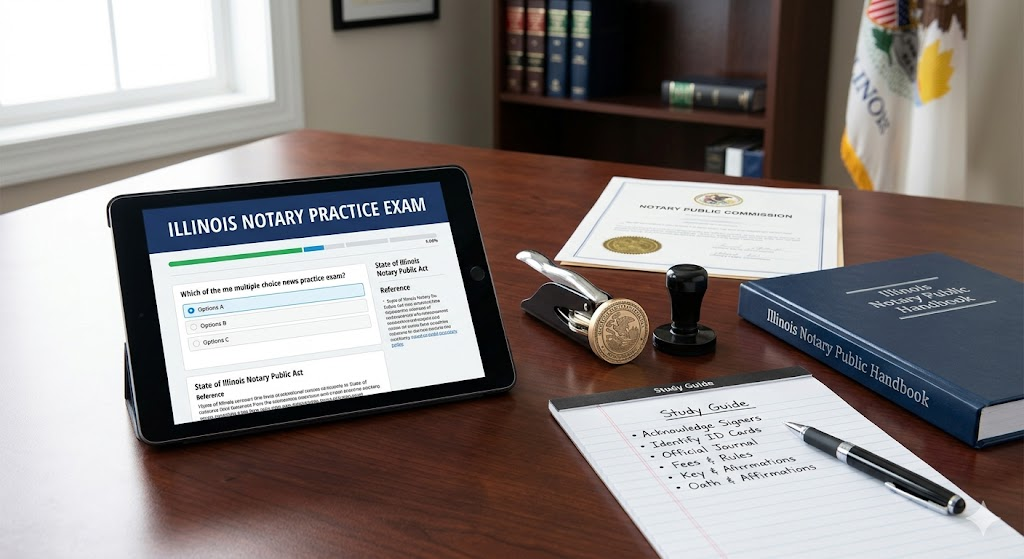
Additional Information
What the Course Entails and Exam Details
The Illinois Notary course and accompanying practice exams cover the fundamental laws and best practices outlined in the Illinois Notary Public Act.
A major focus of the syllabus is identity verification, teaching you how to properly screen signers, identify fraudulent documents, and determine a signer's willingness and awareness.
You will also dive deep into the specific types of notarial acts, including acknowledgments, jurats, oaths, and affirmations.
Additionally, the course covers the mandatory use and maintenance of a notary journal, ensuring you understand exactly what information must be recorded for every transaction.
Recent updates to the curriculum also entail electronic and remote online notarization (RON) rules, guiding you through the digital processes now authorized in the state of Illinois.
What to Expect in the Final Exam
The official Illinois Notary final exam is designed to test your comprehensive understanding of state notary laws and practical scenarios.
The exam typically consists of a 50-question multiple-choice format that closely mirrors the questions you will find in a high-quality practice exam.
To achieve a passing score, candidates are generally required to score at least 85% or higher, depending on the specific state-approved vendor administering the test.
While the test is comprehensive, it is usually open-book, meaning you can refer to your official Illinois Notary Public Handbook during the exam.
However, there is often a time limit—usually around 60 to 90 minutes—so you must be familiar enough with the material to find answers quickly and efficiently without relying too heavily on your notes.
How to Study and Exam Centers
The most actionable study strategy is to read the Illinois Notary Public Handbook cover to cover, highlighting key terms regarding fees, journaling, and disqualifying interest.
After reading the handbook, take multiple full-length practice exams to identify your weak spots and get comfortable with the multiple-choice format.
Make flashcards for situational rules, such as what to do when a signer lacks a state-issued ID or how to handle a remote online notarization.
In Illinois, the mandatory course and final exam are entirely accessible online through state-approved course providers, meaning there is no need to visit a physical testing center like Pearson VUE.
You can complete your studying and take the final exam from the comfort of your home using an authorized online portal, provided you have a stable internet connection and meet the platform's proctoring or identity verification requirements.
Job Opportunities from the Course
Becoming a commissioned notary in Illinois opens the door to a wide variety of career paths and supplemental income opportunities.
Mobile Notary Public: You can work independently, traveling to clients to notarize general documents such as wills, power of attorney forms, and contracts.
Loan Signing Agent: With additional training, you can guide borrowers through mortgage loan documents, which is one of the most lucrative paths for a notary.
Paralegal or Legal Assistant: Law firms highly value administrative staff who hold a notary commission to quickly process affidavits and court filings.
Real Estate Assistant or Escrow Officer: Title companies and real estate agencies rely on in-house notaries to finalize property transfers and closing documents.
Bank Teller or Financial Services Representative: Financial institutions frequently require their staff to be commissioned to assist customers with banking and wealth management paperwork.
Frequently Asked Questions
Reviews
5.0
Based on 0 reviews
Leave a Review
No reviews yet. Be the first to review!