
Illinois Private Alarm Contractor Practice Test
$69.00
- Buy to unlock unlimited access to all Quiz questions and Answers in this Quiz.
- After purchase you can print a PDF of the whole quiz at any point. The PDF will contain the questions and the correct answers.
About this Exam
The Illinois Private Alarm Contractor license is a mandatory certification for any individual or entity wishing to engage in the business of designing, installing, servicing, or maintaining alarm systems for a fee within the state of Illinois. This comprehensive program, which includes this essential practice test, is specifically designed for professionals aiming to start their own alarm contracting business or qualify as a key manager for an existing licensed agency. Obtaining this license signifies to clients and regulators that you possess the necessary expertise, legal knowledge, and high standards required to protect property and, most importantly, lives in a professional capacity.
Ready to test your knowledge?
Buy Now to Access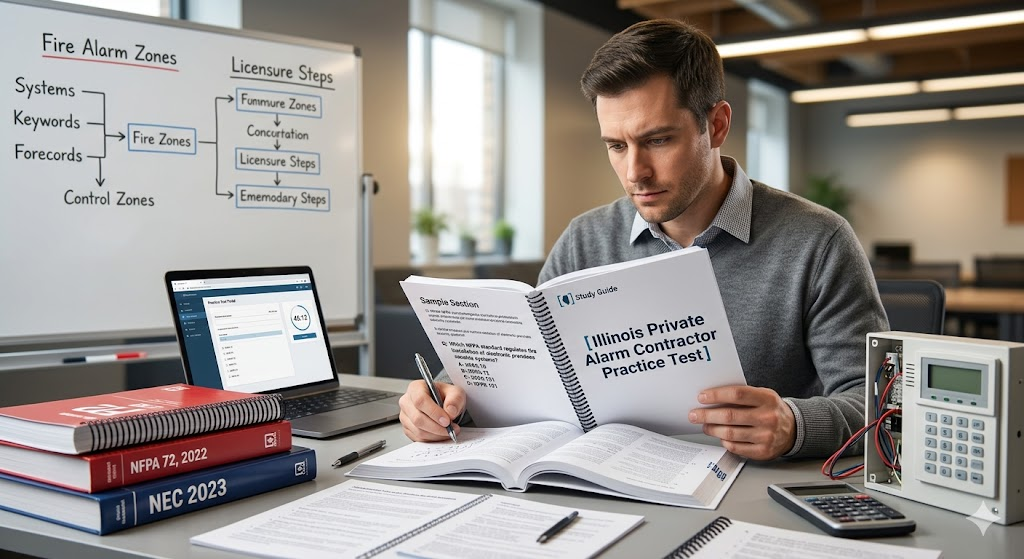
Additional Information
What the Course Entails and Exam Details
This practice test is an essential tool for comprehensive exam preparation, mirroring the content you will encounter on the official Illinois Private Alarm Contractor licensing examination. The state exam is rigorous, and this study guide ensures you cover the entire landscape of required knowledge. It is based on a deep understanding of the regulatory framework and technical standards.
Core topics you must master include:
Licensure and Practice Requirements: A detailed understanding of the Illinois Private Detective, Private Alarm, Private Security, Fingerprint Vendor, and Locksmith Act. This includes key areas like qualifying experience, education, business practices, record-keeping, and the ethical and legal violations that can lead to disciplinary action.
Design, Installation, and Service of Fire Alarm Systems: This section is heavily weighted and covers critical life safety regulations. It requires proficiency in interpreting the latest editions of the NFPA 72 (National Fire Alarm and Signaling Code), the National Electrical Code (NEC/NFPA 70), and the Life Safety Code. Topics include wiring methods, grounding, overcurrent protection, system calculations (like battery and voltage drop), and integration with other building systems.
Design, Installation, and Service of Security Alarm Systems: This portion covers the latest technical standards for non-fire security applications. Expect questions on the installation of electronic premises security systems, the guide for premises security, and best practices for common sensors, control panels, and communication methods, largely drawn from standards like NFPA 730 and 731.
What to Expect in the Final Exam
Knowing what to expect on test day is a huge component of successful preparation. Here are the key details for the official Illinois Private Alarm Contractor Exam:
Format: The exam is a computer-based, closed-book test, meaning you are not allowed to bring any references, charts, or code books into the testing center.
Question Type: It consists of multiple-choice questions, each with four possible answers. The official question pool is vast, and individual exams will consist of 38 carefully selected questions that span the subtopics listed above (Licensure, Fire, Security).
Passing Score: To obtain your license, you must achieve a scaled score of 70 or higher.
Time Limit: You will have exactly 75 minutes to complete the 38-question exam. This is approximately two minutes per question, so time management is crucial.
Administration: The exam is administered by the Illinois Department of Financial and Professional Regulation's (IDFPR) official testing vendor, Continental Testing Services (CTS).
Testing Windows: Unlike some exams that are offered continuously, the Illinois contractor exams are often scheduled in specific testing windows multiple times per year at authorized centers.
How to Study and Exam Centers
Preparation for this challenging exam requires a structured approach and dedication. Here are several actionable strategies and details on taking the official exam:
Actionable Study Strategies:
Obtain the References: The entire test is derived from a core set of referenced code books. Your most important study guides are the actual NFPA standards. This includes NFPA 72, the NEC (NFPA 70), NFPA 730, and NFPA 731. A "Fire Alarm Signaling Systems Handbook" is also strongly recommended. Do not attempt to study for this exam without these primary sources.
Focus on Key Numbers: The exam frequently tests your memory of specific numbers and timeframes. Create flashcards for critical figures, such as the minimum amount of liability insurance ($1,000,000), record-keeping periods (5 years), temporary authority duration (270 days), and common calculations.
Use Practice Tests and Simulations: The best way to build your technical accuracy and timing is through simulated practice. Utilize this practice test, and look for online exam prep tools that offer timed simulations. Pay attention to the rationales for each correct answer to solidify your understanding of the code.
Trust Your Instincts: Studies show that a student's first instinct is often correct. Unless you have a clear reason to believe you misread the question, try to avoid changing answers.
Master Calculations: Be prepared to solve mathematical problems, including Ohm’s Law, voltage drop, and battery standby time, as they relate to fire and security alarm system design.
Exam Centers and Registration:
To register and take the official Illinois Private Alarm Contractor Exam, you must follow the procedures outlined by Continental Testing Services.
Registration: Visit the official website of Continental Testing Services (continentaltesting.net). You will need to create an account, select the correct examination, and pay the required fee to schedule your test.
Locations: CTS administers the exam at authorized testing centers located throughout the State of Illinois. They have permanent locations in larger cities like Chicago, Springfield, and Carbondale, with additional mobile testing sites sometimes available during major testing windows. After successful registration, you will be able to select your preferred location and date.
Job Opportunities from the Course
Earning the Illinois Private Alarm Contractor license opens the door to a specialized and in-demand sector of the security and safety industry. This credential is the foundational requirement for many senior and entrepreneurial roles. Here is a clear list of the career paths this certification unlocks:
Licensed Private Alarm Contractor (Owner/Operator)
Licensed Private Alarm Contractor (Qualifying Manager for a licensed agency)
Senior Fire Alarm System Designer/Project Manager
Senior Security System Designer/Project Manager
Alarm Agency Compliance Officer
Sales and Marketing Executive (for alarm contractors, requiring licensing knowledge)
Expert Witness (for security and fire alarm code compliance)
Life Safety and Security Systems Consultant
Frequently Asked Questions
Reviews
5.0
Based on 0 reviews
Leave a Review
No reviews yet. Be the first to review!