
Illinois Private Sewage Contractor Practice Exam
$69.00
- Buy to unlock unlimited access to all Quiz questions and Answers in this Quiz.
- After purchase you can print a PDF of the whole quiz at any point. The PDF will contain the questions and the correct answers.
About this Exam
Achieving licensure as a private sewage contractor is a vital step for professionals dedicated to protecting public health and the environment through the proper management of domestic wastewater.
The Illinois Private Sewage Contractor Exam is the mandatory gateway certification designed for individuals who intend to design, install, repair, or maintain private sewage disposal systems within the state of Illinois.
This rigorous exam ensures that all contractors operating in this niche sector possess the technical knowledge and comprehensive understanding of state regulations necessary to operate safely and effectively.
It is designed specifically for environmental health professionals, plumbers, excavation specialists, and construction contractors looking to specialize in decentralized wastewater treatment.
Ready to test your knowledge?
Buy Now to Access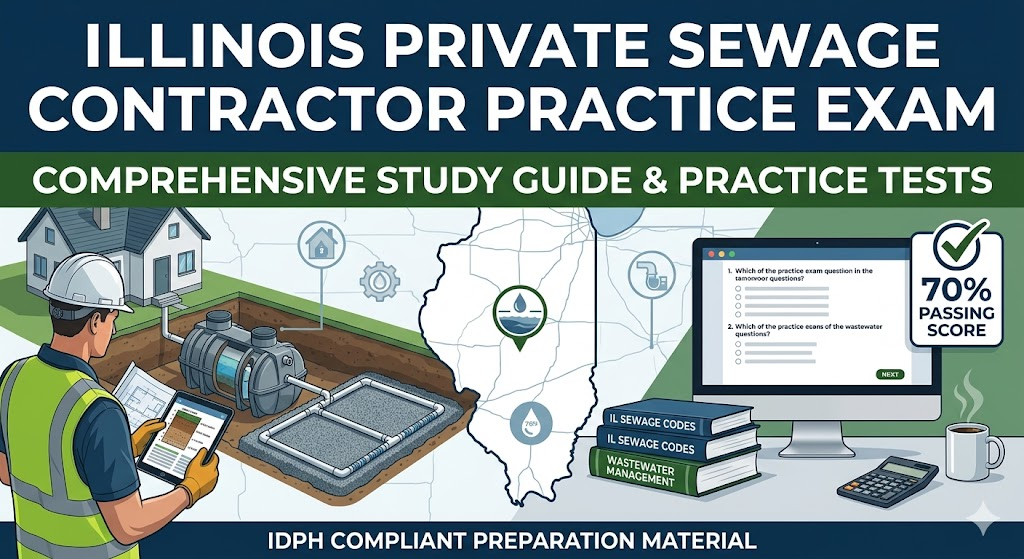
Additional Information
What the Course Entails and Exam Details
To prepare for this examination, candidates must engage in deep study of the complex regulations governing wastewater treatment.
The primary study curriculum is not typically a single class but rather the mastery of the official Illinois Private Sewage Disposal Licensing Act and Code.
Candidates must develop a strong command over critical topics including, but not limited to, detailed soil analysis and classification, daily design flow calculations based on facility type, and proper setback distances from water sources and property lines.
The scope also covers the specific material and construction standards for septic tanks, aeration units, and soil absorption systems, ensuring that every installed system meets uniform safety and efficiency standards.
Furthermore, students must understand the administrative and legal requirements of the license itself, including permitting processes, inspection protocols, and the ethical responsibilities of a licensed contractor.
What to Expect in the Final Exam
The Illinois Private Sewage Contractor examination is designed to strictly evaluate a candidate’s ready knowledge and practical application of the state code.
The exam format usually consists of multiple-choice questions, requiring candidates to select the most accurate response based on legal requirements and industry standards.
Some portions of the exam may require calculations related to system sizing or interpreting soil reports, testing mathematical and analytical aptitude.
Historically, this is a "closed book" examination, meaning candidates must recall technical specifications, formulas, and legal codes without reference material.
To pass, candidates must typically achieve a score of at least 70% to 75%, demonstrating a proficient grasp of the regulatory framework.
Strict time limits apply, making efficient time management during the test essential for completion.
How to Study and Exam Centers
Effective preparation for this exam requires a proactive and focused study strategy rather than reliance on passive reading.
The cornerstone of your preparation must be repeated, thorough review of the Illinois Private Sewage Disposal Code itself.
To move from reading to retention, experts recommend creating detailed flashcards for specific definitions, numerical setback requirements, and formulaic calculations.
Participating in specialized workshops offered by industry associations can provide clarity on complex technical regulations.
Furthermore, utilizing comprehensive Illinois Private Sewage Contractor Practice Exams is crucial for familiarizing yourself with the wording, style, and pacing of the actual test, helping you identify knowledge gaps early.
The exam itself is officially administered by the Illinois Department of Public Health (IDPH).
After submitting your formal application and license fee, IDPH will provide notification regarding specific examination dates, times, and designated testing locations, which may include IDPH regional offices or specific testing centers in cities like Springfield.
Job Opportunities from the Course
Successfully navigating the Illinois Private Sewage Contractor Exam unlocks a specialized and robust career path in the environmental services sector.
The most direct opportunity this licensure provides is the ability to own and operate your own Private Sewage Disposal Contracting business, giving you full control over your operations and clientele.
For those preferring employment, this certification is often required for high-level roles such as Septic System Installation Manager, supervising crews on residential and commercial sites.
It opens doors to becoming a Private Sewage System Designer, specializing in planning custom systems for challenging terrain.
Career opportunities also include serving as a private or municipal Septic Inspector, ensuring regulatory compliance, or functioning as a dedicated Septic Maintenance and Service Technician.
Furthermore, many general excavation and plumbing companies actively seek out licensed individuals to expand their service offerings into wastewater management.
Frequently Asked Questions
Reviews
5.0
Based on 0 reviews
Leave a Review
No reviews yet. Be the first to review!