
Illinois Vision Certification Practice Test
$69.00
- Buy to unlock unlimited access to all Quiz questions and Answers in this Quiz.
- After purchase you can print a PDF of the whole quiz at any point. The PDF will contain the questions and the correct answers.
About this Exam
The Illinois Department of Public Health (IDPH) Vision Screening Technician Certification is a state-mandated program designed for individuals responsible for performing non-diagnostic vision screenings, primarily within educational settings. This certification is crucial for early detection of potential vision problems in school-age and preschool children, ensuring they receive timely referrals to eye care professionals. The course and exam are specifically tailored for nurses, school health personnel, public health technicians, and others who will conduct these essential health checks across public, private, and parochial schools throughout Illinois.
This certification ensures that all screenings are conducted uniformly, accurately, and in compliance with state guidelines, ultimately contributing to better long-term vision health and educational outcomes for Illinois students.
Ready to test your knowledge?
Buy Now to Access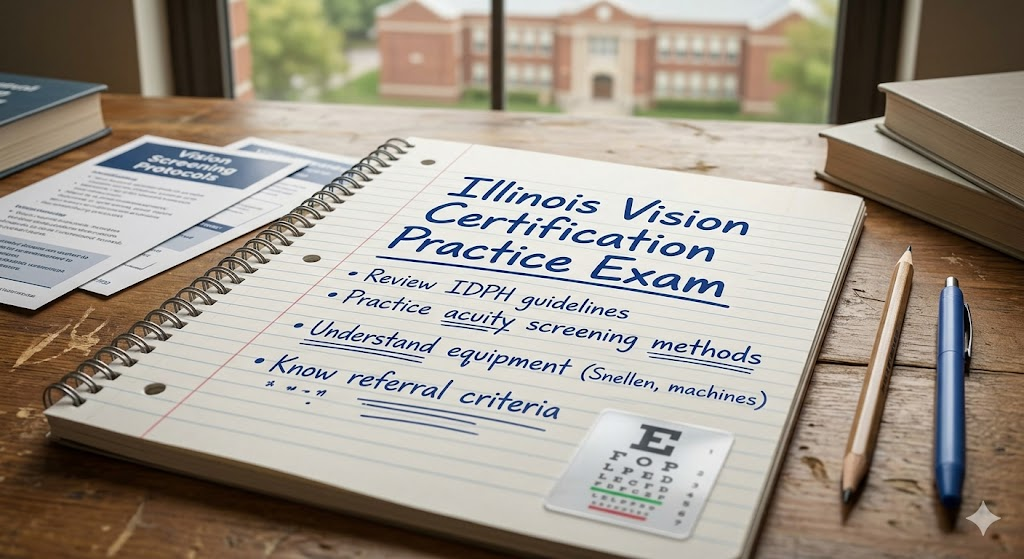
Additional Information
What the Course Entails and Exam Details
The Illinois Vision Certification program typically involves a comprehensive training course, which might be offered in person, online, or a hybrid of both, through state-authorized training providers. The course is not just about passing an exam; it equips you with the fundamental skills and knowledge needed to confidently and accurately screen children.
Core topics and skills covered in the training and assessment include:
Understanding Vision and Common Conditions: Gaining a basic understanding of pediatric eye anatomy and common vision disorders relevant to screening, such as visual acuity issues (nearsightedness, farsightedness), amblyopia (lazy eye), strabismus (misaligned eyes), and muscle balance.
Screening Procedures and Techniques: Master the standardized methods for performing various screening tests. This includes administering distant visual acuity tests (often using Snellen charts or electronic screeners), muscle balance tests, stereo acuity tests, and, in some cases, color vision screening. You will learn age-appropriate techniques for both preschool and school-age populations.
Equipment Use and Maintenance: Learn to correctly set up, use, and properly clean/maintain different types of vision screening equipment, ensuring consistent and reliable results.
State Guidelines and Protocols: Understand and implement the specific IDPH standards, criteria, and reporting regulations governing vision screenings in Illinois schools.
Identification and Referral: Learn to accurately identify children whose screening results meet referral criteria, understand the significance of these findings, and correctly document and manage the referral process to ensure follow-up care by an optometrist or ophthalmologist.
Documentation and Record Keeping: Proper recording of screening data, parent notifications, and state reporting are critical components you will be trained on.
Successful completion of the program typically requires both attending the training and demonstrating competency through a written examination and a practical skills assessment.
What to Expect in the Final Exam
The final step to obtaining your Illinois Vision Certification is the successful completion of the certification assessment, which generally has two main components:
Written or Online Examination: This part typically consists of multiple-choice questions designed to test your understanding of the theoretical knowledge, state regulations, screening methods, equipment use, and documentation procedures. The number of questions and time limit can vary slightly between different training providers but expect a standard length (e.g., 50-100 questions) and a reasonable duration (e.g., 60-90 minutes). A common minimum passing score is approximately 80%.
Practical or Practicum Evaluation: A hands-on assessment where you must demonstrate your proficiency in performing actual vision screening tests correctly on a person (sometimes a training assistant, sometimes another student). You will be evaluated on your ability to set up equipment, explain procedures to the "patient," conduct tests accurately and efficiently using the correct techniques and distances, and correctly record the results and determine referral status based on provided scenarios.
The practical component is typically a brief but crucial demonstration of skill, occurring either immediately following the training or scheduled shortly after. You must pass both the written and practical portions to receive your certification. Certification is typically valid for three years and requires renewal through recertification procedures defined by IDPH.
How to Study and Exam Centers
Preparation is key to succeeding on both parts of the Illinois Vision Certification assessment.
How to Study:
Review Training Materials: Throroughly study all manuals, presentations, and resources provided during your IDPH-authorized training course. Pay close attention to screening protocols, referral criteria, and equipment instructions.
Practice Practical Skills: Dedicate significant time to practicing the screening techniques you learned. If possible, practice on colleagues, friends, or family members to get comfortable with the procedures, equipment handling, and interactions, especially with different age groups. Ensure your practice mirrors the standardized methods taught.
Study State Guidelines: Familiarize yourself with the official IDPH rules and regulations related to child vision and hearing screenings. You can often find these documents on the IDPH website. Understanding why procedures are done a certain way is just as important as knowing how.
Take Practice Tests: While there may not be "official" state-provided practice tests, many training organizations will offer review questions, mock quizzes, or sample scenarios in their study materials. Take advantage of these to identify areas where you need more focus. Use online search carefully for unofficial practice questions, but prioritize accuracy based on your training.
Exam Centers and Locations:
Unlike standardized academic or professional licensing exams taken at Pearson VUE or similar generic centers, the Illinois Vision Certification exam is generally not taken at these types of locations. Instead, you will take the exam through IDPH-authorized training providers. These include:
Regional Offices of Education (ROEs): Many ROEs across Illinois schedule and conduct these training and certification programs.
County Health Departments: Some county health departments are authorized training sites.
School Districts or Large Educational Organizations: Larger districts or special education cooperatives may be approved to provide training and certification internally.
Specific Certified Training Agencies: Certain private or non-profit organizations are specifically designated to offer this training and evaluation on behalf of the state.
When you register for the certification program, you will do so through one of these authorized entities, and they will inform you of the exact location for the training and the subsequent written and practical assessments. The location could be a classroom at an ROE office, a training room at a health department, or a designated space within a school or facility. Some components, especially the written portion, might potentially have online options facilitated through the specific training provider's portal, but this is always under their authorization and guidance, not through a generic testing service. Always confirm the specific exam details and location directly with your chosen authorized training provider.
Job Opportunities from the Course
Upon earning your Illinois Vision Certification, you will possess a qualification required for various roles focused on child and school health within the state. This non-diagnostic screening role is a critical first step in protecting children's vision, making you an essential asset in numerous settings.
Job opportunities this certification unlocks include:
School Nurse (Certification is often required or highly beneficial, especially for screening roles)
School Health Aide / School Health Technician
Vision Screener / Vision Screening Technician (specifically in educational and community settings)
Pediatric Health Screener
Preschool Screening Specialist
Public Health Worker / Health Technician (with a focus on child health programs)
Community Health Worker (supporting school health initiatives)
This certification primarily prepares you for non-diagnostic screening positions. It is important to remember that you will not be a licensed eye doctor, but rather an expert in accurately identifying children who require a comprehensive eye exam from an optometrist or ophthalmologist. This foundational qualification can also be a valuable stepping stone towards further career advancement in nursing, public health, or other healthcare and educational roles.
With dedication, thorough study, and ample practice, you can successfully earn your Illinois Vision Certification and embark on a rewarding path contributing to the healthy development and academic success of children across Illinois. Good luck with your preparation!
Frequently Asked Questions
Reviews
5.0
Based on 0 reviews
Leave a Review
No reviews yet. Be the first to review!