
Illinois Wastewater Class 4 Practice Test
$69.00
- Buy to unlock unlimited access to all Quiz questions and Answers in this Quiz.
- After purchase you can print a PDF of the whole quiz at any point. The PDF will contain the questions and the correct answers.
About this Exam
The Illinois Wastewater Class 4 Certification is an essential milestone for professionals beginning their careers in wastewater management, specifically focusing on the operation and maintenance of lagoon treatment systems. This exam is designed to validate the core competency, fundamental knowledge, and critical practical skills required of entry-level operators. Achieving this certification demonstrates your readiness to work effectively within the essential environmental sector, ensuring public health and protecting Illinois' water resources, while often opening the door to further advancement in the industry.
Ready to test your knowledge?
Buy Now to Access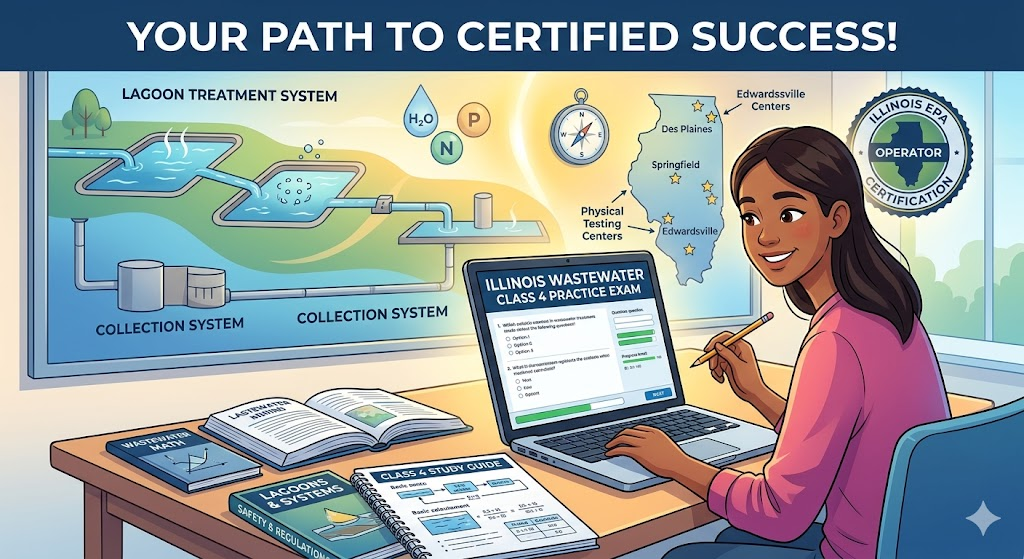
Additional Information
What the Course Entails and Exam Details
This comprehensive guide and subsequent practice exams will focus on the fundamental topics you need to master. While specific course details may vary by authorized training providers, your studies must cover:
Wastewater Characteristics: Understanding the composition and impact of municipal and industrial wastewater.
Lagoon Systems: Operations, maintenance, and essential troubleshooting for stabilization ponds, aerated lagoons, and related processes.
Collection Systems: General principles and primary functions of the networks that transport wastewater.
Primary Treatment: Concepts and operations of screening, grit removal, and primary sedimentation.
Wastewater Math: Essential calculations for flow rates, volumes, detention times, and chemical dosage. Mastering formulas and unit conversions is crucial for success.
Safety and Regulations: Workplace safety procedures and key federal and state environmental regulations, including Illinois EPA (IEPA) specifics.
Laboratory Procedures: Fundamental understanding of sampling, testing methods, and interpreting common wastewater data.
Operation and Maintenance: Practical techniques for equipment upkeep and maximizing system performance.
What to Expect in the Final Exam
The actual Illinois Wastewater Class 4 examination is a significant step, and understanding its format will build confidence:
Format: The exam typically consists of multiple-choice questions designed to test your comprehensive knowledge across all the core areas. It covers both conceptual understanding and critical practical applications, with a strong emphasis on wastewater mathematics and operational knowledge.
Passing Score: To earn your certification, you must achieve a minimum passing score, which is generally 70% or higher. It is essential to check the most current requirements provided by the Illinois Environmental Protection Agency (IEPA) or your authorized training center.
Time Limit: Expect a strict time limit, usually around three hours (e.g., from 9:00 a.m. to 12:00 p.m. in the provided schedule), to complete the entire exam. Practice with timed mock tests can help you manage your pacing effectively.
Rules: The exam process is strictly controlled. You must pre-register and be accepted for an exam date and location, typically via the IEPA Operator Certification Unit. A valid Letter of Admission and a current photo ID are required for entry to the physical exam room. Bringing unauthorized study materials or electronic devices is strictly forbidden. Specific rules, including allowed calculators, will be detailed by the IEPA.
How to Study and Exam Centers
Preparation is the key to success. Here’s a strategic approach and crucial information about exam delivery:
Actionable Study Strategies
Utilize Official Guidelines: Start with the official guidelines and study materials provided or recommended by the Illinois EPA. These are the most direct indications of exam content and required competencies.
Enroll in Authorized Courses: Consider enrolling in an exam preparation course offered by a reputable and IEPA-recognized provider or school (e.g., organizations like the American Water College, Illinois Rural Water Association, or the Environmental Resources Training Center (ERTC) at SIU-E). These courses structure the material logically and often include targeted practice.
Practice, Practice, Practice: Seek out dedicated Illinois Class 4 practice examinations and quizzes. This should include online resources, flashcards for memorizing formulas and terms, and timed mock tests. Focus particularly on your wastewater math—a common point of difficulty for students.
Create a Study Plan: Break down the core topics into manageable study sessions and set a realistic schedule. Consistent, focused study is more effective than rushing at the last minute.
Form a Study Group: Collaborative learning with peers preparing for the same or similar exams can provide mutual support and diverse perspectives.
Exam Delivery & Testing Centers
It is important to note that the Illinois Wastewater Class 4 examination is typically administered as a physical, in-person test at designated locations throughout the state, NOT through a general online portal like Pearson VUE for the certification itself. Training courses can be taken online, but the final examination is generally on-site. The process involves:
Application: Submit an examination request form to the IEPA Wastewater Operator Certification Unit and receive approval to test.
Scheduling: Contact and schedule your date and location with the chosen Testing Site.
Physical Locations: Key locations for the physical exams (which are scheduled at various times, often monthly) typically include:
Springfield: Illinois EPA Headquarters
Des Plaines: Regional Office (near Chicago)
Edwardsville: Environmental Resources Training Center (ERTC) at Southern Illinois University Edwardsville (SIU-E)
Marion: Region Office
Rockford: Regional Office
Other sites may be added or varied, always verify the latest locations with the IEPA.
Job Opportunities from the Course
Successfully navigating the Illinois Wastewater Class 4 Practice Exam and achieving your official Class 4 Certification opens doors to rewarding career paths:
Wastewater Treatment Operator (specifically for Lagoon Systems/Group 4 Facilities)
Municipal Wastewater Treatment Operator
Operations & Maintenance Technician (Focus on Lagoons and Primary Treatment)
Lagoon System Supervisor
Environmental Services Technician
Lead Operator (with experience and potential higher certifications)
Public Works Technician
Industrial Pretreatment Operator (Depending on specific experience)
Your educational path doesn't stop here. This certification is a solid foundation, and you can advance in your career by gaining more extensive experience and obtaining higher-level certifications (Classes 3, 2, and 1) or specializing in areas like collection systems or laboratory analysis.
Good luck with your studies—your journey to becoming a certified Illinois wastewater expert begins now!
Frequently Asked Questions
Reviews
5.0
Based on 0 reviews
Leave a Review
No reviews yet. Be the first to review!