
ILWU Contract Practice Exam
$69.00
- Buy to unlock unlimited access to all Quiz questions and Answers in this Quiz.
- After purchase you can print a PDF of the whole quiz at any point. The PDF will contain the questions and the correct answers.
About this Exam
Securing registered status or promoting to higher-level clerk positions on the US West Coast waterfront is one of the most competitive hurdles in the labor industry. This is not just a job; it is a long-term career milestone.
The ILWU Contract Practice Exam is specifically designed for longshore workers, clerks, and foreman candidates who are seeking to advance within the International Longshore and Warehouse Union. This assessment is designed to verify that candidates possess a thorough, compliant understanding of the collective bargaining agreement that governs all waterfront operations. Mastery of this material ensures safety, efficiency, and adherence to the hard-won work rules established between the ILWU and the Pacific Maritime Association (PMA). This guide will help you prepare to pass that test on your first attempt.
Ready to test your knowledge?
Buy Now to Access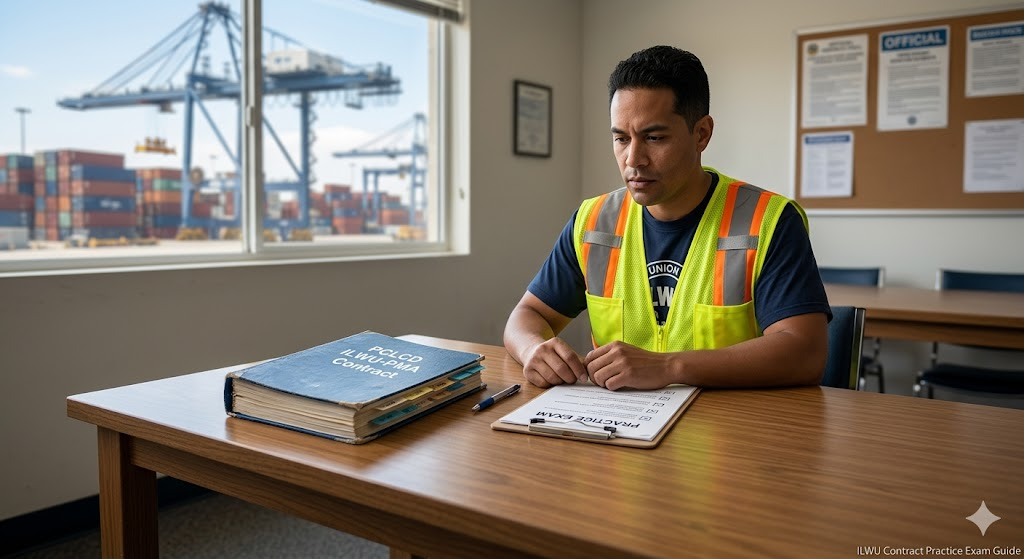
Additional Information
What the Course Entails and Exam Details
To succeed on this exam, you must move beyond general waterfront experience and master the literal text and application of the current Pacific Coast Longshore Contract Document (PCLCD) or the Pacific Coast Clerks’ Contract Document (PCCCD). The specific topics covered depend on the position you are testing for, but the core focus areas remain consistent.
The syllabus primarily entails an intensive focus on work jurisdiction, ensuring candidates understand exactly which tasks belong to specific classifications. It covers the intricacies of the dispatch hall, including daily dispatch procedures, ordering times, and dispatch priority systems. A significant portion of the material tests your knowledge of the Pacific Coast Marine Safety Code (PCMSC), which is paramount on the docks. Furthermore, students must master contractual work rules, such as shift hours, overtime rules, penalty cargo, and guaranteed pay. Lastly, candidates are tested on the established procedures for grievance handling and arbitration, ensuring they understand how contract disputes are officially resolved.
What to Expect in the Final Exam
You should not approach this test expecting easy answers. It is a rigorous assessment of contractual literacy. The final exam format generally consists of multiple-choice and scenario-based questions that test not only your rote memory of the agreement but your ability to apply those rules to real-world waterfront situations.
Candidates should expect a high-stakes, timed exam environment. It is typically a closed-book test. The required passing score is very demanding, reflecting the importance of precise contract knowledge in a safety-sensitive environment; students are often required to achieve a score of 80% or higher to be considered successful. There are no partial marks for missing safety protocols. You must manage your time efficiently, as you will need to read, analyze the context of a scenario, and provide the correct contractual answer within strict time limits.
How to Study and Exam Centers
Effective preparation for this exam requires disciplined immersion in the primary source documents. Do not rely solely on waterfront hearsay; you must study the actual contract language. Your first and most important strategy is to obtain the current copy of the ILWU-PMA contract booklet relevant to your goal (the PCLCD or the PCCCD).
Create highlighted sections focusing on dispatch hours, seniority rules, and work rules. Utilize flashcards to memorize key contractual definitions, ordering times, and safety rules from the PCMSC. Review any scenario-based study guides provided by your specific ILWU Local or promotional committees, as these practice problems are often structured similarly to the actual exam. When studying scenarios, identify the classification of the worker, the time of the shift, and the specific operation (e.g., ship, yard, or gate) to apply the correct rule.
Regarding testing locations, these are not typical computerized exams taken at general Pearson VUE centers. The exams are administered at specific, designated locations, typically managed by the joint ILWU-PMA training or promotional committees. You will take the test in person at designated ILWU Dispatch Halls, joint union-employer training facilities, or PMA administration offices. You will be officially notified by the appropriate union or committee representatives regarding your specific testing center, time, and required identification upon verification of your eligibility to sit for the exam.
Job Opportunities from the Course
Passing this rigorous contract assessment and moving up the hierarchy unlocks significant, stable, and highly sought-after career paths. It marks your transition from entry-level work to a recognized, contracted union professional.
Here is a list of specific job titles and career paths this achievement unlocks:
Registered A-Man Longshore Worker
Registered B-Man Longshore Worker
Registered Marine Clerk
Key Clerk (Vessel and Yard operations)
Supercargo / Ship Planner (often a clerk classification)
Walking Boss / Dock Foreman
Dispatch Hall Dispatcher
Heavy Equipment Operator (Top Pick, Gantry Crane)
Frequently Asked Questions
Reviews
5.0
Based on 0 reviews
Leave a Review
No reviews yet. Be the first to review!