
Image Acquisition and Technical Evaluation Practice Test
$69.00
- Buy to unlock unlimited access to all Quiz questions and Answers in this Quiz.
- After purchase you can print a PDF of the whole quiz at any point. The PDF will contain the questions and the correct answers.
About this Exam
Ready to master the technical side of creating and assessing digital images?
This practice test is expertly crafted for aspiring and current radiologic technologists, medical imaging specialists, and related professionals.
It prepares you for critical examinations focusing on accurate image capture and rigorous technical evaluation, essential for precise diagnoses and high-quality patient care.
Whether you are a student in an imaging program or a seasoned professional seeking to refine your skills or certify, this resource will sharpen your skills and build your confidence.
Ready to test your knowledge?
Buy Now to Access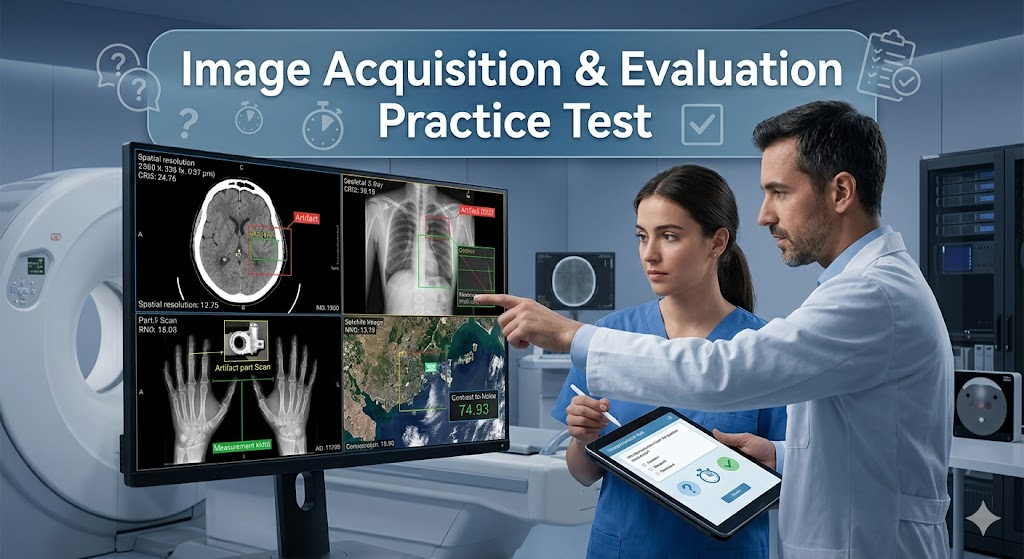
Additional Information
What the Course Entails and Exam Details
The foundational knowledge for this assessment covers the entire spectrum of digital imaging across various modalities.
Expect topics such as digital image formation principles, receptor exposure factors (like kVp, mA, and time), and image processing techniques.
Crucially, you will delve into technical assessment criteria: understanding spatial resolution, contrast-to-noise ratio, artifact recognition, and implementing quality assurance protocols.
This is not just theoretical; it’s about applying technical parameters to optimize image quality and ensure safety and compliance.
What to Expect in the Final Exam
The actual final examination, which this comprehensive practice test mirrors, will test both your recall and practical application.
Anticipate a set of multiple-choice questions designed to rigorously test your understanding of core concepts.
Some questions may involve evaluating actual images for quality, positioning, or identifying specific technical faults or artifacts.
There will be a set time limit (e.g., 60-90 minutes) and a required minimum passing score (often 75% or higher), so both speed and accuracy are key to success.
How to Study and Exam Centers
To succeed, integrate active learning into your study routine and utilize a variety of resources.
Repeated practice with this test is paramount, ensuring you thoroughly review and understand all explanations and rationales provided.
Complement this with focused study of textbooks and course materials on digital imaging physics and quality control, ensuring a deep conceptual grasp.
Forming study groups and practicing image analysis with diverse datasets will further hone your evaluation skills.
Actual examinations are generally administered through authorized testing centers (e.g., Pearson VUE), specific educational institutions, or securely proctored online platforms for certain micro-credentials and advanced certifications.
Always consult the specific official website for your exam body, school, or organization to confirm testing locations, requirements, and scheduling procedures.
Job Opportunities from the Course
Mastering these critical skills significantly enhances your career prospects and unlocks diverse pathways within and beyond medical imaging.
Here are key roles where expertise in image acquisition and evaluation is highly valued:
Radiologic Technologist (encompassing all modalities: X-ray, CT, MRI, Ultrasound, etc.)
Digital Imaging Specialist
Quality Assurance (QA) Radiographer
Medical Imaging Educator
Clinical Applications Specialist (working for imaging equipment manufacturers)
Imaging Informatics Analyst / PACS Administrator (with additional training/experience)
Non-Destructive Testing (NDT) Technician (utilizing industrial imaging)
Digital Imaging Quality Control Inspector (in manufacturing or industrial sectors)
Frequently Asked Questions
Reviews
5.0
Based on 0 reviews
Leave a Review
No reviews yet. Be the first to review!