
IMC Taxation Practice Test
$69.00
- Buy to unlock unlimited access to all Quiz questions and Answers in this Quiz.
- After purchase you can print a PDF of the whole quiz at any point. The PDF will contain the questions and the correct answers.
About this Exam
The Investment Management Certificate (IMC) is a prestigious entry-level qualification within the UK investment profession, administered by CFA Society UK. For aspiring investment managers, research analysts, wealth managers, and anyone seeking a solid foundation in the investment industry, achieving the IMC is often a critical first step. It is recognized by the Financial Conduct Authority (FCA) as an appropriate qualification for specific regulated activities. The qualification is split into two mandatory units: Unit 1 (The Investment Environment) and Unit 2 (Investment Practice). Crucially, a significant portion of Unit 1 is dedicated to the complex and vital area of Taxation in the UK. This comprehensive article and the accompanying practice exam resources are designed to help you prepare effectively for the taxation questions and broader content you will encounter in your IMC Unit 1 exam. Achieving success requires a combination of strong theoretical understanding and extensive, varied practice.
Ready to test your knowledge?
Buy Now to Access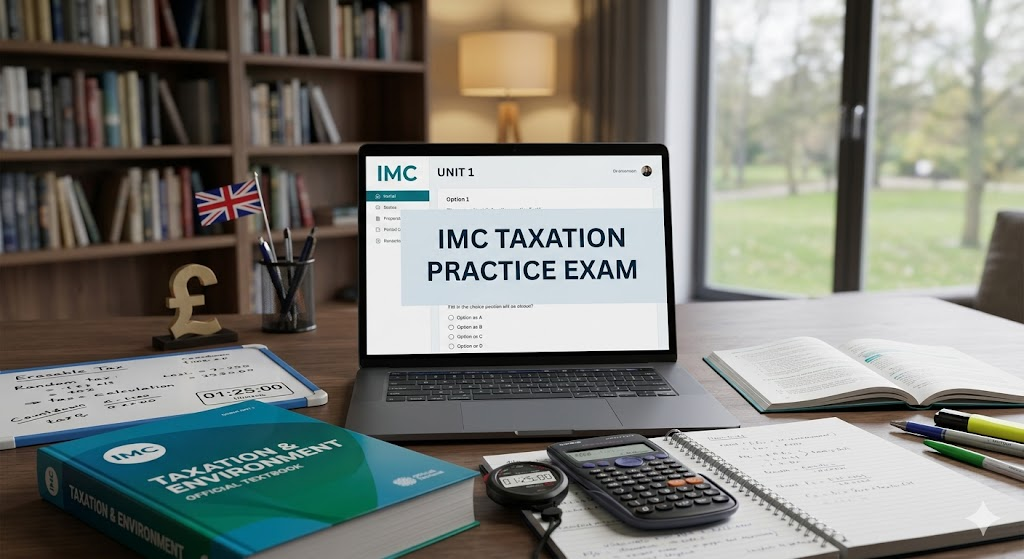
Additional Information
What the Course Entails and Exam Details
To prepare for the taxation component of the IMC Unit 1, candidates must delve into the specifics of the UK tax system, understanding its application, rules, and various calculations. The overall Unit 1 course covers topics such as financial markets, regulation, ethics, legal concepts, and client advice, within which taxation knowledge is integrated. The taxation syllabus typically covers:
The structure of the UK tax system.
Detailed rules, allowances, and calculations for individual taxes:
Income Tax.
National Insurance.
Capital Gains Tax.
Inheritance Tax.
Taxation concepts applicable to businesses:
Corporation Tax.
VAT.
Stamp Duty / Stamp Duty Land Tax.
Tax-efficient investments and reliefs.
Ethical and regulatory requirements concerning taxation advice.
Candidates need to demonstrate not only a knowledge of these rules but also the ability to apply them correctly to various financial scenarios and perform precise calculations. This level of detail requires diligent study and a systematic review of the official CFA UK training manuals and other comprehensive study guides. The final Unit 1 exam is a significant component of the overall IMC qualification process.
What to Expect in the Final Exam
The actual IMC Unit 1 exam is administered as a computer-based test (CBT). It typically consists of approximately 85 multiple-choice, item set, and gap-fill questions, all to be completed within a strict time limit (usually 1 hour and 40 minutes). While taxation is only one topic within the exam, its significant weighting (often 12-24% of the questions, based on past syllabus guides) means you will face a good number of taxation-specific questions. These could range from conceptual multiple-choice questions to detailed, scenario-based calculations where you may need to apply multiple tax rules to a single case or enter specific values in gap-fill formats. There is no specific 'hurdle' pass mark for individual topics; you must achieve an overall pass score, typically between 65% and 75?pending on the exam version, regardless of which sections your correct answers came from. Strict exam conditions apply. Candidates are typically provided with/allowed to use a standard Casio fx-83GT PLUS calculator (or similar specified model), an erasable board, and a pen for rough work. Official resources do not provide formulas in the exam, so memorizing key tax rules, allowances, and formulas is essential.
How to Study and Exam Centers
Effective preparation for the taxation questions and the overall IMC Unit 1 exam hinges on a well-structured study plan and the use of the right resources.
Official Manual: Study the primary CFA UK Official Training Manual for Unit 1. It details the precise syllabus and provides the definitive content and examples on which the exam questions are based. Treat this as your core text.
Structured Study: Use comprehensive study guides and online courses from recognized providers. These often break down the material into manageable sections and provide additional explanations, practice questions, and mock exams that are invaluable for understanding how topics are tested. Ensure you thoroughly cover all the listed taxation topics and practice calculations.
Active Learning: Create flashcards for key tax rules, allowances, rates (e.g., current tax year thresholds), and calculation steps. Regularly test your active recall.
Practice is Key: Utilize the phrase "IMC Taxation Practice Exam" actively. This doesn't just mean one single test, but a continuous process. Look for varied resources:
CFA UK Mock Exams: The official mock exams are the most realistic representation of the actual exam and should be used multiple times in simulated exam conditions.
Study Provider Practice Tests: Leverage the large question banks and full mock exams provided by third-party trainers. They often offer topic-specific quizzes (like taxation) to help you zero in on weak areas.
Self-Test Regularly: At the end of each study session or chapter, take a quick self-test using textbook questions or online tools. Review incorrect answers thoroughly.
Simulate Exam Conditions: For your practice exams, find a quiet space, set a timer for the required time (1 hour 40 minutes), use only the allowed materials (standard calculator, scratchpad), and attempt the entire Unit 1, paying close attention to your time management on taxation and all other questions.
Time Management: Given the variety and potential depth of the questions, efficient time allocation is crucial. Practice moving past particularly tricky questions to ensure you can address every single one in the given time frame.
Registration and Centers: The IMC exams are administered by CFA Society UK via Pearson VUE, which offers both physical testing centers throughout the UK and internationally, as well as a remote proctoring option (OnVUE). You will need to register directly with CFA Society UK. Once registered, you can schedule your Unit 1 and Unit 2 exams for available dates at your preferred location. Plan your study time to culminate in being fully prepared for your chosen test date.
Job Opportunities from the Course
Successfully achieving the Investment Management Certificate (IMC) is a significant milestone that significantly enhances your employability and unlocks various professional career paths within the UK investment and wider financial services industry. The knowledge of UK taxation, particularly within Unit 1, is a valuable asset in many of these roles. Common and rewarding career opportunities that the IMC helps access include:
Investment Manager
Portfolio Manager
Research Analyst (Equity, Fixed Income, Multi-Asset)
Wealth Manager / Private Client Advisor
Investment Analyst
Risk Manager
Relationship Manager (Financial Services / Institutional Clients)
Front Office and Back Office Investment Roles
Financial Planner (often requiring further specialized certifications, but benefitting from IMC knowledge)
Compliance Officer (benefitting from understanding regulatory requirements and legal concepts)
Roles requiring FCA regulated activity knowledge (specifically relevant for those performing activities 10 and 14)
With dedication, thorough study, and extensive, relevant practice, the IMC is an achievable and highly beneficial qualification that can propel your career forward in the dynamic world of investment management.
Frequently Asked Questions
Reviews
5.0
Based on 0 reviews
Leave a Review
No reviews yet. Be the first to review!