
Immediate Life Support Course Practice Test
$69.00
- Buy to unlock unlimited access to all Quiz questions and Answers in this Quiz.
- After purchase you can print a PDF of the whole quiz at any point. The PDF will contain the questions and the correct answers.
About this Exam
The Immediate Life Support (ILS) course is a key qualification designed for healthcare professionals who may need to manage patients in the initial stages of a cardiac arrest or other critical deterioration. It acts as a crucial bridge between Basic Life Support (BLS) and Advanced Life Support (ALS). The course equips you with the knowledge and skills to recognize the deteriorating patient, start resuscitation, and deliver safe defibrillation before the arrival of a specialized cardiac arrest team. It is ideal for a wide range of multidisciplinary personnel, including nurses, doctors, medical students, dentists, midwives, paramedics, and allied health professionals. This training ensures that you can provide high-quality care that significantly improves patient outcomes in emergencies.
Ready to test your knowledge?
Buy Now to Access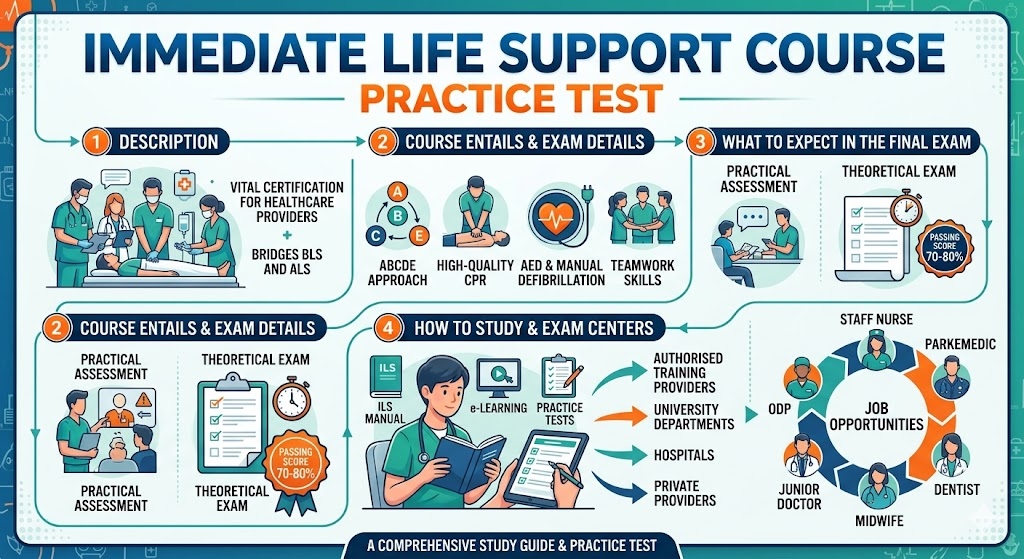
Additional Information
What the Course Entails and Exam Details
The ILS course is usually a one-day, highly interactive, and multidisciplinary program. It balances theoretical knowledge with hands-on practical skills training. While the specific syllabus may vary slightly by country and provider, it almost always follows the standardized guidelines of major resuscitation councils. The core topics covered during the day include:
The standard, systematic ABCDE (Airway, Breathing, Circulation, Disability, Exposure) approach to assessing a deteriorating patient.
Recognition and early management of the critically ill patient to prevent cardiac arrest.
Techniques for delivering high-quality chest compressions and effective ventilations (CPR).
Safe and prompt use of an Automated External Defibrillator (AED) and a manual defibrillator.
Basic airway management techniques, including the use of adjuncts like oropharyngeal and nasopharyngeal airways.
Teamwork skills, focusing on leadership, communication, and dynamics within a resuscitation team.
Understanding the role and responsibilities of the first responder before a resuscitation team arrives.
The course utilizes a combination of lectures, skill stations, and immersive, simulated cardiac arrest scenarios to ensure you are well-prepared for real-world situations.
What to Expect in the Final Exam
The assessment for the ILS course is typically divided into two core components: a practical assessment and a theoretical examination. You must successfully complete both parts to obtain your certification.
Practical Assessment: This takes place continuously throughout the day. Your instructors will observe and evaluate your performance during skill stations and scenario-based simulations. You will be expected to demonstrate proficiency in key areas such as high-quality CPR, safe defibrillation, and applying the ABCDE approach. It is not a single high-pressure "test" at the end, but rather an ongoing evaluation of your competence and engagement.
Theoretical Examination: To assess your understanding of the essential ILS concepts, you will sit for a mandatory multiple-choice question (MCQ) exam, often taken towards the end of the course.
Format: Multiple-choice questions, with one correct answer from a list of options.
Number of Questions: This can vary, but it's typically between 12 and 30 questions.
Time Limit: You will be given a specific time frame, often around 30 to 60 minutes, which is ample for the number of questions.
Passing Score: The required passing score for the MCQ exam is usually set around 70-80%.
You will be informed of your results on the same day as the course. If you do not succeed on your first attempt, most training centers offer an opportunity to retake the MCQ exam, sometimes even on the same day after a brief review period.
How to Study and Exam Centers
Preparation is paramount to success in your ILS course. Effective study strategies will not only help you pass the test but also ensure you can apply your skills confidently in a real emergency.
Pre-course Manual: The most important study resource is the official ILS manual provided by your training center. You should read it thoroughly multiple times before attending the course. Make notes on key algorithms, such as the Universal Resuscitation Algorithm, and memorize drug dosages if applicable.
e-Learning Modules: Many providers now include a mandatory online e-learning component that must be completed before the face-to-face day. Engage with these modules carefully, as they often contain interactive exercises that reinforce crucial learning points.
Practice Tests: Utilizing practice tests, like the one provided in this guide, is an excellent way to assess your knowledge, identify areas that need more attention, and become familiar with the style of questions you will encounter.
Focus on Algorithms: Understand and memorize the core algorithms for managing a cardiac arrest. Visualize each step of the ABCDE approach.
On the Day: The ILS course is interactive. Do not hesitate to ask questions, engage in discussions, and maximize your practical practice time during skill stations. Your instructors are there to help you succeed.
Exam Centers and Booking: The ILS course must be taken through an authorized training provider. You will not book a test at a center like Pearson VUE for this qualification. Instead, you can find and book courses through various organizations, including:
Major resuscitation councils in your country (e.g., Resuscitation Council UK, Australian Resuscitation Council).
University clinical skills departments and hospital training centers.
Private healthcare training providers.
Specialized training centers for specific professions, such as dental schools or ambulance services.
Ensure the course you choose is accredited and widely recognized by employers in your region and field of practice.
Job Opportunities from the Course
Obtaining an Immediate Life Support certification is not just a requirement for many healthcare roles; it is a critical skill that opens doors and enhances your employability. Here are some of the career paths and job opportunities that explicitly require or highly value this qualification:
Staff Nurse: Required in most hospital wards and clinical areas to act as first responders.
Emergency Department (ED) Nurse: Vital for managing acute medical emergencies and trauma.
Intensive Care Unit (ICU) Nurse: Essential for providing high-level, continuous life support.
Operating Department Practitioner (ODP): Key role in managing emergencies during anesthesia and surgery.
Paramedic: Fundamental for out-of-hospital emergency care.
Midwife: Critical for managing maternal and neonatal life-threatening emergencies.
Dentist and Dental Care Team: Necessary for handling rare but serious medical emergencies in a dental practice.
Junior Doctor / Foundation Doctor: Mandatory training for beginning medical practice.
Physiotherapist (in acute settings): Often required for roles involving acutely unwell patients.
Allied Health Professional (in acute settings): Includes roles in radiography, occupational therapy, and other specialized fields.
Ambulance Technician: Crucial skill for providing pre-hospital care.
Clinical Skills Instructor: A stepping stone to becoming an ILS or ALS instructor.
Good luck with your preparation for the ILS Course Practice Test. This qualification is an investment in your career and, most importantly, in your ability to save a life. You can do this!
Frequently Asked Questions
Reviews
5.0
Based on 0 reviews
Leave a Review
No reviews yet. Be the first to review!