
Immigration and Customs Enforcement (ICE) Competency Practice Exam
$69.00
- Buy to unlock unlimited access to all Quiz questions and Answers in this Quiz.
- After purchase you can print a PDF of the whole quiz at any point. The PDF will contain the questions and the correct answers.
About this Exam
The Immigration and Customs Enforcement (ICE) Competency Exam is a crucial stepping stone for individuals aspiring to build a rewarding career in federal law enforcement.
This rigorous assessment is specifically designed to evaluate the cognitive abilities, reasoning skills, and professional judgment of prospective agents.
It targets candidates applying for highly competitive roles within the agency, such as Enforcement and Removal Operations (ERO) or Homeland Security Investigations (HSI).
Passing this exam proves to the hiring board that you have the foundational analytical and problem-solving skills required to navigate complex federal laws.
Ready to test your knowledge?
Buy Now to Access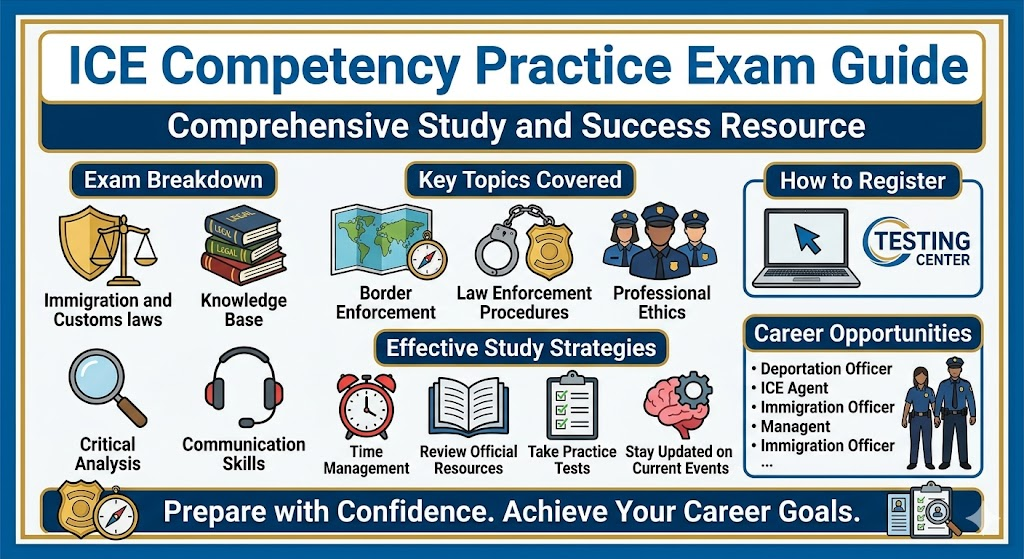
Additional Information
What the Course Entails and Exam Details
Preparing for the ICE Competency Exam requires a deep dive into several core cognitive areas rather than simply memorizing historical facts.
The syllabus primarily focuses on arithmetic reasoning, logical reasoning, and written communication skills.
You will encounter various scenarios that test your ability to read complex federal policies, analyze data, and draw accurate, logical conclusions.
Additionally, the exam covers situational judgment assessments to evaluate your interpersonal skills, integrity, and decision-making capabilities under pressure.
Mastering these core topics ensures you are equipped with the critical thinking framework necessary for daily law enforcement operations and investigations.
What to Expect in the Final Exam
The final evaluation is typically administered as a secure, computerized, multiple-choice test.
Candidates are usually given a strict time limit of around three to four hours to complete all sections of the exam, making time management an absolute necessity.
You must work swiftly but carefully, as the logical reasoning and reading comprehension passages can be quite dense and intentionally challenging.
While exact scoring metrics can vary by specific job announcements, candidates generally need to achieve a passing score of at least 70% to advance to the interview and background check phases.
Strict testing rules always apply, meaning no outside electronics, study materials, or unapproved calculators are permitted inside the testing room.
How to Study and Exam Centers
To succeed on test day, you should build a structured study schedule that incorporates daily practice of logical reasoning and arithmetic problems.
Utilize official federal study guides and take timed practice exams to build your stamina and familiarize yourself with the precise question formats.
Focus heavily on improving your reading speed and comprehension, as this will help you navigate the situational judgment questions effectively without second-guessing yourself.
The exam is typically scheduled through the USAJOBS portal once your initial application is reviewed and accepted by federal human resources.
Testing is generally conducted in-person at authorized Pearson VUE centers, OPM (Office of Personnel Management) testing facilities, or specific regional federal hiring hubs.
Job Opportunities from the Course
Successfully passing this competency exam unlocks a variety of rewarding and high-paying federal career paths.
One prominent role is a Deportation Officer, where you will manage and execute the processing and removal of individuals who violate immigration laws.
You can also pursue a career as a Criminal Investigator within Homeland Security Investigations (HSI), tackling transnational crime, cyber threats, and smuggling rings.
Another excellent opportunity is becoming an Intelligence Research Specialist, tasked with analyzing complex data to support active field operations.
Finally, passing this credential can also make you a highly competitive candidate for broader federal roles, such as a Customs and Border Protection (CBP) Officer or a Federal Air Marshal.
Frequently Asked Questions
Reviews
5.0
Based on 0 reviews
Leave a Review
No reviews yet. Be the first to review!