
IMSA Signal Technician Level 1 Practice Exam
$69.00
- Buy to unlock unlimited access to all Quiz questions and Answers in this Quiz.
- After purchase you can print a PDF of the whole quiz at any point. The PDF will contain the questions and the correct answers.
About this Exam
The IMSA (International Municipal Signal Association) Traffic Signal Technician Level 1 certification is a foundational program designed for entry-level professionals in the traffic control industry. This certification is the first step on a critical career path, ensuring that technicians possess a standardized, fundamental understanding of signalized traffic control devices and systems.
It is specifically tailored for individuals who work with traffic signal construction, maintenance, and operation. While a primary audience, this certification is also beneficial for traffic engineers, planners, and anyone who needs a solid understanding of basic traffic signal functionality. The primary prerequisite for this certification is typically one year of experience in the traffic field and a valid IMSA Work Zone Temporary Traffic Control Technician or equivalent safety certification.
Ready to test your knowledge?
Buy Now to Access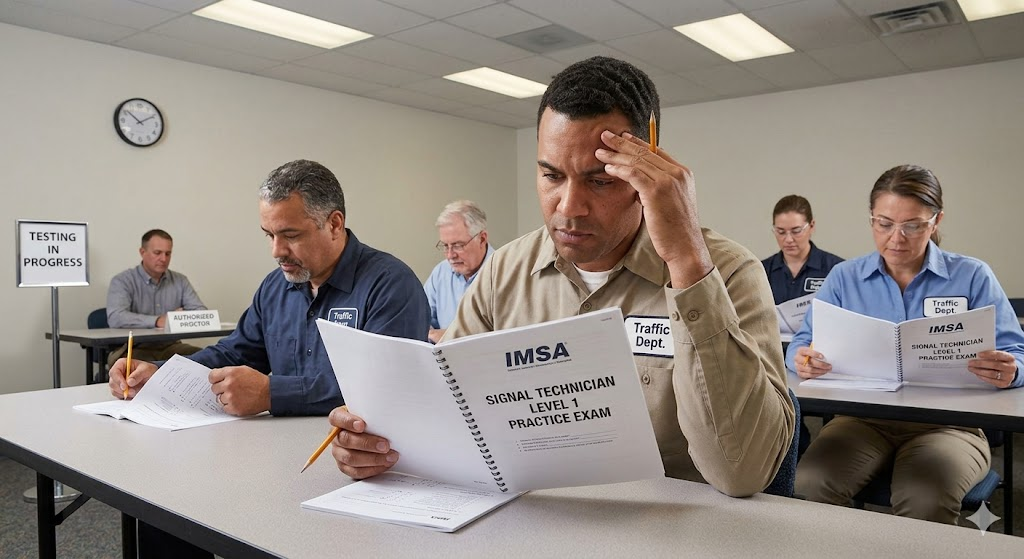
Additional Information
What the Course Entails and Exam Details
The course of study for the IMSA Traffic Signal Technician Level 1 certification is comprehensive, covering the core knowledge required for an entry-level technician to operate safely and effectively on a traffic signal crew. While some sections may be covered by previous safety certifications, the Level 1 curriculum deepens the understanding of:
Safety and Regulations: Rigorous instruction on worksite safety, personal protective equipment (PPE), work zone traffic control, and an introduction to relevant regulatory standards such as OSHA (Occupational Safety and Health Administration) and the NEC (National Electrical Code).
Traffic Signal Fundamentals: An introduction to the purpose, history, and operation of traffic signals, including detailed coverage of the Manual on Uniform Traffic Control Devices (MUTCD) Part 4, which defines all legal standards for traffic signal display, signing, and indications.
Electrical Theory: Critical foundation in basic electrical concepts, including understanding voltage, current, resistance, power, and the application of Ohm's Law. This knowledge is essential for basic circuit troubleshooting and understanding component specifications.
Traffic Signal Components and Cabinetry: In-depth examination of the hardware that makes a signalized intersection work. This includes understanding the components within the controller cabinet (e.g., NEMA, 170/2070 controllers, load switches/switch packs), signal heads, pedestrian signals, and various forms of detection (e.g., inductive loop detectors, pedestrian push buttons).
Installation and Maintenance: Instruction on proper construction and installation methods, including understanding utilities (underground and overhead), signal supports, wiring, and grounding. It also covers preventative maintenance procedures and basic troubleshooting concepts.
The formal exam that occurs at the end of the certification course is the final step to earning your designation.
What to Expect in the Final Exam
The final IMSA Signal Technician Level 1 exam is designed to objectively measure your proficiency in the core subject areas covered by the course manual. Knowing the format can alleviate anxiety and focus your preparation.
Exam Format: The formal certification exam is a multiple-choice test. It is typically structured to cover the distinct domains of knowledge taught, such as fundamental electrical concepts, component identification and operation, and safety/regulatory standards.
Passing Score Requirements: To earn the Level 1 certification, candidates must achieve a passing score, which is generally in the 70% to 80% range, though the exact official threshold should be confirmed with your training provider.
Time Limits and Special Rules: The exam is timed and must be completed in one sitting, often lasting several hours. It is a closed-book examination, meaning you are not permitted to use any personal study materials or resource manuals, such as the MUTCD, during the test.
Specific Content Areas: Expect detailed questions that require you to apply electrical formulas, identify MUTCD standards for signal display, understand the purpose and wiring of specific cabinet components, solve safety-related problems, and understand the basic operating principles of detection systems.
How to Study and Exam Centers
Preparation is the key to success on any standardized exam. Here are actionable strategies to prepare for your Level 1 test:
How to Study
Master the Course Manual: The official IMSA course manual is your most important resource. Read it thoroughly, highlight key terms, and understand all diagrams, formulas, and bullet points. Test questions are directly derived from this material.
Practice Electrical Problems: Do not simply memorize formulas. Practice using Ohm’s Law and power calculations until they are second nature. Understand how to solve for unknown voltage, current, or resistance in a basic circuit.
Review MUTCD Standards: Get intimately familiar with MUTCD Part 4. Be able to identify standard signal indications, the purpose of specific pedestrian clearance intervals, and the correct placement of signal indications relative to lanes.
Visualize Component Operation: For equipment like loop detectors or controller logic, don't just memorize definitions. Understand how they work. For instance, what does a loop detector change when a car arrives, and what does that signal to the controller?
Use Practice Exams: While not a substitute for study, utilizing an IMSA Signal Technician Level 1 Practice Exam can help you identify weak areas, understand the question structure, and build pacing skills for the timed final test.
Exam Centers
The Level 1 exam is almost exclusively administered as the conclusion to an approved in-person or live-online certification course. These courses are offered throughout the year by various IMSA-authorized entities, which can include:
IMSA Local Sections: Check the IMSA International website to find your local section’s training schedule.
Kentucky Technology Transfer Program (KYTC T2).
Authorized Private Training Academies (e.g., Sunshine Safety Council, Phase Academy).
Upon successful registration for and completion of the official course, the proctored, final exam is included as the mandatory last step. You will generally take the test in a formal, supervised setting or an authorized, secure online platform.
Job Opportunities from the Course
Earning your IMSA Signal Technician Level 1 certification is a significant milestone that validates your competence to employers and opens doors to key positions. The specific job titles this certification unlocks or enhances include:
Traffic Electronics Technician I / Trainee
Traffic Signal Technician / Trainee
Traffic Signal Field Inspector I
Traffic Construction Laborer/Technician (on signal specialized crews)
Work Zone Temporary Traffic Control Technician (often a complementary or simultaneous role)
This certification is more than a one-time achievement; it is a foundational requirement. With this level, you gain the qualifications and experience necessary to pursue higher levels of certification (Level II Bench, Level II Field, Level III), which are typically required for lead technician, supervisor, and managerial roles within the traffic control industry. These higher levels often come with significantly increased salary, leadership responsibilities, and influence over municipal traffic operations.
Frequently Asked Questions
Reviews
5.0
Based on 0 reviews
Leave a Review
No reviews yet. Be the first to review!