
Incident Commander Practice Exam
$69.00
- Buy to unlock unlimited access to all Quiz questions and Answers in this Quiz.
- After purchase you can print a PDF of the whole quiz at any point. The PDF will contain the questions and the correct answers.
About this Exam
The Incident Commander (IC) is the cornerstone of any effective emergency response operation. This certification validates that an individual possesses the critical decision-making skills, leadership abilities, and deep understanding of the Incident Command System (ICS) required to manage incidents of all types and complexities. From small-scale local emergencies to large-scale, multi-agency disasters, the Incident Commander is responsible for all aspects of the response, including developing objectives, ordering resources, and having overall responsibility for the safety and management of all personnel.
This exam is designed for public safety professionals—including firefighters, law enforcement officers, EMS personnel, emergency management directors, and private sector resilience managers—who are either currently serving as or aspiring to become Incident Commanders. It signifies a master-level competency in the National Incident Management System (NIMS) and the specific tactical applications of ICS.
Ready to test your knowledge?
Buy Now to Access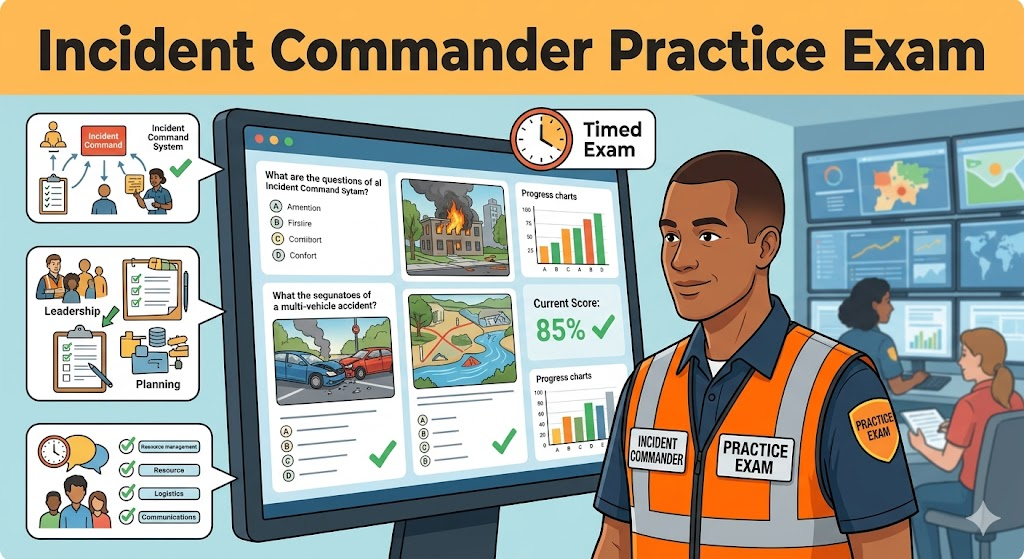
Additional Information
What the Course Entails and Exam Details
The path to Incident Commander certification generally involves extensive coursework, typically building upon FEMA's NIMS/ICS core curriculum (like ICS-100, IS-200, ICS-300, and ICS-400). The specific Incident Commander training (often titled 'ICS-400: Advanced ICS' or a dedicated 'Incident Commander' course) delves deep into:
Command and General Staff Functions: Mastering the complex roles of the Command Staff (Safety Officer, Liaison Officer, Public Information Officer) and General Staff (Operations, Planning, Logistics, Finance/Administration).
Multi-Agency Coordination (MAC): Developing the communication pathways, agreements, and operational frameworks to manage complex incidents involving hundreds of different agencies and jurisdictions.
Unified Command: Understanding when and how to implement a Unified Command structure to ensure a cohesive response among agencies with different geographical or functional responsibilities.
Advanced Incident Planning: Formulating and approving complex Incident Action Plans (IAPs) that account for resource management, safety analysis, and tactical objectives.
Strategic Resource Management: Techniques for ordering, tracking, assigning, and demobilizing resources efficiently across a large-scale event.
Risk Management and Safety: Principles of dynamic risk assessment and a comprehensive, zero-compromise approach to responder and public safety.
What to Expect in the Final Exam
While the specific formatting can vary by the certifying body (e.g., a state's emergency management agency or a specialized professional association), the final Incident Commander exam is rigorous and comprehensive.
Exam Format: You should prepare for a hybrid exam. The core component is typically a comprehensive multiple-choice examination. However, many master-level certifications also require a practical component. This may involve a complex, real-time table-top exercise or a dynamic computer simulation where candidates are forced to make decisions and issue commands based on a rapidly evolving disaster scenario.
Core Knowledge Areas: The multiple-choice portion focuses on advanced NIMS/ICS theory, agency policies, resource categories, and regulatory compliance.
Practical Application: The scenario-based part tests your ability to apply knowledge under pressure, communicate effectively, and manage the complexity of an escalating incident.
Time Limits: You are typically allocated several hours (e.g., 3–4 hours) for the comprehensive multiple-choice segment. Practical scenarios may take another half-day to a full day to complete.
Passing Score: Most professional command-level certifications require a high degree of mastery, often setting the minimum passing score between 70% and 80%.
How to Study and Exam Centers
Given the command-level scope of the material, passive reading will not suffice. Successful study strategies require active engagement and practical application.
Official FEMA/EMI Training: The absolute foundation for your study is the core NIMS/ICS curriculum, particularly ICS-300: Intermediate ICS and ICS-400: Advanced ICS. All study materials should be referenced against the official FEMA training materials.
Utilize Practice Exams: Seek out high-quality "Incident Commander Practice Exams" and simulations. These resources are critical for identifying knowledge gaps and becoming accustomed to the complexity of scenario-based questions.
Participate in Exercises: Do not just read about Incident Command; practice it. Maximize your participation in functional and full-scale exercises at your department or within your regional All-Hazards Incident Management Team (AHIMT).
Study Guides and Flashcards: Supplement official materials with comprehensive study guides. Create flashcards for critical concepts like "NIMS management characteristics," "Unified Command," and the specific "14 features of ICS."
Exam Centers and Registration:
The final exam is usually administered in one of two ways:
Authorized Training Facilities: You will often take the final written or simulation exam at the completion of a multi-day, residency-style course hosted by a state or regional fire academy, an emergency management training center, or an authorized academic institution (e.g., Texas A&M Engineering Extension Service (TEEX)).
Specialized Testing Portals: Some certifying bodies for private-sector command roles may use online, proctored testing services. You must verify the specific proctoring requirement with your certifying organization.
Job Opportunities from the Course
A certification as an Incident Commander is a significant professional milestone, demonstrating advanced leadership and management capability. It unlocks numerous opportunities across multiple sectors:
Incident Commander (Local, State, or Federal Response)
Emergency Management Director
Battalion Chief (Fire Service)
Division Commander or Captain (Law Enforcement)
EMS Chief/Director
Corporate Emergency Response Team (CERT) Lead
Corporate Resilience and Continuity Manager
Safety Director
Risk Management Consultant
Hospital Emergency Preparedness Coordinator
Frequently Asked Questions
Reviews
5.0
Based on 0 reviews
Leave a Review
No reviews yet. Be the first to review!