
Indiana Appraiser License Practice Exam
$69.00
- Buy to unlock unlimited access to all Quiz questions and Answers in this Quiz.
- After purchase you can print a PDF of the whole quiz at any point. The PDF will contain the questions and the correct answers.
About this Exam
The Indiana Appraiser License exam is the primary gateway for professionals seeking to launch or advance a career in real estate valuation within the state. This licensing process, and the associated final examination, are meticulously designed for individuals who desire to become a state-licensed or certified appraiser. It is ideal for Trainee Appraisers who have completed their initial experience and education hours, as well as existing appraisers from other jurisdictions who need to qualify to practice in Indiana. Becoming a licensed appraiser in Indiana places you in a critical role, as you are responsible for providing impartial and credible opinions of property value, essential for real estate transactions, mortgage lending, and taxation. The certification you obtain validates your expert understanding of the Hoosier State's real estate market and its regulatory landscape.
Ready to test your knowledge?
Buy Now to Access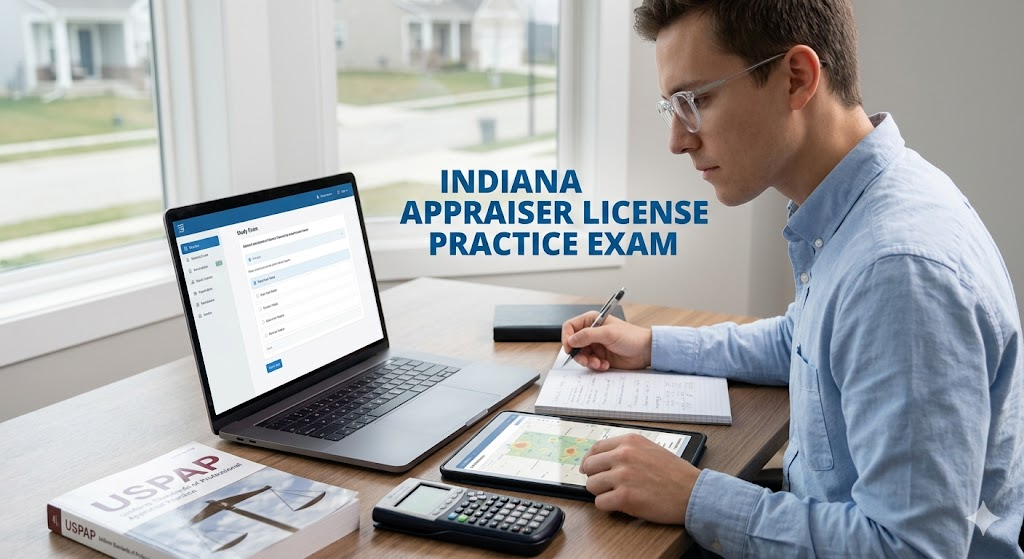
Additional Information
What the Course Entails and Exam Details
Before qualifying to take the final licensing exam, candidates must complete a rigorous regimen of state-approved qualifying education. The amount and specific curriculum depend on the level of license desired—Licensed Residential, Certified Residential, or Certified General—ranging from approximately 75 to 300 total hours of instruction. These courses are not just prerequisites; they form the bedrock of knowledge required to pass the exam.
The core topics and curriculum covered by this preparatory pathway are standardized but intensive. You will master the fundamentals of real estate finance and principles. A significant portion of your study will focus on the Appraisal Process, including market analysis, highest and best use analysis, and the three universal approaches to value: the Cost Approach, the Sales Comparison Approach, and the Income Capitalization Approach. Crucially, all appraisers must become deeply proficient in the Uniform Standards of Professional Appraisal Practice (USPAP), which defines ethical and professional guidelines. Furthermore, your education will address specific Indiana real estate license laws and board regulations, ensuring you understand the legal context of your work within the state. The exam will also test your real estate math and site valuation skills.
What to Expect in the Final Exam
When you arrive for your exam, you will be taking a section of the National Uniform Licensing and Certification Exam, which is tailored to the specific license level you are seeking. The examination is administered by a state-authorized testing provider, such as Pearson VUE or PSI, which means you can expect a highly professional, secure environment.
The format is standardized across all levels. It consists of multiple-choice questions designed to assess your competence in applying appraisal principles to practical scenarios. The examination typically has a total of 125 questions. Of these, 110 are scored items, and the remaining 15 are non-scored pre-test questions that may be used for future exam development.
Your time limit and complexity vary by the license type:
Licensed Residential Appraiser: 4 hours to complete.
Certified Residential Appraiser: 4 hours to complete.
Certified General Appraiser: 6 hours to complete, reflecting a broader scope that includes complex commercial properties.
A passing score on the national exam is a scaled score of 75, which represents a standardized passing level rather than a fixed percentage. It is crucial to manage your time effectively, as you must demonstrate both accuracy and speed to successfully navigate the entire test. You will need to show valid government-issued identification to enter the test center.
How to Study and Exam Centers
Passing the Indiana Appraiser License exam requires a strategic combination of knowledge mastery and test-taking practice. Here are actionable study strategies to maximize your chances:
Utilize a Dedicated Practice Exam: This is your single most effective tool. Engage with multiple comprehensive practice exams. This not only reinforces concepts but also familiarizes you with the phrasing, structure, and timing of the official test. A strong "Indiana Appraiser License Practice Exam" will highlight your specific weaknesses for targeted study.
Create a Consistent Study Schedule: Break down the core topics into manageable sections and create a calendar. Daily study is more effective than cramming.
Master USPAP: A substantial portion of the exam is dedicated to USPAP. Dedicate specific time to understanding and memorizing key definitions, rules, and standards of professional conduct. It is a critical, non-negotiable section.
Focus on Math and Case Studies: Appraisal relies heavily on math. Ensure you can confidently perform all required calculations, and practice using the basic, non-programmable calculator permitted during the test. Analyze case studies to see how theoretical principles are applied to real-world scenarios.
Form or Join a Study Group: Collaborating with other aspiring appraisers can expose you to different perspectives, problem-solving techniques, and moral support.
The exam itself is not taken at a course provider's location. You must schedule and take the test at an authorized physical testing center. In Indiana, exams are commonly administered through major third-party testing organizations like Pearson VUE. To schedule, you will first need to receive authorization from the Indiana Real Estate Appraiser Licensure and Certification Board after meeting your qualifying education and experience requirements. Once authorized, you can create an account with the testing administrator, find a convenient location, and select an available time slot. Prepare to register in advance, as popular times can fill quickly.
Job Opportunities from the Course
Upon successfully passing your examination and meeting all experience requirements, your Indiana appraiser license will unlock a variety of lucrative and stable career paths within the real estate industry. Specific job titles and career opportunities that this certification opens include:
Licensed Residential Appraiser
Certified Residential Appraiser
Certified General Appraiser
Fee Appraiser (independent business owner)
Staff Appraiser for a bank or lending institution
Right-of-Way Appraiser for a state or local government agency
Real Estate Valuation Consultant
Property Tax Appeal Specialist
Real Estate Investment Analyst
Asset Manager for a real estate investment trust (REIT)
Foreclosure and REO Appraiser
Becoming an Indiana-licensed appraiser is a highly respected and essential designation that provides both a challenging, diverse workload and a secure professional future.
Frequently Asked Questions
Reviews
5.0
Based on 0 reviews
Leave a Review
No reviews yet. Be the first to review!