
Indiana FFA State Welding CDE Practice Test
$69.00
- Buy to unlock unlimited access to all Quiz questions and Answers in this Quiz.
- After purchase you can print a PDF of the whole quiz at any point. The PDF will contain the questions and the correct answers.
About this Exam
The Indiana FFA State Welding Career Development Event (CDE) is a highly-regarded competition designed for ambitious Indiana FFA members interested in the welding and fabrication industry. It provides a platform for students to showcase their technical knowledge, practical skills, and commitment to safety in an agricultural and industrial welding context. The CDE aims to assess proficiency in various welding and cutting processes, blueprint reading, and general fabrication knowledge. Participants typically compete as part of a team, demonstrating not only individual talent but also effective teamwork and problem-solving abilities. This event is perfect for students looking to jumpstart a career in welding, engineering, or related agricultural trades and to develop valuable industry connections.
Ready to test your knowledge?
Buy Now to Access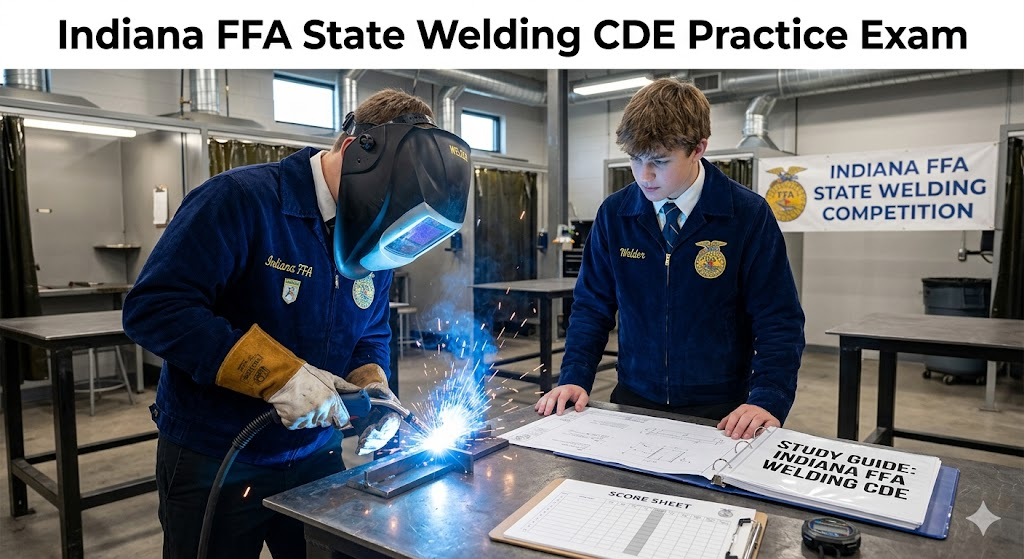
Additional Information
What the Course Entails and Exam Details
Preparing for the Indiana FFA State Welding CDE requires comprehensive knowledge and practical competence in multiple areas. A proper course or study plan for this event should encompass:
Welding Processes: A solid understanding of Shielded Metal Arc Welding (SMAW), Gas Metal Arc Welding (GMAW), and sometimes Flux-Cored Arc Welding (FCAW), and potentially others like Gas Tungsten Arc Welding (GTAW). Candidates must understand the fundamentals, equipment settings, appropriate applications, and common issues of each process.
Cutting Techniques: Proficiency in Oxy-Fuel Cutting and potentially Plasma Arc Cutting, including proper setup, safety procedures, and achieving clean, accurate cuts.
Safety Standards: Paramount importance is placed on comprehensive safety knowledge, including personal protective equipment (PPE), equipment handling, and workplace safety rules.
Blueprint Reading & Measurement: The ability to interpret technical drawings and welding symbols, as well as accurately measuring and laying out projects according to specifications.
Metallurgy & Materials: A basic understanding of metal types, their properties, and how different welding processes affect them.
Fabrication & Problem Solving: Demonstrating logical thinking to plan and execute fabrication tasks efficiently and effectively.
The event structure typically involves both knowledge-based assessments (written test) and performance-based tasks (practical welding and cutting exercises). The specific components can vary slightly but are generally designed to reflect real-world scenarios. The final exam of this context is the actual state-level CDE, which students often prepare for using practice tests, workshops, and extensive shop time. This guide and related practice tests are essential preparation tools for that defining event.
What to Expect in the Final Exam
While "practice" is a key part of the title and preparation, it is crucial to know what the ultimate competition, the Indiana State FFA Welding CDE, entails. Students competing in this event should anticipate:
Written Examination: A comprehensive test covering theoretical knowledge. Expect questions on safety, welding principles, process troubleshooting, blueprint reading, welding symbols, metallurgy, and related mathematical calculations. This could include multiple-choice questions, matching, and short answer formats.
Practical Skills Assessment: This is the heart of the CDE. Students must execute specific welding jobs, typically including one or more common weld joints (e.g., T-joint, butt joint) in various positions (flat, horizontal, vertical) and using designated processes (like SMAW and/or GMAW). A time limit (often strict, such as 60 minutes for specific phases) is usually enforced.
Cutting Performance: Demonstrating clean, accurate cuts using oxy-fuel or plasma cutting equipment, often following specific layout markings.
Safety Adherence: Judges meticulously monitor candidates for strict compliance with safety rules and the proper use of required PPE (including welding helmet, gloves, safety glasses, and suitable clothing/boots). Failing safety checks can result in point deductions or disqualification.
Scoring & Evaluation: Welds and cuts are judged on specific criteria such as penetration, quality, uniformity, conformity to specifications, and visual appearance. Written tests are graded for accuracy. Team scores are typically a combination of the individual scores of all members. Passing or qualifying for advanced levels requires achieving high combined scores, which can vary annually and depending on the division.
Specific Rules: Each CDE has a set of detailed rules, including eligibility (team size, division), required tools (often specific items the team must provide), and permitted techniques/materials. Candidates must review the most recent official rules carefully.
How to Study and Exam Centers
Effective preparation is key to success in the Indiana FFA State Welding CDE.
Study Strategies:
Utilize Practice Tests: Engage with previous years’ written exams and official FFA practice materials (like those this guide supports). Take these under timed conditions to simulate the pressure.
Hands-on Practice: Spend significant time in your school shop, refining your welding and cutting techniques. Practice the specific joints and positions common to the competition and pay close attention to achieving clean, strong welds. Work under supervision and seek regular feedback.
Master Blueprints & Symbols: Dedicated time to learning and practicing interpreting blueprints and understanding all the key welding symbols. Test yourself with sample drawings.
Review Safety Manuals: Memorize all core safety procedures for various equipment and processes. Consider obtaining a relevant certification (like OSHA 10) as a foundation.
Attend Workshops/Mentorship: Seek out specialized workshops offered by your FFA chapter, local trade schools, or industry partners. Find a teacher, mentor, or local professional welder who can provide guidance and constructive criticism.
Simulate Competition: Create timed practice scenarios for both the written test and practical jobs. Ask a teacher to "judge" your practical work according to potential criteria.
Team Practice: If competing in a team event, practice together to develop efficient delegation and communication. Simulate the team dynamics of the competition.
Exam Centers:
CDE Final Events: The actual Indiana FFA State Welding CDE typically takes place at designated physical locations. These are often hosted at specific technical centers, university campuses (such as Purdue University, traditionally linked with State FFA events), or industry facilities in Indiana, usually around the timing of the State FFA Convention or other specific CDE days. Registration and specific details are always handled through a student’s high school FFA advisor. They will receive information on dates, locations, divisions, registration processes, and any district-level qualifiers required to advance to the state competition. Practice tests can be accessed online via resources provided by the Indiana FFA Association or reputable educational platforms.
Job Opportunities from the Course
A strong performance in the Indiana FFA State Welding CDE and the training that leads to it unlocks a variety of rewarding career paths:
Certified Welder: Secure employment across manufacturing, construction, energy, and fabrication sectors, with opportunities for specialized certifications (e.g., ASME, AWS codes).
Fabricator: Design, assemble, and build complex metal structures and components according to engineering blueprints, combining welding, cutting, and layout skills.
Underwater Welder (Advanced): Specialize in a high-demand, specialized field involving repair and construction on marine structures and pipelines.
Welding Inspector: Crucial for quality control and safety, inspect welds on critical infrastructure, pipelines, and equipment to ensure compliance with standards.
Robotic Welding Operator/Programmer: Utilize advanced technology to operate and program robotic welding systems in automated manufacturing environments.
Welding Engineer (Higher Ed Path): Apply engineering principles to design, test, and improve welding processes, materials, and equipment.
Agricultural Mechanic with Welding Expertise: Vital role within the agri-business sector, maintaining and repairing farm equipment and structures.
Entrepreneur/Shop Owner: Utilize your skills and business acumen to establish and manage your own welding and fabrication service.
Frequently Asked Questions
Reviews
5.0
Based on 0 reviews
Leave a Review
No reviews yet. Be the first to review!