
Indiana Fire Fighter Mandatory Practice Test
$69.00
- Buy to unlock unlimited access to all Quiz questions and Answers in this Quiz.
- After purchase you can print a PDF of the whole quiz at any point. The PDF will contain the questions and the correct answers.
About this Exam
The Indiana Fire Fighter Mandatory certification is the foundational stepping stone for anyone looking to begin a rewarding career in the fire service within the state of Indiana.
This vital exam is designed for aspiring volunteer and career firefighters who need to prove their baseline competence in essential firefighting operations.
Passing this exam demonstrates your commitment to public safety and verifies that you have the basic knowledge required to protect lives and property safely.
Whether you are joining a local volunteer department or aiming for a full-time municipal role, mastering this material is your first critical mission.
Ready to test your knowledge?
Buy Now to Access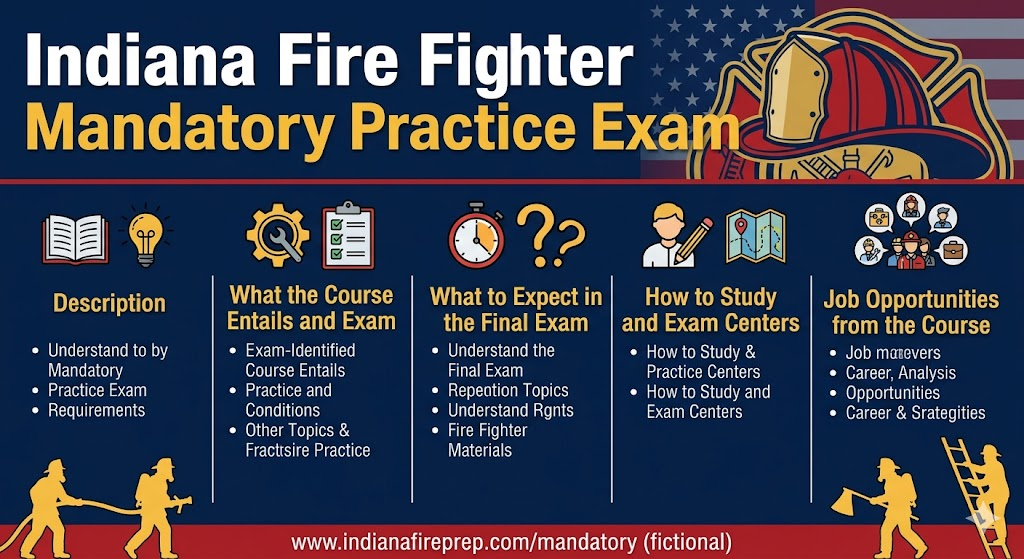
Additional Information
What the Course Entails and Exam Details
The syllabus for the Indiana Fire Fighter Mandatory course is comprehensive and heavily focused on practical, life-saving skills.
Candidates will dive deep into the science of fire behavior, learning exactly how fires start, spread, and can be efficiently extinguished.
You will cover the critical use of Personal Protective Equipment (PPE) and Self-Contained Breathing Apparatus (SCBA) to ensure your ultimate safety in hazardous, smoke-filled environments.
The course also details various building construction types, emphasizing how different structures react and potentially collapse under extreme heat and stress.
Further core topics include mastering ropes and knots, executing structural search and rescue operations, understanding forcible entry techniques, and the proper deployment of ground ladders.
Additionally, candidates will learn the fundamentals of tactical ventilation, municipal and rural water supply operations, and the physical handling of fire hoses and streams.
What to Expect in the Final Exam
When sitting for the final exam, candidates should prepare for a rigorous evaluation of both their theoretical knowledge and practical, hands-on abilities.
The written portion of the exam typically consists of multiple-choice questions designed to test your recall of standard operating procedures, safety protocols, and basic fire science.
You will usually have a strict time limit to complete the written cognitive test, requiring you to pace yourself effectively.
To successfully pass the written portion, candidates are generally required to achieve a minimum passing score of 70%.
In addition to the written test, you must pass a hands-on practical skills evaluation where state evaluators will observe you performing essential physical tasks.
Strict adherence to safety rules is heavily enforced during the practical exam, and missing a critical safety step—such as failing to check your air supply—can result in an automatic failure for that station.
How to Study and Exam Centers
Success on this exam requires a highly strategic blend of textbook review and physical hands-on practice.
Start by thoroughly reading the required state-approved manuals and taking advantage of online practice tests to familiarize yourself with the multiple-choice question format.
Forming a study group with fellow recruits is highly encouraged, as it allows you to drill each other on complex theoretical topics and step-by-step practical procedures.
For the physical component, repetition is your best study tool; practice donning your PPE and SCBA until the motions become pure muscle memory.
The final certification exams are strictly regulated and administered through the Indiana Department of Homeland Security (IDHS).
Testing is typically conducted at authorized physical testing centers, state-approved regional fire academies, or hosted directly at local fire departments under the supervision of certified IDHS proctors.
Job Opportunities from the Course
Earning your Indiana Fire Fighter Mandatory certification opens the door to a variety of exciting, impactful, and fast-paced roles in emergency services.
Here are the specific career paths and job titles this certification can help unlock for you:
Volunteer Firefighter: Serve your local community by responding to structure fires and emergencies on a dedicated, on-call basis.
Career Firefighter: Pursue competitive, full-time employment with municipal, city, or county professional fire departments.
Industrial Firefighter: Work in specialized private sectors, such as manufacturing plants or refineries, protecting specific high-risk commercial facilities.
Emergency Medical Responder: Pair your foundational fire certification with basic medical training to serve as a highly versatile first responder on complex rescue scenes.
Fire Apparatus Operator: Use this certification as a baseline to gain experience, eventually training to drive and operate complex fire engines and aerial ladder trucks.
Fire Inspector: Build upon your baseline knowledge of fire behavior and building construction to transition into fire prevention, inspecting buildings for safety code compliance.
Frequently Asked Questions
Reviews
5.0
Based on 0 reviews
Leave a Review
No reviews yet. Be the first to review!