
Indiana Haz-Mat Operations and Awareness Practice Test
$69.00
- Buy to unlock unlimited access to all Quiz questions and Answers in this Quiz.
- After purchase you can print a PDF of the whole quiz at any point. The PDF will contain the questions and the correct answers.
About this Exam
The Indiana Hazardous Materials (Haz-Mat) Operations and Awareness certification is a crucial milestone for emergency responders, firefighters, and industrial safety personnel.
This vital credential equips professionals with the foundational knowledge required to safely identify, isolate, and defensively manage hazardous material spills, leaks, or accidents.
It is specifically designed for first responders who are typically the first to arrive on the scene of a chemical emergency and must make rapid, critical decisions to protect lives, property, and the surrounding environment without becoming victims themselves.
Ready to test your knowledge?
Buy Now to Access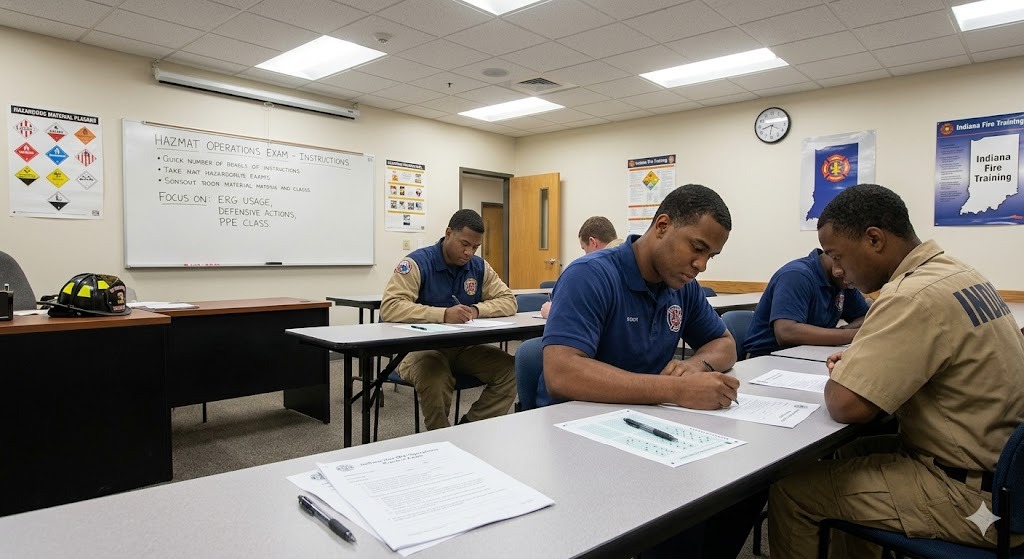
Additional Information
What the Course Entails and Exam Details
Training for this certification is deeply rooted in National Fire Protection Association (NFPA) standards, specifically NFPA 1072 and NFPA 470 guidelines.
At the Awareness level, the course covers the basic recognition and identification of hazardous materials and weapons of mass destruction (WMD).
Moving into the Operations level, the syllabus expands to cover defensive mitigation strategies.
Core topics include mastering the Emergency Response Guidebook (ERG), implementing scene control and incident management protocols, analyzing incident behavior, and selecting appropriate Personal Protective Equipment (PPE).
Students also learn the technical specifics of emergency and mass decontamination procedures, ensuring they can stabilize a scene while awaiting specialized hazmat technicians.
What to Expect in the Final Exam
The final exam is a comprehensive evaluation of both your theoretical knowledge and practical decision-making skills.
Administered under the oversight of the Indiana Department of Homeland Security (IDHS), the written exam primarily consists of multiple-choice questions.
You can expect to face between 50 to 100 questions depending on whether the Awareness and Operations exams are combined or taken sequentially.
Candidates are generally given a strict time limit, typically ranging from one to two hours, to complete the written portion.
To pass and earn your state certification, you must achieve a minimum passing score, which is conventionally set at 70%.
In addition to the written test, candidates must successfully pass a practical skills evaluation where they physically demonstrate competencies like donning PPE, setting up decontamination corridors, and referencing the ERG.
How to Study and Exam Centers
Preparation is the key to passing this exam on your first attempt.
Start by thoroughly reading the recognized textbooks, such as those published by IFSTA or Jones & Bartlett, and memorize the color-coded sections of the Emergency Response Guidebook (ERG).
Taking multiple practice exams is one of the most actionable strategies you can employ; it helps you build test-taking stamina and identifies knowledge gaps in areas like chemical properties or DOT hazard classes.
Flashcards are also incredibly effective for memorizing hazard placards and UN identification numbers.
When you are ready to test, exams are scheduled and managed through the state's Acadis Portal.
Testing is usually conducted at authorized locations, which include regional fire academies, local fire departments with proctoring capabilities, or approved testing centers like Ivy Tech Community College campuses across Indiana.
Job Opportunities from the Course
Earning this certification unlocks numerous career paths in public safety and industrial sectors.
Firefighter: Most municipal and volunteer fire departments in Indiana require Haz-Mat Operations as a mandatory prerequisite for career advancement.
Emergency Medical Technician (EMT) or Paramedic: EMS personnel utilize this training to safely approach scenes, triage chemically exposed patients, and assist in decontamination.
Environmental Health and Safety (EHS) Specialist: Corporate and manufacturing facilities hire EHS professionals to oversee site safety, manage chemical storage, and lead industrial emergency response teams.
Hazardous Materials Technician: This certification serves as the essential stepping stone to becoming a fully specialized Haz-Mat Tech, dealing with offensive leak control and advanced chemical identification.
Emergency Management Coordinator: County and state emergency management agencies look for this background when hiring personnel to plan for and coordinate large-scale disaster responses.
Frequently Asked Questions
Reviews
5.0
Based on 0 reviews
Leave a Review
No reviews yet. Be the first to review!