
Indiana Primary Instructor Practice Exam
$69.00
- Buy to unlock unlimited access to all Quiz questions and Answers in this Quiz.
- After purchase you can print a PDF of the whole quiz at any point. The PDF will contain the questions and the correct answers.
About this Exam
The Indiana Primary Instructor certification is a prestigious credential designed for experienced Emergency Medical Services (EMS) professionals who want to transition into educational roles.
This certification allows skilled EMTs, Advanced EMTs, and Paramedics to step to the front of the classroom and train the next generation of first responders.
By passing the Indiana Primary Instructor exam, you prove that you not only possess top-tier medical knowledge but also the pedagogical skills required to teach others effectively.
This program is perfect for field veterans who are passionate about mentoring, standardizing care, and improving the overall quality of emergency medical training across the state of Indiana.
Ready to test your knowledge?
Buy Now to Access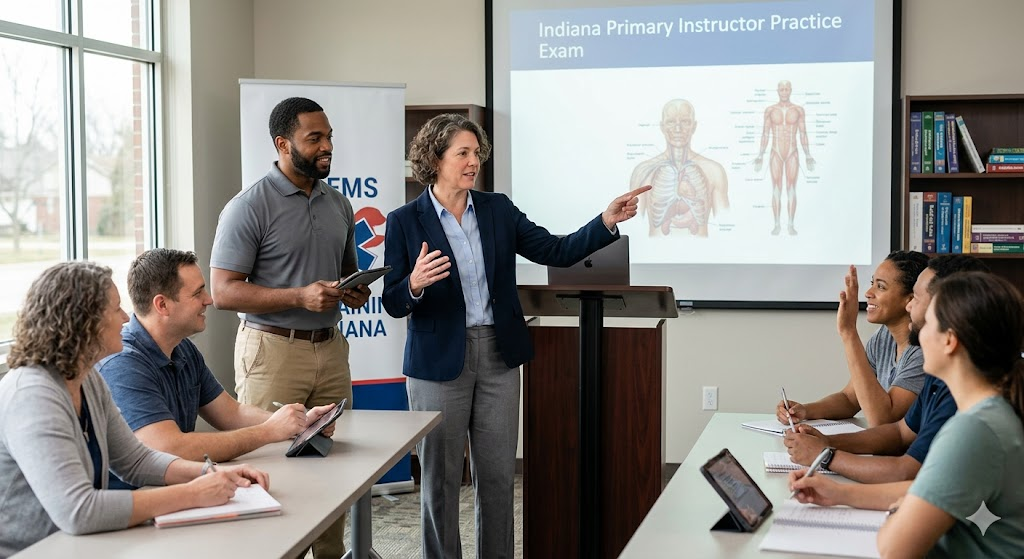
Additional Information
What the Course Entails and Exam Details
The Primary Instructor course bridges the gap between being a clinical expert and becoming a highly effective educator.
Throughout the syllabus, candidates dive deep into adult learning theories, discovering how adult students process, retain, and apply complex medical information.
You will master the art of lesson plan development, ensuring that every class you teach is structured, engaging, and compliant with state and national EMS standards.
The curriculum also covers essential classroom management techniques, helping you handle disruptive behaviors and maintain a positive learning environment.
Furthermore, the course places a heavy emphasis on evaluation techniques and psychomotor skills testing, teaching you how to accurately assess a student's hands-on abilities during high-stress scenarios.
Finally, candidates are thoroughly briefed on the specific rules, regulations, and administrative guidelines enforced by the Indiana EMS Commission.
What to Expect in the Final Exam
The Indiana Primary Instructor final exam is a comprehensive assessment designed to test your grasp of instructional methodology rather than just your clinical EMS knowledge.
You can expect a multiple-choice format that challenges your understanding of teaching strategies, evaluation methods, and state regulations.
Typically, the exam consists of 100 to 150 questions, and candidates are generally given between two to three hours to complete the assessment.
To achieve a passing score, you will usually need to score an 80% or higher, reflecting the high standard expected of state-certified educators.
Strict testing rules apply, meaning no outside materials, electronic devices, or reference guides are allowed in the testing area.
You may also be required to pass a practical evaluation or submit a supervised student-teaching portfolio prior to being fully certified by the state.
How to Study and Exam Centers
Success on the Primary Instructor exam requires a strategic approach to studying, focusing heavily on educational concepts rather than clinical medicine.
Begin by thoroughly reviewing the NAEMSE (National Association of EMS Educators) guidelines, as these form the foundation of most instructor exams.
Utilize practice exams and flashcards specifically tailored to adult learning theories and classroom management scenarios.
Forming study groups with fellow instructor candidates can be incredibly beneficial, allowing you to practice delivering mini-lectures and receiving constructive feedback.
When it comes time to take the test, exams are typically coordinated through the Indiana Department of Homeland Security (IDHS) and the Acadis training portal.
You will likely take your final exam at a state-approved testing facility, which often includes local Ivy Tech Community College testing centers or authorized EMS training institutions across Indiana.
Always verify your specific testing location, date, and required identification through your Acadis portal well in advance of your test day.
Job Opportunities from the Course
Earning this certification opens the door to a highly rewarding career in medical education, allowing you to work in a variety of academic and clinical settings.
Below are the primary career paths this credential unlocks:
EMS Primary Instructor: Lead EMT and EMR certification courses at community colleges, fire departments, and private ambulance services.
Training Officer: Manage the continuing education, recertification, and skills verification for active crews within a fire department or EMS agency.
EMS Program Director: Oversee the administrative, financial, and educational operations of an entire EMS training academy.
Clinical Educator: Work within a hospital system to train nursing staff and emergency department technicians on pre-hospital care protocols.
AHA/Red Cross Instructor: Expand your teaching portfolio by offering CPR, ACLS, PALS, and First Aid courses to the general public and healthcare professionals.
State Evaluator/Proctor: Serve as an official state examiner during psychomotor skills testing for new EMS graduates.
Frequently Asked Questions
Reviews
5.0
Based on 0 reviews
Leave a Review
No reviews yet. Be the first to review!