
Indiana Water Rescue Technician Practice Test
$69.00
- Buy to unlock unlimited access to all Quiz questions and Answers in this Quiz.
- After purchase you can print a PDF of the whole quiz at any point. The PDF will contain the questions and the correct answers.
About this Exam
Becoming a certified Water Rescue Technician is a critical step for first responders and public safety personnel who face water-related emergencies. In Indiana, this advanced-level training is essential for those who must enter dynamic and potentially hazardous water environments, including swiftwater rivers, flood zones, and low-head dams, to perform life-saving "go" rescues. The role requires physical stamina, technical proficiency, and a comprehensive understanding of hydrology and rescue scene management. This study guide is designed to help individuals preparing for the state-administered certification exam, offering a focused review of key concepts and actionable test-taking strategies. The certification is typically for firefighters, law enforcement officers, EMS personnel, and members of specialized search and rescue teams.
Ready to test your knowledge?
Buy Now to Access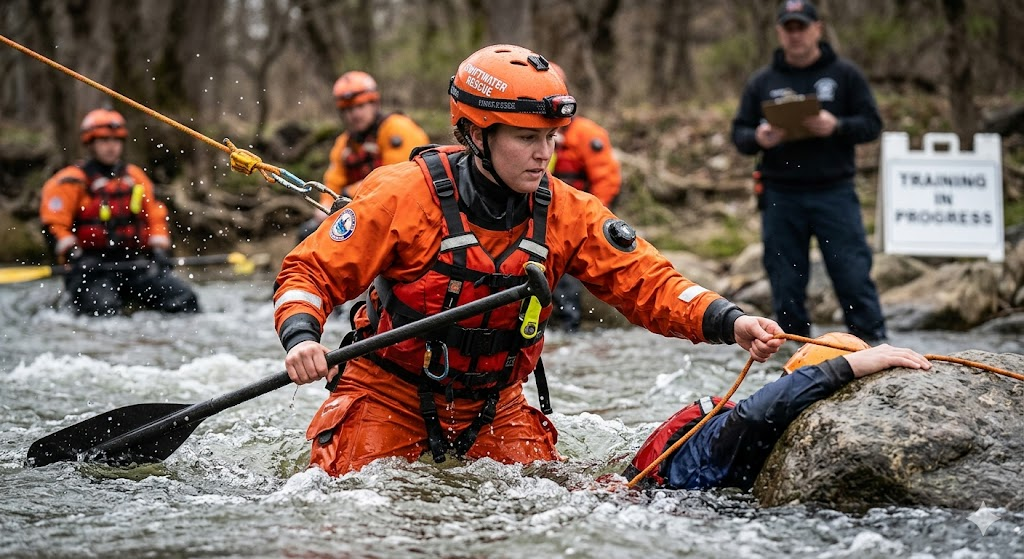
Additional Information
What the Course Entails and Exam Details
Outline the core topics, syllabus, or skills covered.
A Water Rescue Technician course is an intensive, multi-day program that blends theoretical instruction with extensive hands-on, practical training. The curriculum is built upon the rigorous standards set by NFPA 1006 (Standard for Technical Rescuer Professional Qualifications) and NFPA 1670 (Standard on Operations and Training for Technical Search and Rescue Incidents), and it exceeds awareness and operations-level requirements. Students will develop specialized skills through a range of core topics, including:
Swiftwater Hydrology: Understanding the powerful mechanics of moving water, including current flow, eddy lines, strainers, and hydraulic hazards.
Risk Assessment and Incident Management: Mastering the Incident Command System (ICS) for water rescue, performing thorough size-ups, and making critical safety decisions.
Personal Protective Equipment (PPE): Correct selection, use, and maintenance of specialized gear like Type V PFDs, swiftwater helmets, thermal protection, and water rescue boots.
Rescue Techniques:
Shore-Based Rescue: Using throw bags, reaching tools, and other non-entry methods.
Swimming “Go” Rescues: Techniques for entering and moving through swift water to secure and retrieve a victim.
Tethered and In-Water Systems: Setting up and operating rope systems and mechanical advantage for controlled rescue.
Boat-Based Operations: Basic maneuverability and rescue techniques from inflatable rescue crafts or personal watercraft.
Rope and Knots: Proficiency with critical knots like the Figure 8 family, Prusik knot, and water knot, and understanding anchor systems.
Victim Management: Techniques for calming, stabilizing, packaging, and extricating a distressed person from the water.
What to Expect in the Final Exam
To earn the Indiana Water Rescue Technician certification, candidates must successfully complete both a thorough practical skills evaluation and a formal written examination. This guide is a study and practice resource for the written exam component. The actual certification process is administered by the Indiana Department of Homeland Security (IDHS) State Fire Marshal’s office and is typically conducted at authorized training facilities across the state.
The final written exam will assess your mastery of the theoretical knowledge presented throughout the course. While specific details like the exact number of questions and time limit can vary and should be confirmed with the official testing agency, candidates can generally expect the following format and structure:
Format: The exam is typically a closed-book, multiple-choice test. Questions will be designed to test not just rote memorization but also your ability to apply core concepts and principles to various rescue scenarios.
Content: Questions will be drawn from all theoretical and conceptual areas of the course curriculum, with significant focus on swiftwater hydrology, hazard identification, NFPA standards, safety procedures, the use of PPE, rope work, and emergency management protocols.
Passing Score: A passing grade, usually 70% or higher, is required.
Administration: Candidates must be logged in through the IDHS Acadis Portal to access the online written exam. The practical evaluation must typically be completed successfully before taking the written component. Check current state fire marshal guidelines for specific sequencing rules.
How to Study and Exam Centers
Preparing for the Indiana Water Rescue Technician written exam requires a structured and dedicated approach. Success hinges on a combination of reviewing course materials, engaging in hands-on practice, and taking practice tests. Here are actionable study strategies:
Review Official Materials: Your primary source should be the student manual, presentations, and any NFPA standards referenced during your course. Take detailed notes and highlight key definitions, formulas, and safety protocols.
Use Practice Tests: Leverage a dedicated Indiana Water Rescue Technician Practice Test to get familiar with the types of questions and the overall style of the exam. This tool can help you identify areas where your understanding is weak, allowing you to focus your remaining study time effectively. Repeat the practice test until you consistently achieve a high score.
Visualize Techniques: For rope work and practical methods, visualize every step of a process. Tie different knots and set up basic mechanical advantage systems in a non-emergency environment until the actions become second nature.
Create Flashcards: Flashcards are highly effective for memorizing key terms, definitions (e.g., standard river signals), and the components of various rescue systems.
Study in a Group: If possible, study with fellow trainees. Explaining concepts to others and debating the correct application of rescue methods can solidify your own knowledge and uncover new perspectives.
Physical Conditioning: Don’t forget that the practical component of the training and evaluation is physically demanding. Maintain a high level of water fitness throughout your preparation.
Official Exam Centers and Testing
The final certification exam process, both practical and written, is facilitated through authorized channels. The written exam is online, while the practical must be done at a recognized physical location.
Written Exam: In Indiana, after successfully completing the required coursework and practical evaluation, the written component is typically administered online via the state's official Acadis Portal. Candidates will use their Public Safety Identification (PSID) number to log in and access the test.
Practical Skills Evaluation: The practical skills assessment takes place at authorized training schools and district training centers throughout Indiana. Notable examples include the Indiana River Rescue School, based on the St. Joseph River, and other sites approved by the IDHS. Check the available training and testing schedule on the IDHS Acadis Portal for specific locations and dates.
Job Opportunities from the Course
Earning the Water Rescue Technician certification significantly expands career and volunteer opportunities in public safety and emergency services. This advanced-level qualification demonstrates that you possess the specialized skills to manage and execute complex water-based rescue operations, making you an invaluable asset to any department or organization tasked with protecting a community near dynamic water bodies. Here are some of the job titles and career paths unlocked by this certification:
Fire Fighter (specifically for departments with water rescue responsibilities)
Fire Chief / Department Administrator
Emergency Medical Services (EMS) Personnel (Paramedic, EMT)
Law Enforcement Officer (Conservation Officer, specialized patrol)
Specialized Search and Rescue (SAR) Team Member
Rescue Team Leader / Supervisor
Swiftwater and Flood Rescue Instructor
Industrial Water Safety Specialist
Whitewater Rafting Guide / Outdoor Adventure Leader
Advanced Lifeguard (specifically for dynamic or open water environments)
Frequently Asked Questions
Reviews
5.0
Based on 0 reviews
Leave a Review
No reviews yet. Be the first to review!