
Industrial Maintenance Mechatronics Practice Test
$69.00
- Buy to unlock unlimited access to all Quiz questions and Answers in this Quiz.
- After purchase you can print a PDF of the whole quiz at any point. The PDF will contain the questions and the correct answers.
About this Exam
The Industrial Maintenance Mechatronics certification is designed for individuals seeking to validate their expertise in maintaining and troubleshooting complex, integrated industrial systems that combine mechanical, electrical, computer, and control engineering. This comprehensive exam targets aspiring or current maintenance technicians, electromechanical specialists, automation technicians, engineering students, and anyone involved in the operation and upkeep of modern automated manufacturing and processing equipment. Successfully passing this exam demonstrates your proficiency in handling sophisticated systems and significantly boosts your career prospects in diverse industrial sectors, from automotive and electronics to pharmaceuticals and energy.
Ready to test your knowledge?
Buy Now to Access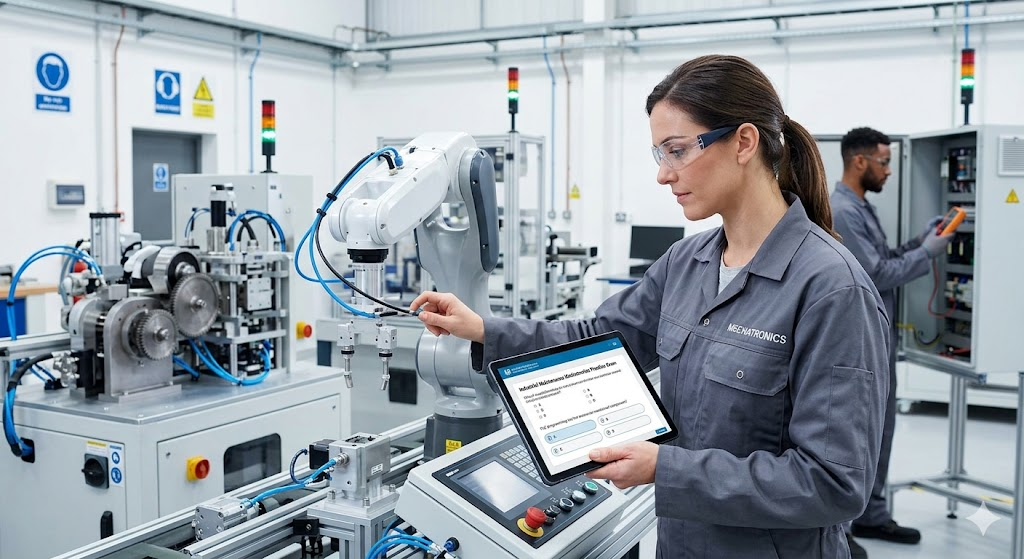
Additional Information
What the Course Entails and Exam Details
To excel in the Industrial Maintenance Mechatronics exam, you must possess a solid understanding of several key technical areas. The underlying curriculum and exam syllabus comprehensively cover the fundamentals of electrical systems (AC/DC circuits, motor control, industrial wiring), mechanical principles (gears, bearings, pneumatics, hydraulics), automation and control systems (Programmable Logic Controllers (PLCs), sensors, drives, robotics fundamentals), and effective troubleshooting methodologies. Expect questions and scenarios evaluating your ability to interpret technical diagrams, safely operate diagnostic tools, perform preventative maintenance, and efficiently diagnose and repair integrated system failures, all while strictly adhering to crucial industrial safety standards.
What to Expect in the Final Exam
The actual Industrial Maintenance Mechatronics certification exam generally utilizes a multiple-choice question format, which can be delivered either online through secure proctoring platforms or in person at authorized testing centers. Candidates should prepare for a significant number of questions assessing theoretical knowledge, practical scenarios, and critical problem-solving skills across all the core mechatronics domains mentioned previously. The time limit for completion typically ranges from 90 to 120 minutes, necessitating strong time management. A passing score, often around 70-80?pending on the specific certifying body, is required for successful certification, so thorough preparation is essential for success. Strict rules regarding prohibited materials, electronic devices, and proper identification will be enforced, so ensure you are fully aware of and compliant with all exam regulations prior to your test date.
How to Study and Exam Centers
Effective preparation for this demanding exam involves a combination of strategies. Utilizing comprehensive study guides, reviewing relevant textbooks and manufacturer documentation, and engaging in hands-on practice with mechatronics components (where safe and feasible, perhaps through educational labs or online simulations) are all highly recommended methods. However, one of the most beneficial approaches is to take advantage of targeted practice tests, like the specific exam detailed here. This allows you to become familiar with the question types, assess your knowledge across different domains, identify weak areas, and practice managing your time, significantly boosting your confidence and preparedness. To find where and how to take the actual certification exam, you should primarily consult the website of the relevant certifying organization (such as specific technical societies or industry associations) as they will list authorized testing methods and locations, which may include online portals, prominent physical testing centers like Pearson VUE or Prometric, or authorized technical schools and training facilities globally.
Job Opportunities from the Course
Earning an Industrial Maintenance Mechatronics certification significantly enhances your resume and opens doors to numerous in-demand, rewarding career paths within advanced manufacturing and related fields. This credential signals to potential employers that you have validated skills in a critical cross-functional area, positioning you competitively for a wide range of roles including:
Industrial Maintenance Technician: Diagnosing and repairing diverse industrial machinery and integrated systems.
Mechatronics Technician: Specializing in the maintenance of complex automated and robotic systems combining multiple engineering disciplines.
Electromechanical Technician: Focused on systems involving both electrical and mechanical components.
Automation Technician: Working with Programmable Logic Controllers (PLCs), sensors, drives, and control networks to optimize and maintain automated processes.
PLC Programmer: Developing and maintaining the critical software code that controls industrial equipment.
Robotics Technician: Installing, programming, troubleshooting, and maintaining industrial robots and robotic workcells.
Maintenance Engineer: A potentially advanced role (often requiring additional experience or education) involving planning, supervising maintenance operations, and optimizing system reliability and performance.
Facilities Maintenance: Applying mechatronics expertise to the critical systems within manufacturing plants or large commercial facilities.
Process Technician: Ensuring the optimal operation and continuous uptime of intricate production and processing lines through skilled maintenance and proactive optimization.
Frequently Asked Questions
Reviews
5.0
Based on 0 reviews
Leave a Review
No reviews yet. Be the first to review!