
Infection Control for Dental Assisting Practice Exam
$69.00
- Buy to unlock unlimited access to all Quiz questions and Answers in this Quiz.
- After purchase you can print a PDF of the whole quiz at any point. The PDF will contain the questions and the correct answers.
About this Exam
The Infection Control for Dental Assisting certification is a critical credential designed to validate a dental professional's competency in maintaining a safe, sterile clinical environment.
This exam is specifically tailored for prospective and current dental assistants, sterilization technicians, and dental office staff members.
By successfully passing this assessment, candidates demonstrate their absolute commitment to protecting both patients and healthcare personnel from potentially harmful pathogens.
It is an essential stepping stone for anyone looking to establish a trusted and professional career in the modern dental industry.
Ready to test your knowledge?
Buy Now to Access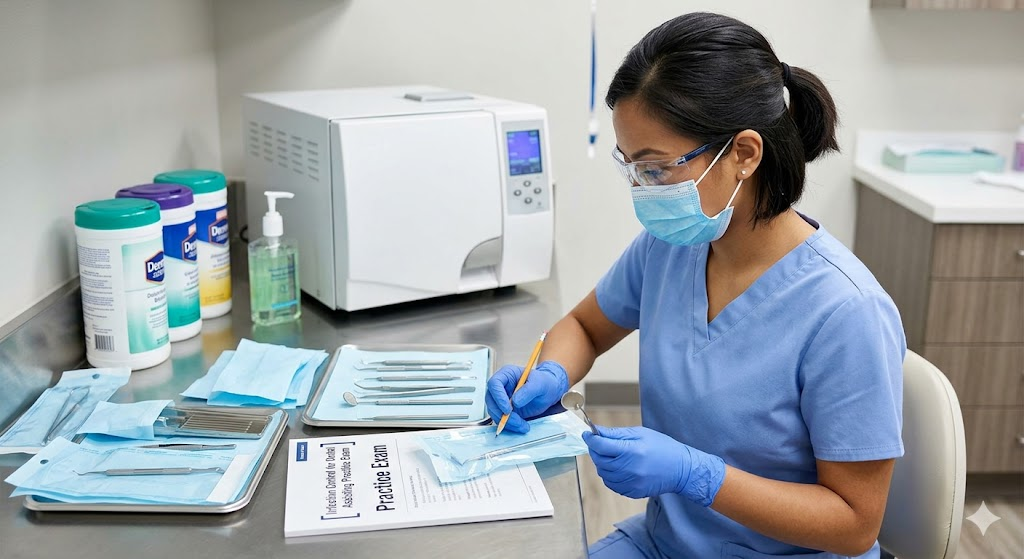
Additional Information
What the Course Entails and Exam Details
Preparing for this exam requires a deep dive into the fundamental principles of clinical safety and cross-contamination prevention.
Candidates will extensively cover standard precautions, occupational safety regulations, and the proper utilization of personal protective equipment (PPE).
The syllabus heavily emphasizes the protocols set forth by the CDC and OSHA, ensuring that students understand the legal and ethical mandates of dental safety.
Additional core topics include instrument processing, environmental surface disinfection, dental unit waterline maintenance, and the safe handling of hazardous materials.
Students will also learn how to properly manage exposure incidents and implement emergency protocol responses.
What to Expect in the Final Exam
The final exam typically consists of multiple-choice questions designed to test both theoretical knowledge and practical, scenario-based decision-making.
Candidates can generally expect around 80 to 100 questions, depending on the specific certifying board such as the Dental Assisting National Board (DANB).
You will be given a strict time limit, usually ranging from 60 to 75 minutes, to complete the examination.
To pass, students must achieve a minimum scaled score, which is often around 400 on a scale of 100 to 900.
Strict exam rules apply, meaning no outside materials, electronic devices, or personal items are allowed in the testing area to ensure complete academic integrity.
How to Study and Exam Centers
Success on the infection control exam begins with a structured, consistent study plan focused on active recall.
Students should heavily utilize practice exams to familiarize themselves with the wording of the questions and to identify personal knowledge gaps.
Flashcards are highly recommended for memorizing specific OSHA standards, sterilization temperatures, and chemical contact times.
When it comes time to take the test, exams are predominantly administered through authorized testing networks like Pearson VUE.
Candidates can easily schedule their exam at a physical, high-security testing center near them.
Alternatively, many boards now offer secure online proctoring, allowing you to take the exam from the comfort of a quiet, private room at home.
Job Opportunities from the Course
Earning your infection control certification opens the door to a variety of rewarding and stable career paths within the healthcare sector.
Certified Dental Assistant (CDA) – You will be fully equipped to assist dentists chairside while ensuring all sterile protocols are flawlessly executed.
Infection Control Coordinator – In this specialized role, you will oversee the safety compliance of the entire dental practice and train other staff members.
Sterilization Technician – This vital position focuses entirely on operating autoclaves, processing instruments, and managing the sterile supply chain of the clinic.
Dental Office Manager – With a strong grasp of compliance and safety, certified individuals often transition into management roles where they handle OSHA documentation and facility safety audits.
Dental Hygiene Assistant – You can assist dental hygienists by prepping treatment rooms and ensuring that all environmental surfaces are perfectly sanitized between patients.
Frequently Asked Questions
Reviews
5.0
Based on 0 reviews
Leave a Review
No reviews yet. Be the first to review!