
Information Systems Practice Test 2026 | Exam Prep Questions and Answers
$69.00
- Buy to unlock unlimited access to all Quiz questions and Answers in this Quiz.
- After purchase you can print a PDF of the whole quiz at any point. The PDF will contain the questions and the correct answers.
About this Exam
The landscape of modern business is built entirely upon robust technological infrastructure. An Information Systems (IS) certification or practice test serves as a crucial validation point for professionals tasked with bridging the gap between business needs and technological solutions. This comprehensive examination is designed for aspiring information systems auditors, IT managers, systems analysts, and security professionals who are preparing to demonstrate their proficiency in managing, auditing, and securing an organization's critical information assets.
Ultimately, this course and its associated practice exams are designed to ensure you possess the necessary critical thinking skills to analyze complex scenarios, recommend effective technological interventions, and uphold the integrity, confidentiality, and availability of data in a volatile digital ecosystem. Whether you are a university student aiming for college credit through exams like the CLEP or a working professional seeking a recognized professional credential, mastering this practice material is a pivotal step toward validating your expertise for the 2026 landscape.
Ready to test your knowledge?
Buy Now to Access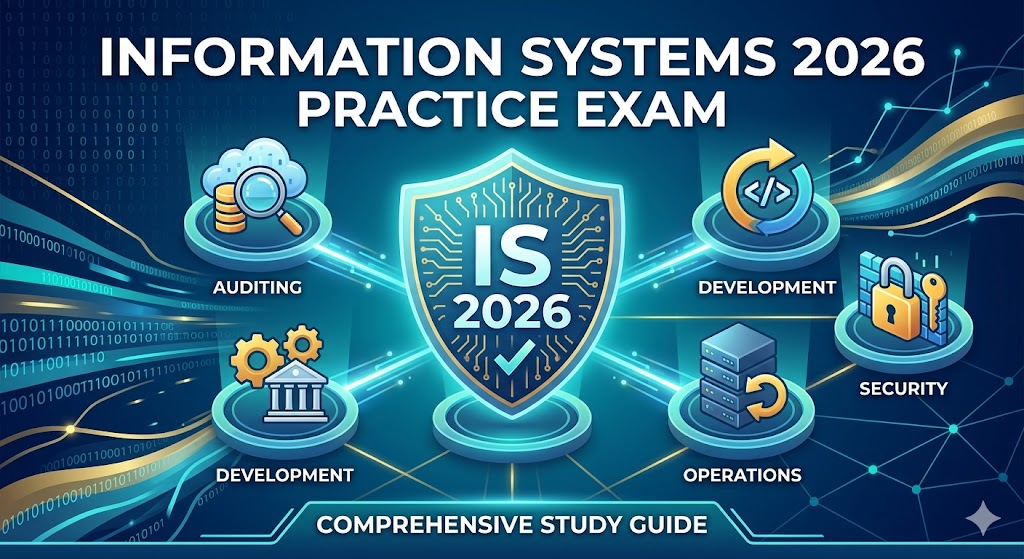
Additional Information
What the Course Entails and Exam Details
Preparing for the Information Systems final exam requires a deep understanding of several core domains. The syllabus typically covers a mix of management theory, technical infrastructure, and regulatory compliance. You must demonstrate a holistic understanding of how these elements intersect to support strategic organizational goals.
In 2026, the exam domains focus heavily on the lifecycle of information systems, from inception to retirement. We structure our practice materials to help you master the five following key job practice areas:
Domain 1: Information Systems Auditing Process: Understanding risk-based audit planning, internal controls, and evidence collection techniques.
Domain 2: Governance and Management of IT: Analyzing IT organizational structures, strategic alignment with business goals, and resource management.
Domain 3: Information Systems Acquisition, Development, and Implementation: Mastering the Software Development Life Cycle (SDLC) phases, project management methodologies (such as Agile and Waterfall), and data conversion processes.
Domain 4: Information Systems Operations and Business Resilience: Focus on data management, service management, Business Continuity Planning (BCP), and Disaster Recovery (DR) strategies.
Domain 5: Protection of Information Assets: Developing proficiency in logical and physical access controls, network security, encryption techniques, and security incident response.
What to Expect in the Final Exam
While exact parameters vary slightly depending on the specific awarding body (such as ISACA for CISA or the College Board for CLEP), most standardized Information Systems professional exams follow a similar, rigorous structure. You should prepare for an objective assessment that tests both foundational knowledge and the practical application of concepts.
The final exam is usually a proctored, computer-based testing environment. For a standard 2026 professional certification level, you can expect the following structure:
Format: Roughly 100 to 150 multiple-choice questions. These are often scenario-based, requiring you to choose the "best" or "most likely" answer among plausible alternatives.
Time Limit: You will typically be allocated between 2 and 4 hours. Time management is critical, as you have approximately 1.5 minutes per question.
Passing Score: Most exams operate on a scaled scoring system. A scaled score of 450 on a scale of 200–800 is a common requirement, demanding a solid understanding across all domains, not just high proficiency in one.
Testing Rules: Most sites enforce strict closed-book policies. You may be provided an online calculator, but personal electronic devices, study materials, and breaks that stop the exam timer are generally prohibited.
How to Study and Exam Centers
Effective preparation requires a balance of theoretical study and practical application. We recommend starting your study journey by obtaining the official review manual from the awarding body for the most accurate and up-to-date content weightings. However, practice is your most powerful tool.
Use practice tests to simulate the final exam environment. Time yourself, identify your weak domains, and focus your subsequent study sessions on those specific areas. We encourage you to focus not just on memorizing the correct answers to practice questions, but on understanding the rationale behind the correct answer to build critical decision-making skills.
Once you are ready to take the final exam, you will usually register through the official portal of the testing authority. For many professional Information Systems certifications, you will take your exam at authorized physical testing centers managed by global partners like Pearson VUE or PSI. These sites ensure a secure, standardized environment. In 2026, online proctored testing may also be available for certain classifications of the exam, allowing you to take the test from your home or office while being monitored via webcam.
Job Opportunities from the Course
Earning an Information Systems certification or demonstrating mastery via comprehensive practice exams significantly enhances your career trajectory. These credentials signal to employers that you possess both the managerial oversight and technical acumen required in the modern enterprise.
Mastering this curriculum unlocks diverse, high-demand career paths across all industries, including finance, healthcare, government, and manufacturing. You can expect to be qualified for the following specific job titles:
Information Systems Auditor (IS Auditor)
IT Manager or Chief Information Officer (CIO)
Information Security Analyst
Computer Systems Analyst
Database Administrator
Business Analyst (with a technical focus)
IT Consultant
Risk Management Professional
Project Manager (Technology Sector)
Compliance Officer (IT Regulatory)
Frequently Asked Questions
Reviews
5.0
Based on 0 reviews
Leave a Review
No reviews yet. Be the first to review!