
Information Systems Technician Second Class (IT2) Advancement Practice Exam
$69.00
- Buy to unlock unlimited access to all Quiz questions and Answers in this Quiz.
- After purchase you can print a PDF of the whole quiz at any point. The PDF will contain the questions and the correct answers.
About this Exam
The Information Systems Technician Second Class (IT2) Advancement Practice Exam is a crucial study tool for U.S. Navy Sailors aiming to elevate their careers and achieve the rank of Petty Officer Second Class (E-5). This guide is designed for dedicated Information Systems Technicians (ITs) currently at the IT3 level who are ready to demonstrate their technical proficiency, leadership potential, and commitment to the Navy’s mission.
Moving from E-4 to E-5 represents a significant step up in responsibility. To make this leap, Sailors must prove they have a deep understanding of the Navy's complex communication networks, information systems, and security protocols. This practice exam and study guide are engineered to provide a comprehensive overview of the material, helping candidates identify knowledge gaps and approach the actual Navy-wide Advancement Exam (NWAE) with confidence and readiness.
Ready to test your knowledge?
Buy Now to Access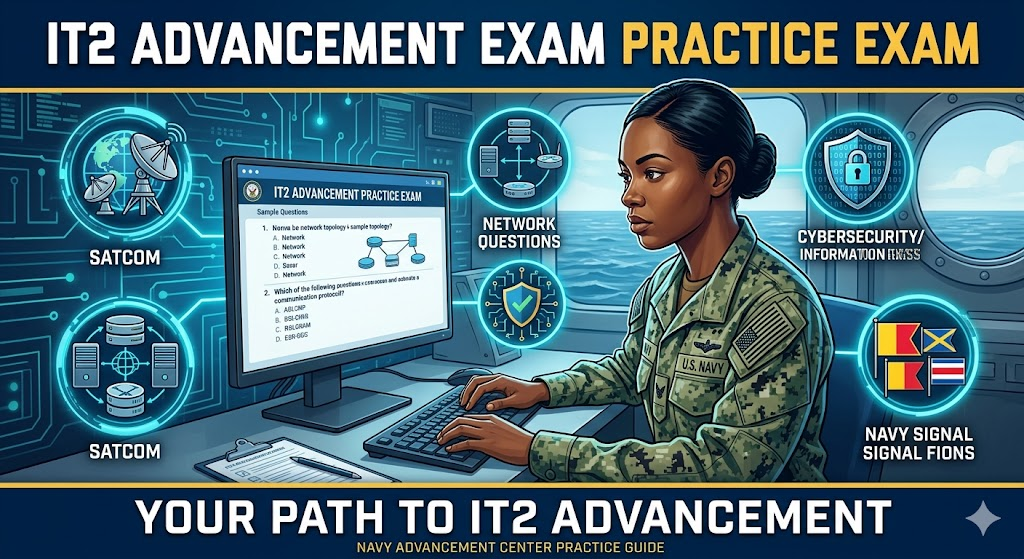
Additional Information
What the Course Entails and Exam Details
This examination does not stem from a single "course," but rather evaluates a culmination of on-the-job training, official Navy correspondence courses, rating manuals, and professional military knowledge. The syllabus for the IT2 advancement is vast, reflecting the complex and rapidly evolving nature of modern information technology within naval operations.
To succeed on this exam, candidates must master numerous technical and professional domains. The exam details and core skills covered include:
Network and System Administration: Proficiency in administering, troubleshooting, and securing LAN/WAN architectures, including servers (both Windows and Linux environments), routers, switches, and network protocols (TCP/IP, DNS, DHCP).
Communications Systems: Deep knowledge of naval communication methods, including Satellite Communications (SATCOM), High Frequency (HF), Ultra High Frequency (UHF), Extremely High Frequency (EHF) systems, and specialized messaging systems like C4I (Command, Control, Communications, Computers, and Intelligence).
Information Assurance (IA) and Cybersecurity: Understanding DoD and Navy cybersecurity policies, managing user permissions, implementing defense-in-depth strategies, vulnerability management, and incident response protocols.
Equipment Maintenance and Administrative Procedures: Knowledge of the 3-M System (Maintenance and Material Management), quality assurance procedures, official message traffic handling, and the management of Information Technology service requests.
What to Expect in the Final Exam
The actual Navy-wide Advancement Exam for IT2 is a standardized, multiple-choice test that remains one of the primary factors in a Sailor’s Final Multiple Score (FMS), which determines advancement. Candidates should go into the test knowing exactly what to expect.
Here are the critical details regarding the final exam:
Exam Format: The test consists of 175 questions, all multiple-choice, designed to test both technical rating knowledge and Professional Military Knowledge (PMK).
Time Limit: Sailors are generally given three hours (180 minutes) to complete the examination. Efficient time management is crucial to ensure every question is addressed.
Scoring and Passing: Navy advancement is competitive. There is no simple "passing score." The exam score is combined with a Sailor’s performance evaluations (evals), awards points, time-in-rate, and previous test performance to create the FMS. Advancing requires scoring high enough to fall within the quota set by the Navy for that cycle.
Testing Protocol: The exam is typically a closed-book, paper-based (sometimes computerized depending on command resources) test administered by proctors from the command’s Educational Services Office (ESO). Personal electronics, study materials, or communication devices are strictly prohibited in the testing area.
How to Study and Exam Centers
Effective studying for the IT2 exam must be a long-term strategy rather than a last-minute cram session. Success requires a dedicated analysis of the official bibliographies (Bibs) for that specific exam cycle.
Recommended study strategies include:
Analyze the Bibs: Go to the Navy Advancement Center (NAC) website via MyNavy Portal and download the Bibliographies for the upcoming exam. This list tells you exactly which manuals, instructions, and publications the questions are drawn from. Focus 100% of your study time on these sources.
Utilize Official Navy Learning Tools: Complete relevant Navy e-Learning (NeL) courses associated with the IT rating. These courses are often listed in the Bibs and are directly relevant to exam content.
Practice with Purpose: Utilize practice exams from reputable military advancement study guides and online forums. Practice identifying the specific instruction or manual a question refers to. Creating and sharing flashcards with shipmates is an excellent way to reinforce knowledge.
Identify Your Weaknesses: Take a baseline practice test early. Analyze which sections (e.g., SATCOM vs. Networking) you scored lowest in, and dedicate a proportionate amount of study time to those areas.
Exam Centers and Locations
Navy Advancement Exams are administered uniquely through military command structures rather than civilian testing centers (like Pearson VUE):
Command Administration: The NWAE is typically proctored by the Sailor’s command at their current duty station. This could be in a base classroom, gymnasium, or training facility for shore-based personnel.
Deployed or Afloat: Sailors who are deployed at sea during the exam window will take the exam aboard their ship, proctored by the ship’s Educational Services Officer (ESO) or designated proctors, often in common areas like the mess decks or training classrooms.
Job Opportunities from the Course
Advancing to Information Systems Technician Second Class (IT2) is a massive career milestone that significantly increases a Sailor’s responsibility and technical authority. In the Navy, this rank opens doors to more specialized and coveted duty assignments and leadership roles. For those considering a future civilian career, holding the rank of IT2 demonstrates proven, high-level IT proficiency and leadership to DoD contractors and the private sector.
Achieving IT2 status unlocks specialized job opportunities and roles such as:
Workcenter Supervisor (managing IT3s and IT strikers)
Afloat/Shore Network Administrator
Information Assurance Officer (IAO) or Cybersecurity Analyst
SATCOM/Communication Systems Specialist
Cyber Strike Team Member
System Administrator (Windows/Linux Server management)
Telecommunications Manager
Technical Instructor at "A" or "C" schools
Frequently Asked Questions
Reviews
5.0
Based on 0 reviews
Leave a Review
No reviews yet. Be the first to review!