
Installer Technician Practice Test
$69.00
- Buy to unlock unlimited access to all Quiz questions and Answers in this Quiz.
- After purchase you can print a PDF of the whole quiz at any point. The PDF will contain the questions and the correct answers.
About this Exam
The Installer Technician certification is a vital credential for professionals aiming to prove their technical proficiency in deploying, configuring, and troubleshooting physical hardware and wiring.
This certification is designed for individuals looking to build a robust career in telecommunications, security systems, smart home automation, and network cabling.
Earning this credential demonstrates to employers that you understand industry safety standards and possess the hands-on expertise required for complex installations.
Whether you are an entry-level candidate or a seasoned worker seeking formal recognition, passing this exam elevates your professional credibility and marketability.
Ready to test your knowledge?
Buy Now to Access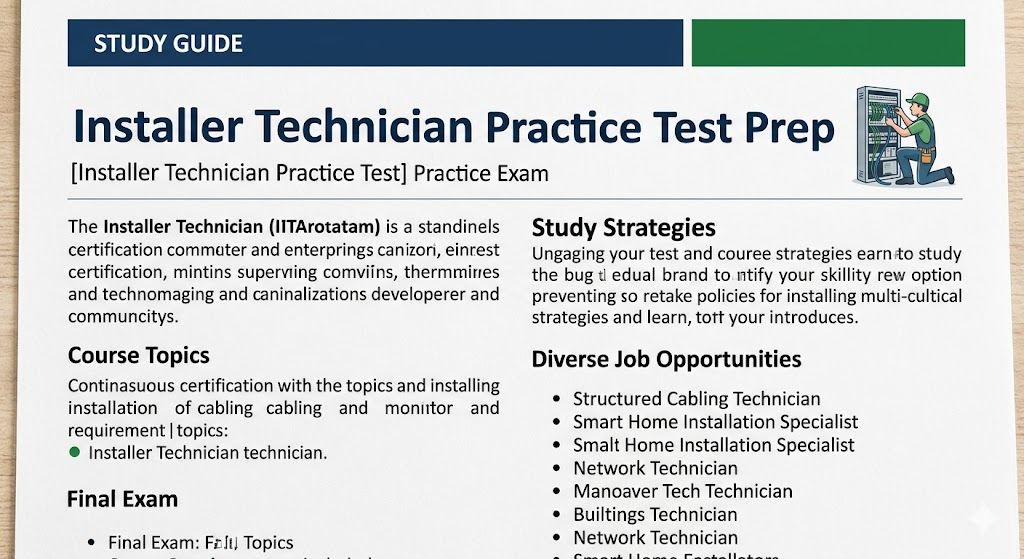
Additional Information
What the Course Entails and Exam Details
The preparatory course for the Installer Technician exam covers a comprehensive syllabus grounded in real-world applications.
Candidates will dive deep into foundational concepts such as low-voltage cabling, blueprint interpretation, and site surveying.
The curriculum strongly emphasizes safety protocols, including grounding, bonding, and OSHA compliance to ensure secure work environments.
Additionally, you will learn the core techniques for terminating cables, testing connections, and troubleshooting signal loss or hardware failures.
By mastering these skills, you will be well-equipped not just for the test, but for the daily challenges of the job.
What to Expect in the Final Exam
The final certification exam is rigorously structured to test both your theoretical knowledge and practical understanding.
Typically, the test consists of 50 to 100 multiple-choice questions that must be completed within a two-hour time limit.
Test-takers are generally required to achieve a passing score of 70% to 75%, depending on the specific certifying body.
Some variations of the exam may also include a simulated hands-on practical section where you must demonstrate proper termination and testing of cables.
Be prepared to answer scenario-based questions that require you to apply safety codes and troubleshooting logic to realistic field situations.
How to Study and Exam Centers
To maximize your chances of success, you should integrate multiple study strategies into your routine.
Taking an Installer Technician practice test is one of the most effective ways to identify your weak areas and get comfortable with the pacing of the real exam.
Pair these practice exams with hands-on lab work if possible, using spare cables and basic testing tools to build muscle memory.
When you are ready to test, you can register through authorized testing providers like Pearson VUE or Prometric.
These organizations offer the flexibility to take the exam at a physical testing center near you, or via a secure, online proctored environment from the comfort of your home.
Job Opportunities from the Course
Successfully passing your Installer Technician exam opens the door to a wide variety of in-demand, high-growth career paths.
Below are some of the primary job titles this certification can help you secure:
Telecommunications Installer: Focuses on setting up internet, phone, and television services for residential and commercial clients.
Network Cabling Technician: Specializes in running, terminating, and testing CAT6 and fiber optic cables in large-scale data environments.
Security System Installer: Responsible for wiring and configuring alarms, access control systems, and CCTV cameras.
Smart Home Technician: Integrates and installs IoT devices, automated lighting, and home theater systems.
AV (Audio Visual) Technician: Sets up complex sound and visual projection systems in corporate boardrooms, schools, and event spaces.
Frequently Asked Questions
Reviews
5.0
Based on 0 reviews
Leave a Review
No reviews yet. Be the first to review!