
Instrument Fitter Practice Test
$69.00
- Buy to unlock unlimited access to all Quiz questions and Answers in this Quiz.
- After purchase you can print a PDF of the whole quiz at any point. The PDF will contain the questions and the correct answers.
About this Exam
The Instrument Fitter certification is a specialized credential designed for craft professionals who specialize in the installation, connection, and maintenance of the piping, tubing, and mechanical support systems for industrial measurement and control devices. It is an ideal path for apprentices aiming to formalize their training and for experienced fitters seeking to validate their journeyman-level skills. Achieving this certification demonstrates a mastery of the physical infrastructure that underpins modern process automation, making the certified individual a vital asset in heavy industries ranging from oil and gas to manufacturing and chemical processing. This practice test is engineered to help you prepare for the high-stakes knowledge assessment required for certification.
Ready to test your knowledge?
Buy Now to Access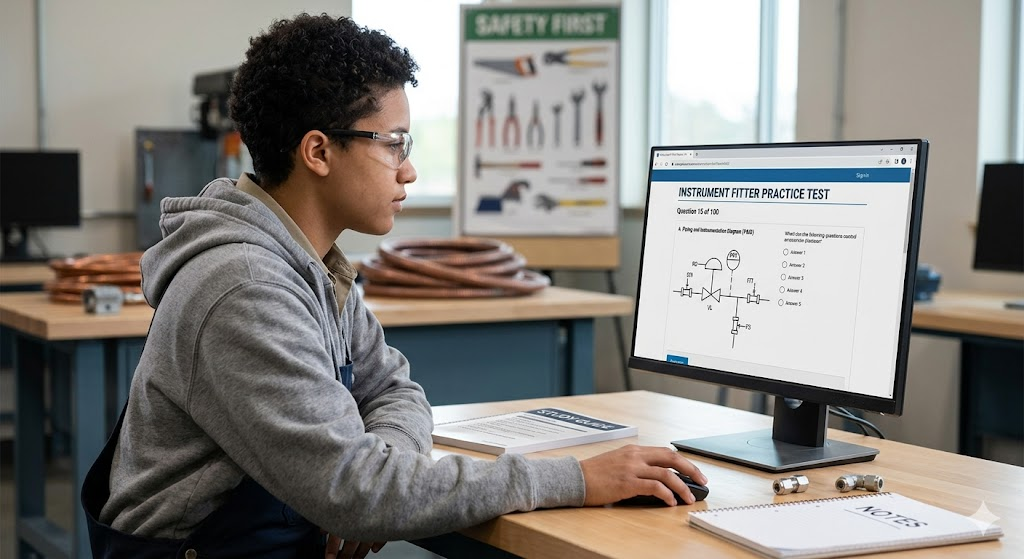
Additional Information
What the Course Entails and Exam Details
This practice exam is a comprehensive review of the core curriculum areas a qualified Instrument Fitter must understand. The material covered simulates the actual knowledge verification assessment, focusing on the mechanical aspects of the trade. Participants should be proficient in:
Safety Practices: Specific focus on lockout/tagout, chemical handling, and trade-specific hazards.
Hand and Power Tools: Identifying, safely operating, and maintaining specialized trade tools.
Drawings and Documents: Interpreting Piping and Instrumentation Diagrams (P&IDs), loop diagrams, and location drawings.
Materials and Fasteners: Proper handling and installation of various alloys, gaskets, O-rings, and fasteners.
Tubing and Piping: Techniques for cutting, bending, and installing small-bore tubing and pipe.
Fitting and Supports: Selecting and installing appropriate supports, clamps, and hangers for instrument lines.
Testing and Commissioning: Performing hydrostatic and pneumatic pressure leak tests.
What to Expect in the Final Exam
While formats for specific practice tests vary, a comprehensive self-assessment should closely simulate the final computer-based test (CBT). For the real certification knowledge assessment, you can expect:
Format: A closed-book, multiple-choice exam administered via computer.
Questions: Approximately 100 questions covering the key domains outlined above.
Time Limit: Candidates typically have 2 to 3 hours to complete the assessment, making time management critical.
Passing Score: The required passing grade varies by the certifying body but is generally around 70%.
Focus: The exam evaluates theoretical and practical knowledge; it does not typically include a physical hands-on component at this stage (though that may be required for a separate "Certified Plus" designation).
How to Study and Exam Centers
Preparation is key to passing the Instrument Fitter certification assessment. Utilize a strategic approach with a combination of methods:
Study Strategies:
Take Multiple Practice Tests: Use different sources to expose yourself to a variety of question styles and ensure you aren't just memorizing one specific test's answers.
Time Yourself: Simulate the real exam environment by taking practice tests within the 2 to 3-hour window to improve your pacing.
Review Wrong Answers: After each practice attempt, thoroughly analyze the correct solutions and the reasoning behind them to eliminate knowledge gaps.
Focus on Specific Domain Areas: If practice tests reveal weakness in interpreting P&IDs or tubing bending calculations, dedicate focused study time to those specific topics.
Exam Centers:
Practice Tests: These are almost exclusively taken online through various educational portals and authorized training providers.
Actual Certification Assessment: The real certification exam must be scheduled at a proctored, authorized testing center. Common locations include Pearson VUE test centers, local Joint Apprenticeship and Training Committees (JATCs), and specialized craft training schools accredited by the certifying body.
Job Opportunities from the Course
A certified Instrument Fitter possesses a specialized and highly marketable skill set. Completing this path opens a wide array of career opportunities in heavy industrial and technical sectors.
Specific job titles and career paths this certification unlocks include:
Instrument Fitter
Instrumentation Mechanic
Industrial Maintenance Fitter
Pipe Fitter (with a specialization in small-bore systems)
Field Service Technician
Process Automation Specialist
Maintenance Mechanic
Apprenticeship Instructor (after gaining sufficient field experience)
Frequently Asked Questions
Reviews
5.0
Based on 0 reviews
Leave a Review
No reviews yet. Be the first to review!