
Instrument Flight for Army Aviators Practice Test
$69.00
- Buy to unlock unlimited access to all Quiz questions and Answers in this Quiz.
- After purchase you can print a PDF of the whole quiz at any point. The PDF will contain the questions and the correct answers.
About this Exam
The Instrument Flight for Army Aviators exam is a critical milestone for military pilots looking to prove their proficiency in navigating aircraft solely by reference to flight instruments.
This rigorous certification process is designed specifically for United States Army aviators, including both rotary-wing and fixed-wing pilots.
It ensures that military pilots can safely operate in adverse weather conditions, low visibility, and complex airspace environments.
Passing this exam demonstrates a high level of aeronautical knowledge, decision-making skills, and mastery of military flight regulations, making it essential for anyone pursuing a long-term career in military or commercial aviation.
Ready to test your knowledge?
Buy Now to Access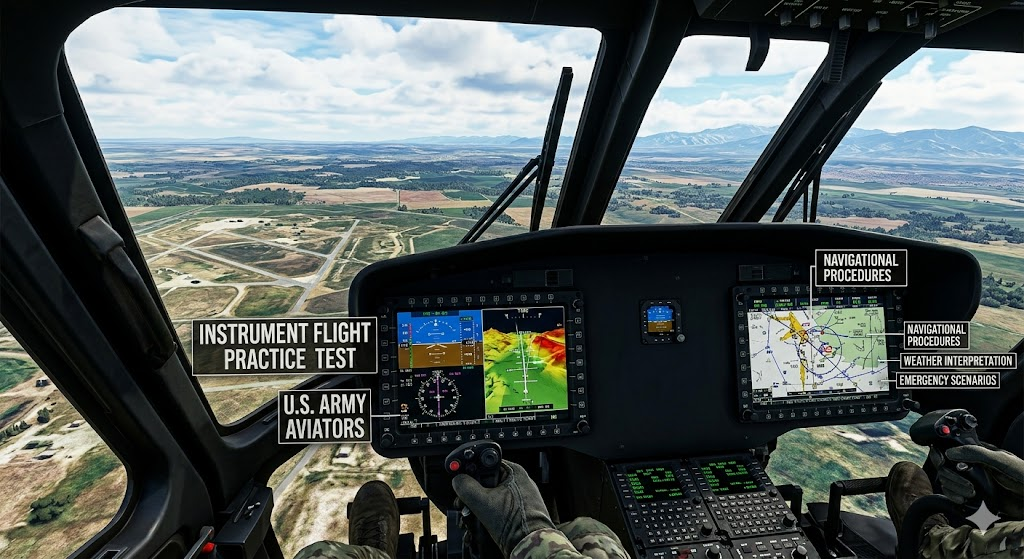
Additional Information
What the Course Entails and Exam Details
The syllabus for this certification is intensive, covering a wide array of advanced aviation topics grounded in Training Circular (TC) 3-04.5.
Candidates will dive deeply into the fundamentals of aerodynamics and the inner workings of pitot-static and gyroscopic flight instruments.
The course heavily emphasizes advanced navigation systems, including GPS, VOR, and instrument landing systems (ILS).
Students will also master the interpretation of complex aviation weather reports, forecasts, and radar data to make sound pre-flight and in-flight decisions.
Additionally, the curriculum covers strict adherence to Army Regulation 95-1 (Flight Regulations), IFR en-route procedures, instrument approach procedures, and handling unexpected in-flight emergencies while operating under Instrument Flight Rules (IFR).
What to Expect in the Final Exam
The final evaluation generally consists of a rigorous written knowledge test followed by a practical check ride in an aircraft or approved simulator.
The written exam features a multiple-choice format designed to test your theoretical knowledge, spatial orientation, and procedural memory under pressure.
Candidates are typically given a strict time limit, often around two to three hours, to complete the comprehensive question bank.
To achieve a passing score, examinees must typically score 70% or higher, though aiming for perfection is highly encouraged in military aviation.
During the exam, strict rules are enforced regarding the use of reference materials, and candidates must rely solely on their memorization of procedures, chart-reading skills, and mental math.
How to Study and Exam Centers
Success on this exam requires a structured and disciplined study approach.
Start by thoroughly reading TC 3-04.5 and actively highlighting key instrument procedures and regulatory requirements.
Utilize flashcards for memorizing weather minimums, holding pattern entries, and emergency checklists.
Taking practice exams is one of the most effective strategies, as it helps you get accustomed to the wording of the questions and the pacing of the test.
Whenever possible, supplement your written studies with time in a flight simulator to build muscle memory and translate theoretical concepts into practical skills.
The official written exams are administered at authorized military testing centers, base education offices, or specialized training hubs like Fort Novosel.
Consult your unit's standardization pilot or training officer to schedule your test via approved military testing portals or affiliated Pearson VUE testing centers.
Job Opportunities from the Course
Earning your instrument flight qualification opens up highly rewarding career paths both within the military and in the civilian sector.
Below are the primary career opportunities this certification unlocks:
Army Helicopter Pilot (UH-60, AH-64, CH-47)
Military Medical Evacuation (MEDEVAC) Pilot
Fixed-Wing Military Transport Pilot
Civilian Helicopter Emergency Medical Services (HEMS) Pilot
Commercial Airline Pilot (upon civilian transition)
Corporate or Charter Aviation Pilot
Flight Instructor (Military or Civilian)
Frequently Asked Questions
Reviews
5.0
Based on 0 reviews
Leave a Review
No reviews yet. Be the first to review!