
Instrumentation and Electrical (I&E) Technician Practice Test
$69.00
- Buy to unlock unlimited access to all Quiz questions and Answers in this Quiz.
- After purchase you can print a PDF of the whole quiz at any point. The PDF will contain the questions and the correct answers.
About this Exam
The Instrumentation and Electrical (I&E) Technician certification is a highly respected credential designed for professionals who want to prove their expertise in industrial electrical systems and process control.
This exam evaluates your ability to safely install, maintain, troubleshoot, and repair complex electrical and instrumentation equipment.
It is specifically tailored for aspiring technicians, plant operators, and maintenance professionals looking to elevate their careers in manufacturing, oil and gas, energy, and automated industrial environments.
By passing this exam, you demonstrate to employers that you possess the critical technical skills required to keep vital operational systems running smoothly and safely.
Ready to test your knowledge?
Buy Now to Access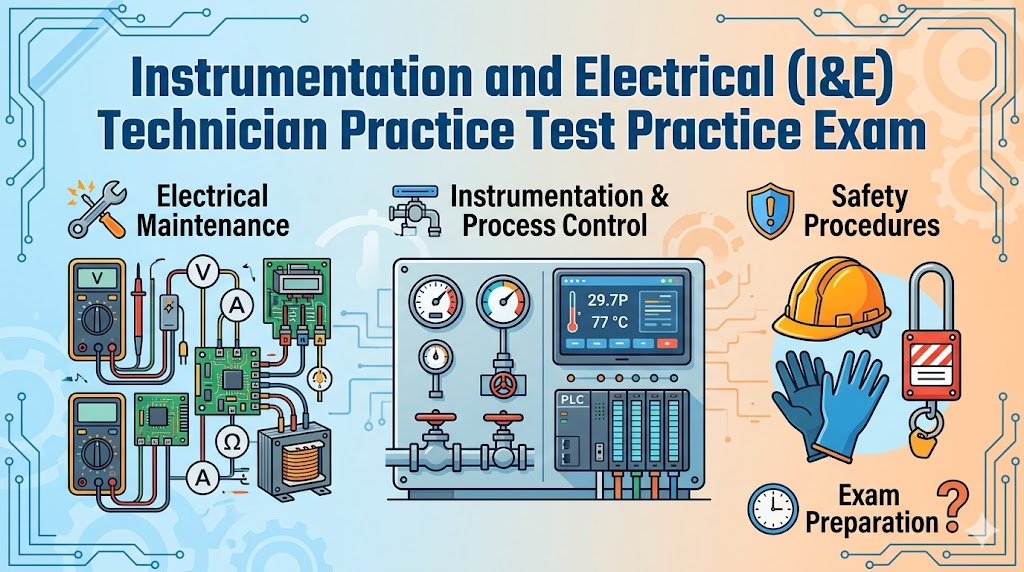
Additional Information
What the Course Entails and Exam Details
Preparing for the I&E Technician exam requires a deep dive into a variety of interconnected technical disciplines.
The core syllabus heavily focuses on foundational electrical theory, including Ohm’s Law, alternating and direct current principles, and electrical safety standards like OSHA and the National Electrical Code (NEC).
You will also cover extensive instrumentation topics, such as understanding process variables like pressure, temperature, flow, and level.
Furthermore, the curriculum delves into the operation and troubleshooting of Programmable Logic Controllers (PLCs), motor controls, variable frequency drives (VFDs), and precision calibration techniques.
Students must also demonstrate a strong grasp of reading and interpreting complex electrical schematics and piping and instrumentation diagrams (P&IDs).
What to Expect in the Final Exam
The final certification exam is rigorously designed to test both your theoretical knowledge and your practical problem-solving abilities.
Typically, the exam consists of 100 to 150 multiple-choice questions, though some variations of the test may include a practical, hands-on assessment where you must troubleshoot a live circuit or calibrate a sensor.
You can generally expect a strict time limit of two to three hours to complete the written portion.
To achieve a passing grade, most certifying bodies—such as NCCER or ISA—require a minimum score ranging from 70% to 75%.
The exam is strictly closed-book, meaning you must rely entirely on your memory, analytical skills, and real-world experience, especially when answering critical questions regarding safety protocols and hazardous location classifications.
How to Study and Exam Centers
Success on the I&E Technician exam comes down to combining consistent study habits with hands-on practice.
Start by taking multiple practice exams to familiarize yourself with the question formats and to identify your weak areas in electrical theory or instrumentation.
Create flashcards for essential formulas, NEC codes, and common P&ID symbols.
Whenever possible, spend time in a lab or workshop practicing multimeter readings, sensor calibrations, and circuit troubleshooting to reinforce your theoretical knowledge.
When you are ready to test, you can schedule your exam through major testing networks like Pearson VUE or Prometric, which offer secure testing environments globally.
Additionally, many authorized technical schools, community colleges, and local trade unions serve as accredited testing centers, and some organizations now offer securely proctored online exams that you can take from the comfort of your home.
Job Opportunities from the Course
Earning this certification opens the door to a highly lucrative and in-demand sector of the industrial workforce.
Here are the specific job titles and career paths this certification unlocks:
Instrumentation and Electrical (I&E) Technician: The primary role, focusing on the maintenance and repair of dual-discipline systems in industrial plants.
Process Control Technician: Specializes in monitoring and fine-tuning the automated systems that govern manufacturing and chemical processes.
Industrial Electrician: Focuses heavily on the high-voltage electrical infrastructure, motor control centers, and power distribution within a facility.
PLC Programmer/Technician: Concentrates on writing, diagnosing, and updating the logic code that controls automated machinery.
Calibration Technician: Responsible for ensuring that all precision measuring instruments and sensors are accurate and compliant with industry standards.
Maintenance Supervisor: A leadership role overseeing a team of technicians, coordinating repair schedules, and ensuring plant safety compliance.
Frequently Asked Questions
Reviews
5.0
Based on 0 reviews
Leave a Review
No reviews yet. Be the first to review!