
Instrumentation and Process Control Practice Test
$69.00
- Buy to unlock unlimited access to all Quiz questions and Answers in this Quiz.
- After purchase you can print a PDF of the whole quiz at any point. The PDF will contain the questions and the correct answers.
About this Exam
The Instrumentation and Process Control certification validates the essential skills required to operate, maintain, and troubleshoot the complex control systems used in modern industrial environments. This comprehensive exam is designed for technicians, plant operators, and aspiring engineers who are looking to formalize their expertise in automation. It confirms your ability to measure physical variables, analyze data, and optimize processes for efficiency, safety, and reliability. This credential serves as a powerful professional benchmark, signaling to employers that you possess the rigorous technical foundation needed to thrive in sectors ranging from manufacturing and energy to pharmaceuticals and water treatment.
Ready to test your knowledge?
Buy Now to Access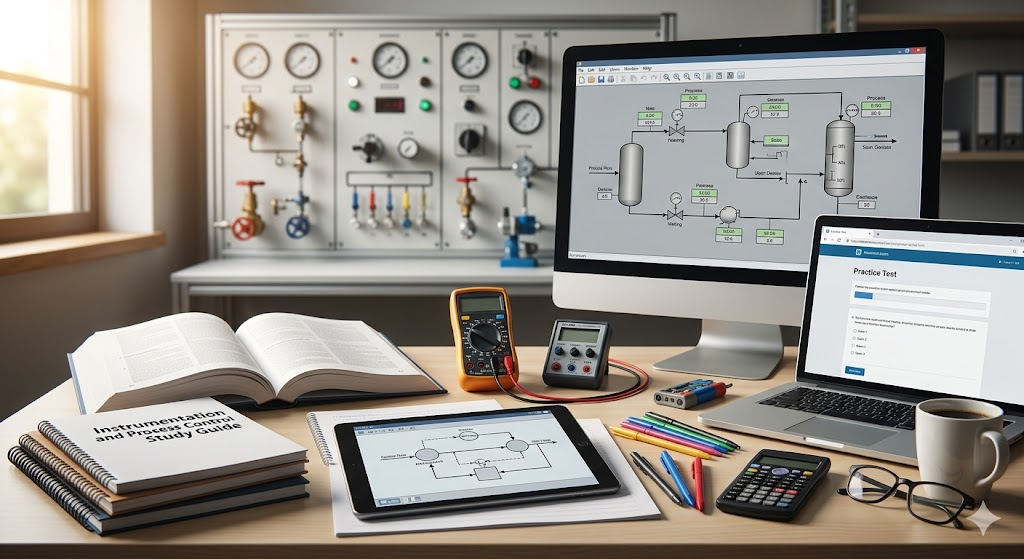
Additional Information
What the Course Entails and Exam Details
The preparatory coursework and the final exam cover a robust set of technical domains. You will first master the fundamentals of measurement instrumentation, focusing on sensors and transmitters for key variables such as pressure, temperature, flow, and level. This includes learning about various types of devices, their operational principles, installation best practices, and systematic calibration procedures.
The curriculum then advances into the core principles of process control. This involves deep dives into control loop feedback mechanisms, focusing on key elements like setpoints, process variables, and final control elements (such as control valves). Students learn how to analyze process dynamics and master the art of PID (Proportional-Integral-Derivative) controller tuning to ensure stable and optimal system performance.
Furthermore, the study guide encompasses a modern perspective by covering essential automation technologies, including Programmable Logic Controllers (PLCs), Distributed Control Systems (DCS), and Human-Machine Interfaces (HMIs). This ensures you have a comprehensive understanding of the entire automated system architecture, including safety-instrumented systems (SIS) and industrial communication protocols.
What to Expect in the Final Exam
The final certification exam typically adopts a comprehensive, structured approach, ensuring that your theoretical knowledge and practical application skills are rigorously tested. Candidates should be prepared for a series of multiple-choice questions that assess your core knowledge across all major syllabus areas.
The exam often features realistic scenario-based questions where you must diagnose process anomalies or propose optimal control strategies for given situations. The exact number of questions can vary by the specific certification body, but candidates are generally expected to achieve a passing score, often set around 70% or higher. The time limit is substantial, frequently ranging from two to three hours, which requires efficient time management and a steady, focused approach. The exam environment is typically closed-book, demanding a robust and accessible recall of complex principles.
How to Study and Exam Centers
Effective preparation is key to success. We highly recommend utilizing a multi-faceted study approach. Begin with a thorough review of the official study guide and any recommended textbooks to establish a foundational understanding of the theories. Complement this with practical, hands-on experience, perhaps in a lab environment or by using process simulation software to experiment with control loop tuning.
To assess your readiness and identify areas that require more focus, integrate practice tests into your study plan. These simulated exams are invaluable for building your confidence and improving your speed. You can take the final exam through various channels. Check with authorized technical colleges, vocational schools, or proprietary testing organizations for available dates and locations. Many certification bodies also offer convenient, secure, and proctored online exams, allowing you to take the test from your home or office.
Job Opportunities from the Course
Earning a certification in Instrumentation and Process Control opens doors to a wide range of specialized, well-compensated career paths in industries where automation is paramount. This credential can catalyze your career, leading to specific roles such as:
Instrumentation and Control (I&C) Technician
Process Control Engineer
Automation Engineer
Control System Specialist
Plant Operations and Maintenance Technician
PLC Programmer
Calibration Technician
Field Service Engineer
Systems Integration Specialist
Achieving this certification demonstrates a powerful commitment to your professional development and positions you as a critical asset in optimizing the productivity and safety of any modern industrial operation.
Frequently Asked Questions
Reviews
5.0
Based on 0 reviews
Leave a Review
No reviews yet. Be the first to review!