
Instruments, Attitude Instrument Flying & Aerodynamics Practice Test
$69.00
- Buy to unlock unlimited access to all Quiz questions and Answers in this Quiz.
- After purchase you can print a PDF of the whole quiz at any point. The PDF will contain the questions and the correct answers.
About this Exam
The Instruments, Attitude Instrument Flying, and Aerodynamics certification module is a critical milestone for aspiring aviators and aviation professionals.
It is expertly designed for student pilots, commercial pilot candidates, and those seeking an Instrument Rating (IR) to fly safely under Instrument Flight Rules (IFR).
This comprehensive exam assesses a pilot's ability to navigate and control an aircraft relying entirely on the flight deck panels without outside visual reference.
By mastering these complex concepts, you ensure your capability to fly safely through adverse weather conditions, dense clouds, and zero-visibility scenarios.
Earning this credential proves you have the technical knowledge and spatial awareness required to handle high-stakes environments in modern aviation.
Ready to test your knowledge?
Buy Now to Access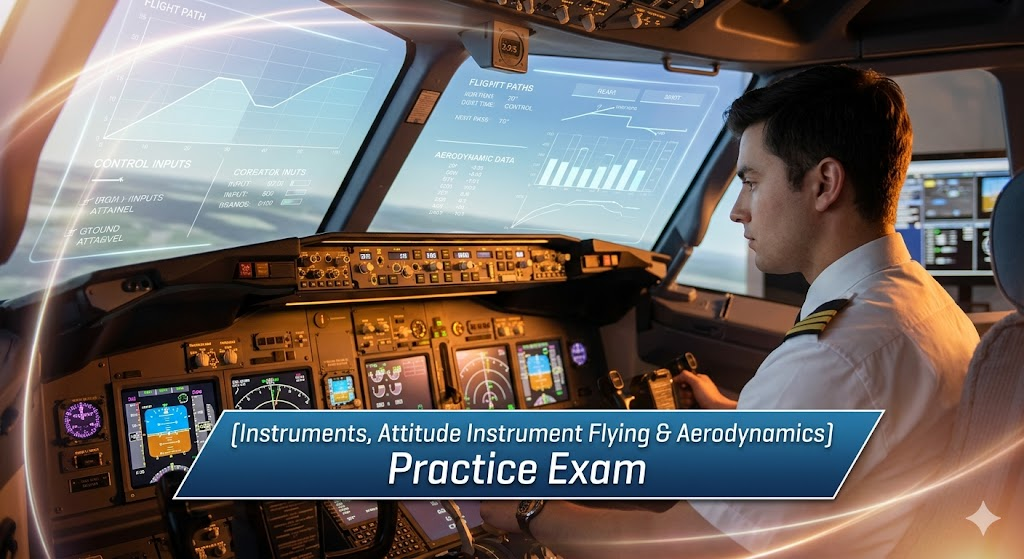
Additional Information
What the Course Entails and Exam Details
This extensive course dives deeply into the mechanical and electronic systems that keep an aircraft flying safely and efficiently.
First, it covers the inner workings of pitot-static instruments, such as the airspeed indicator, altimeter, and vertical speed indicator.
You will also explore gyroscopic instruments, including the attitude indicator, heading indicator, and turn coordinator, learning how to interpret their readings accurately.
The Attitude Instrument Flying portion focuses heavily on the primary and supporting instrument methods, cross-check techniques, and recognizing instrument errors or failures.
Finally, the Aerodynamics syllabus explores the fundamental forces of flight: lift, weight, thrust, and drag.
Students will analyze stalls, spins, load factors, atmospheric pressure changes, and aircraft stability, ensuring a well-rounded grasp of why and how an airplane flies.
What to Expect in the Final Exam
The final written examination is a rigorous, computer-based test designed to challenge your theoretical and practical understanding of aviation principles.
You can expect a multiple-choice format, typically consisting of 60 to 100 questions depending on your specific aviation authority (such as the FAA or EASA).
Candidates are generally granted a time limit of 2.5 to 3 hours, which provides ample time to calculate performance metrics and analyze complex aerodynamic scenarios.
To achieve a passing grade, you must score at least a 70%, though aiming for a higher score is highly recommended to impress future employers and flight examiners.
Strict testing rules apply, meaning personal electronic devices are prohibited, but you will be allowed to use an approved mechanical or electronic E6B flight computer and authorized navigation plotters.
How to Study and Exam Centers
Success on this demanding test requires a blend of rote memorization, conceptual understanding, and practical application.
Begin by incorporating daily practice tests into your routine to familiarize yourself with the phrasing of aviation questions and to identify your weak areas.
Utilize flashcards for memorizing critical V-speeds, instrument tolerances, and regulatory requirements, while relying on a home flight simulator to visualize attitude instrument flying techniques in real-time.
When you are consistently scoring above 85% on your mock exams, you are ready to book your official test session.
Exams are administered in person at certified testing facilities, such as PSI or Pearson VUE computer testing centers, as well as at authorized local flight schools.
Be sure to schedule your appointment well in advance through your aviation authority’s online portal and bring all required identification and instructor
Job Opportunities from the Course
Successfully mastering this material and obtaining your instrument rating unlocks a highly lucrative and exciting array of career paths in the aviation industry.
Commercial Airline Pilot (First Officer or Captain for major and regional airlines)
Corporate / Charter Pilot (Flying private jets for businesses and high-net-worth individuals)
Certified Flight Instructor - Instrument (CFII) (Teaching the next generation of instrument students)
Cargo and Freight Pilot (Operating overnight logistics flights for companies like FedEx or UPS)
Air Ambulance / Medevac Pilot (Flying critical medical transport missions in marginal weather)
Law Enforcement / Aerial Surveillance Pilot (Supporting ground units using advanced instrument navigation)
Frequently Asked Questions
Reviews
5.0
Based on 0 reviews
Leave a Review
No reviews yet. Be the first to review!