
Integrated Science and Technology (ISAT) Exam 3 Practice
$69.00
- Buy to unlock unlimited access to all Quiz questions and Answers in this Quiz.
- After purchase you can print a PDF of the whole quiz at any point. The PDF will contain the questions and the correct answers.
About this Exam
The Integrated Science and Technology (ISAT) Exam 3 Practice is a critical self-assessment tool designed for students enrolled in comprehensive, multidisciplinary STEM programs. This practice exam is specifically structured to evaluate foundational knowledge across the primary scientific domains—biology, chemistry, physics, and environmental science—while emphasizing their real-world application in modern technology. It is ideal for undergraduate students, high school students in advanced integrated science tracks, or any individual preparing for a foundational ISAT cumulative assessment. By simulating the format and content complexity of the official test, it helps learners identify knowledge gaps, build testing stamina, and master the "systems thinking" approach essential for success in an integrated scientific career.
Ready to test your knowledge?
Buy Now to Access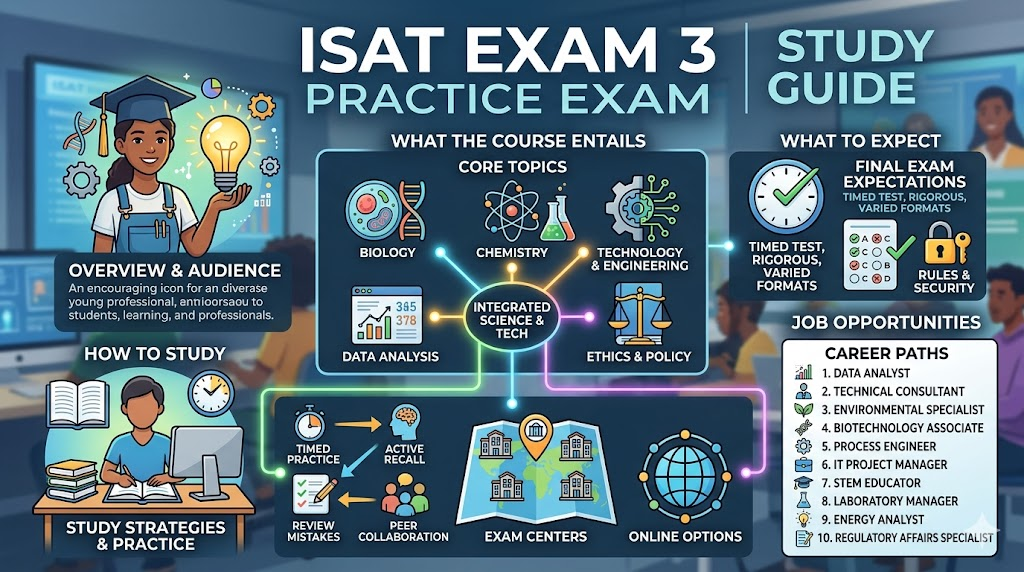
Additional Information
What the Course Entails and Exam Details
This examination is not about isolated facts but about the intersection of scientific principles. It covers a broad syllabus centered on problem-solving at the boundary of science and societal needs. The core topics generally include:
Biological Systems and Biotechnology: Understanding cellular processes, genetics, and how biological knowledge is applied in fields like medicine and agriculture.
Chemical Structure and Reactivity: Mastering the fundamentals of matter, chemical reactions, and their industrial or environmental applications.
Physical Principles and Energy: Exploring thermodynamics, electricity, and mechanics, with a strong focus on energy production, conservation, and efficiency.
Environmental Science and Sustainability: Analyzing ecosystems, pollution, climate systems, and the technological solutions required for sustainable development.
Applied Computing and Data Analysis: Using computational tools, basic programming logic, and statistical methods to model scientific phenomena and interpret complex data sets.
What to Expect in the Final Exam
While the format can vary slightly depending on the specific ISAT program, the foundational Exam 3 Practice typically simulates a standardized assessment structure. Students can expect a rigorous evaluation focused on applying knowledge rather than simple recall. The final exam details usually entail:
Format: The exam predominantly consists of multiple-choice questions, which may include set-based questions requiring the analysis of provided data, charts, or scientific scenarios.
Time Limit: Learners are generally given a fixed duration, often between 90 to 120 minutes, to complete the assessment, testing both accuracy and speed.
Passing Score: While this is a practice exam, the official assessment usually requires a passing score of approximately 70%, making this practice a vital tool for benchmarking.
Scientific Tools: A non-programmable scientific calculator is often permitted, and necessary data, such as a periodic table or specific constants, are usually provided within the exam interface.
How to Study and Exam Centers
Effective preparation for an integrated exam requires a connected study strategy. To succeed, students should move beyond memorizing definitions and focus on how different scientific concepts interact. Actionable study methods include:
Create Interdisciplinary Mind Maps: Draw connections between topics, such as linking chemical reaction energy (chemistry/physics) to environmental impact (environmental science) and technological solutions (technology).
Practice Active Recall and Timed Sessions: Use this practice exam under timed conditions. Afterwards, intensely review every incorrect answer to understand the underlying misconception, not just the correct option.
Focus on Data Interpretation: ISAT exams heavily feature graphs, tables, and models. Practice extracting key information quickly and making predictions based on data trends.
Utilize Authorized Resources: Leverage standard textbooks for biology, chemistry, physics, and environmental science, alongside specific ISAT program study guides and problem sets.
Regarding Exam Centers, as this is a practice tool, it is primarily accessed online through dedicated educational portals or university learning management systems. For the official ISAT assessments, exams are typically administered in-person at authorized testing centers within registered schools, universities, or through secure, remotely proctored online platforms designated by the ISAT curriculum provider. Students should consult their specific program coordinator for exact location details.
Job Opportunities from the Course
A strong performance on an ISAT foundation course, validated by Exam 3, demonstrates the versatile, holistic problem-solving skills that employers in growth industries value. It is a critical stepping stone on a path to diverse and high-demand STEM careers. Students with this foundation are well-prepared for the final stages of their degree and are competitive for entry-level roles such as:
Laboratory Technician (in Biotechnology or Environmental labs)
Research Assistant (STEM disciplines)
Quality Control Analyst
Junior Environmental Science Associate
Data Analyst (Science and Technology focus)
Technical Sales or Support Specialist
Technical Writer (STEM and Industry)
A dedication to mastering these integrated concepts can unlock pathways into advanced specialized engineering, environmental management, or scientific research careers.
Frequently Asked Questions
Reviews
5.0
Based on 0 reviews
Leave a Review
No reviews yet. Be the first to review!