
Integumentary System Anatomy and Physiology Practice Test
$69.00
- Buy to unlock unlimited access to all Quiz questions and Answers in this Quiz.
- After purchase you can print a PDF of the whole quiz at any point. The PDF will contain the questions and the correct answers.
About this Exam
The Integumentary System A&P Practice Test is a vital resource designed for students and aspiring professionals entering the medical, nursing, skincare, and allied health fields. This test provides a comprehensive self-assessment to gauge your understanding of the largest organ in the human body – the skin – and its associated structures and functions. Whether you are preparing for a nursing exam (like the NCLEX), a medical terminology quiz, an esthetics certification, or a standard anatomy and physiology course final, this practice test serves as a critical stepping stone. It allows you to build confidence, identify knowledge gaps, and become comfortable with the terminology and concepts critical to this physiological system. Master the layers of the epidermis, the complexities of the dermis, the importance of hair and nails, and the system's diverse roles in protection, regulation, and sensation.
Ready to test your knowledge?
Buy Now to Access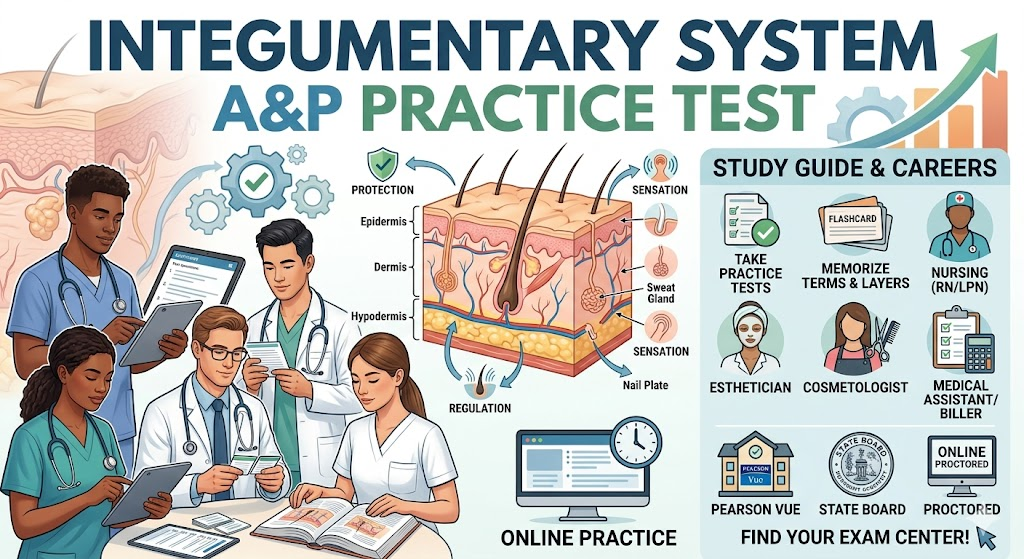
Additional Information
What the Course Entails and Exam Details
The course of study and the practice test content delve deep into the anatomy and physiology of the entire integumentary system. You can expect questions and material covering:
The detailed layers of the skin, including the five strata of the epidermis, the structural complexity of the dermis with its blood vessels and nerves, and the underlying hypodermis.
The function and structure of accessory organs like hair follicles, nails, sebaceous glands (which produce oil), and sweat glands (including eccrine and apocrine types).
The core physiological purposes of the system, such as barrier protection, temperature regulation (thermoregulation), synthesis of Vitamin D, sensation, and water loss prevention.
Basic terminology and concepts related to common skin conditions, healing processes, and pathological indications that appear on final certification exams.
Common real-world final exams, which this practice test accurately mimics, typically feature multiple-choice questions, though some advanced tests might include labeling diagrams, short answers, or even practical skill scenarios in clinical or esthetic settings. The practice test itself is structured to prepare you for these diverse formats, mirroring the difficulty and common question styles.
What to Expect in the Final Exam
While the exact structure varies significantly by institution and certification board, typical final exams (for which the practice test prepares you) possess these key characteristics:
The majority of these exams consist of multiple-choice questions, which evaluate your foundational knowledge, application, and analysis skills regarding the system.
Be prepared for a fixed number of questions, commonly ranging from 50 to 100 or more, within a dedicated time frame, ensuring you must manage your time effectively, just like during the practice test.
Most certification or course exams require a minimum score, often around 70% or higher, to achieve a pass, highlighting the importance of thorough preparation.
Many modern exams, including key licensing tests, are administered electronically, sometimes with an optional clinical skill or practical component depending on the specific field.
The practice test is your best chance to experience this pressure and structure beforehand.
How to Study and Exam Centers
Preparation for both the practice test and your final exam should involve a variety of active study methods:
Leverage practice tests and quiz platforms regularly to reinforce learning and become familiar with different question styles. Use detailed diagrams of skin layers, hair, and nails to practice labeling and visual recall. Focus on understanding the relationships between structure and function. Create flashcards for key anatomical terms, physiological processes, and relevant conditions to boost memory. Review educational videos that visually explain complex processes like sweat production or skin repair. Join or form study groups to discuss and explain concepts to others, which is one of the most effective ways to solidify knowledge.
As for taking your tests:
The Integumentary System A&P Practice Test is often available online through educational websites, textbook resources, and special apps, which you can typically access from anywhere at your convenience.
For your final, official certification or course exams, you will need to identify authorized testing venues, which might include specific physical centers like Pearson VUE or Prometric locations, state board testing sites, or secure, online-proctored systems like ProctorU or other approved platforms used by your institution or certification body. Always check with your specific program or licensing board for the exact location and registration procedures.
Job Opportunities from the Course
A strong understanding of the integumentary system, validated by qualifications that include this subject, unlocks various career opportunities. Here is a list of job opportunities often following a successful certification:
Registered Nurse (RN)
Licensed Practical Nurse (LPN)
Nurse Practitioner (NP)
Physician Assistant (PA)
Dermatology Nurse or Assistant
Licensed Esthetician / Aesthetician
Cosmetologist
Medical Assistant
Medical Biller and Coder
Surgical Technologist
Medical Laboratory Technician
Your path in medical and skincare sciences starts with a fundamental knowledge of this fascinating system!
Frequently Asked Questions
Reviews
5.0
Based on 0 reviews
Leave a Review
No reviews yet. Be the first to review!