
Integumentary System Practice Test
$69.00
- Buy to unlock unlimited access to all Quiz questions and Answers in this Quiz.
- After purchase you can print a PDF of the whole quiz at any point. The PDF will contain the questions and the correct answers.
About this Exam
The Integumentary System Practice Test is designed for students and professionals seeking to master the complexities of the body’s largest and most crucial barrier. Whether you are aiming for a career in nursing, medical assisting, cosmetology, esthetics, or are simply curious about human anatomy and physiology, this comprehensive practice exam serves as an essential tool. This practice assessment evaluates your understanding of the structure, function, common disorders, and assessment techniques related to the skin, hair, and nails. Our guide is your roadmap to success in the actual exam that this practice test prepares you for, unlocking a fundamental understanding required in many health and beauty professions. We encourage you to use this resource as a stepping stone towards achieving your educational and career goals.
Ready to test your knowledge?
Buy Now to Access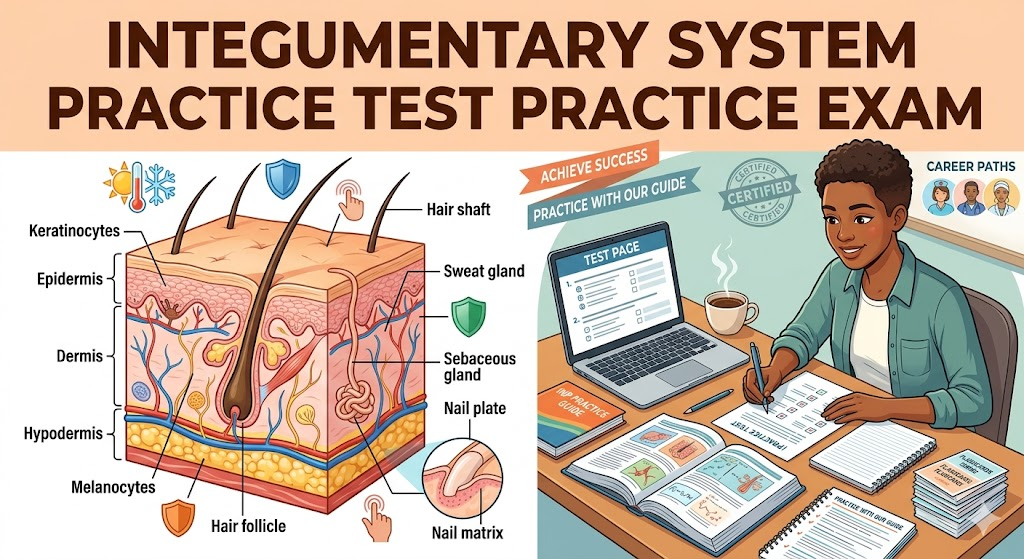
Additional Information
What the Course Entails and Exam Details
While this practice test itself is an assessment tool, it mirrors a rigorous academic course or certification module focused solely on the Integumentary System. The comprehensive subject matter includes:
Skin Anatomy and Structure: A deep dive into the epidermis, dermis, and hypodermis, including specific cell types like keratinocytes and melanocytes.
Functions of the Integument: Understanding protection, thermoregulation, sensory perception, and vitamin D synthesis.
Accessory Structures: In-depth knowledge of hair, nails, sebaceous glands, and sweat glands, including their development and roles.
Common Integumentary Disorders: Recognizing and understanding acne, eczema, psoriasis, various skin cancers (such as melanoma), infections, and pigmentation issues.
Assessment Techniques: Learning how to visually examine skin, evaluate wounds, and identify normal and abnormal findings.
Wound Healing: Grasping the intricate process of deep wound repair and its phases.
Relevant Medical Terminology: Mastering the language used to describe the skin, conditions, and procedures.
The practice exam typically features 100 well-crafted multiple-choice and matching questions that span these critical topics, providing a thorough review and identifying your areas of strength and weakness. It’s an invaluable tool for any comprehensive exam preparation strategy.
What to Expect in the Final Exam
While specific formats vary by the final certification or academic program (e.g., NCLEX for nurses, RMA/CMA for medical assistants, or state board exams for estheticians/cosmetologists), the comprehensive final assessment typically linked to a deep study of the integumentary system is crucial. The official final exam, which this practice test expertly prepares you for, often includes standard types:
Format: Multiple-choice, matching, some labeling of diagrams, and perhaps short-answer or case-study style questions, depending on the qualifying body.
Question Count: A realistic final exam can range from 100 to 150 questions, mirroring the comprehensive nature of the topic.
Duration: Expect a time limit of 2 to 3 hours for the comprehensive final exam. This practice test helps you manage your time effectively and build your exam stamina.
Passing Score: Requirements can vary, but generally, a passing score of 70% to 80% is common to demonstrate mastery. We recommend aiming for at least 85% on your practice attempts to be well-prepared.
Specific Rules: Online proctoring is now common for home-based final exams, which may require specific software, a web camera, and a quiet, secure testing environment. Physical testing centers (discussed below) will have strict identification protocols, no-allowance for personal items, and timed sections. Always confirm the specific rules of your final certifying body well in advance. Our practice test provides a low-stakes environment to get comfortable with the exam pressure and structure.
How to Study and Exam Centers
Preparation is the key to success, and effective study strategies make all the difference. Our Integumentary System Practice Test should be a central part of your routine:
Active Practice: Take our practice exam multiple times. Review all answers, understanding not only why the correct answer is right, but also why the others are incorrect. Use this iterative process to target your weakest areas.
Visualization & Diagrams: The skin is highly visual. Use colorful anatomical diagrams and 3D models to understand the layers, structures, and their interactions. Practice labeling these yourself.
Use Diverse Resources: Combine taking practice tests with standard textbooks, detailed anatomy atlases, reputable online educational platforms, and flashcards (great for terminology and layers).
Study Groups & Discussion: Talk through complex concepts, disorders, and assessment techniques with peers. Explaining a topic to someone else often deepens your own understanding.
Focus on Function & Assessment: Don't just memorize structures. Deeply understand why each part matters and how you would assess it in a clinical or client-facing setting. Link conditions to the underlying physiology.
Regarding where and how to take the exam:
Practice Test Access: Our Integumentary System Practice Test is typically available through authorized online learning portals and course-specific platforms. There is no physical center required for a practice exam, allowing you to study in the comfort and convenience of your home, and take the test when it best suits you.
Final Certification/Exam Delivery: The final proctored exam which provides you with your official certification is delivered through standardized, secure methods:
Proctored Online Portals: Many certifications use online proctoring services (like OnVUE or similar) that monitor your computer and surroundings to ensure academic integrity during the test.
Physical Testing Centers: Standardized healthcare and professional exams are often delivered at independent, authorized facilities. Major networks like Pearson VUE and Prometric operate physical centers globally. These provide a secure, quiet, and standardised environment.
Course-Specific or School Centers: If your exam is part of a larger curriculum, your educational institution or the authorizing school might host the final examination within their own secure testing facilities. Always confirm the specific delivery method and location options when scheduling your official final exam. This practice guide is applicable regardless of the final testing method.
Job Opportunities from the Course
A strong, verified understanding of the integumentary system is a vital component for numerous rewarding career paths in the health and beauty industries. Successful completion of your final exam, for which this test prepares you, can directly support your qualification for:
Dermatology Assistant: Directly assisting dermatologists in patient examinations, medical record management, and minor skin procedures. Your expert knowledge of skin conditions is paramount.
Medical Assistant: Providing crucial administrative and clinical support in a variety of medical settings, from primary care to specialty dermatology clinics, where wound care and skin assessment are routine duties.
Esthetician: Specializing in facial treatments, skin analysis, and non-invasive cosmetic procedures. Your deep understanding of skin health, types, and the underlying structure directly enhances your service and client safety.
Nursing (LPN, RN, Nurse Practitioner): A foundational knowledge required across all nursing roles for daily patient assessments, wound care, infection control, and condition monitoring. Many nurses specialize as wound care nurses.
Surgical Technician (Dermatological Focus): Assisting in skin cancer removals, dermatological surgeries, and other specialized operating procedures, where an intricate knowledge of the tissues being worked on is essential.
Clinical Research Coordinator (Skin Health): Facilitating and managing clinical trials for new skincare products, dermatological drugs, or treatments. A scientific background and precise knowledge are critical.
Medical Coder & Biller (Dermatology): Accurately coding and billing for skin-related conditions, diagnostic tests, and treatment procedures based on medical records, requiring an understanding of the conditions being billed.
Phlebotomist: While focused on drawing blood, phlebotomists must have a solid grasp of skin structure, preparation, and safety to minimize trauma and infection.
Each of these roles benefits directly from the in-depth knowledge verified by successfully completing an exam on the integumentary system. This guide and practice test are your first step in demonstrating that mastery.
Frequently Asked Questions
Reviews
5.0
Based on 0 reviews
Leave a Review
No reviews yet. Be the first to review!