
Intelligence Preparation of the Operational Environment (IPOE) Practice Test
$69.00
- Buy to unlock unlimited access to all Quiz questions and Answers in this Quiz.
- After purchase you can print a PDF of the whole quiz at any point. The PDF will contain the questions and the correct answers.
About this Exam
Intelligence Preparation of the Operational Environment (IPOE) is a fundamental, systematic process used by intelligence professionals and operational planners to analyze the atmospheric, terrain, weather, and threat characteristics of a specific geographic area. It is not just about gathering data; it is about synthesizing information to understand the environment's effects on both friendly and enemy operations and to accurately predict potential adversary courses of action. This crucial skill enables commanders to make informed decisions, anticipate challenges, and develop effective strategies.
While this study guide is tailored for those preparing for a proficiency evaluation or practice test related to IPOE, it's important to understand that a universally recognized, public "IPOE Certification Exam" might not exist. Rather, IPOE expertise is assessed through various internal military and government training programs, readiness exercises, and organization-specific evaluations. This guide aims to help students and professionals master the core concepts tested in such assessments, ensuring readiness for practical application and proficiency checks within their respective organizations.
Typically, this course or skill development is designed for:
Intelligence Analysts (All-Source, GEOINT, HUMINT, etc.)
Operational Planners
Military Intelligence Officers and Enlisted Personnel
Government Contractors supporting intelligence and planning functions
Anyone involved in analyzing operational environments or predicting threat behavior
Ready to test your knowledge?
Buy Now to Access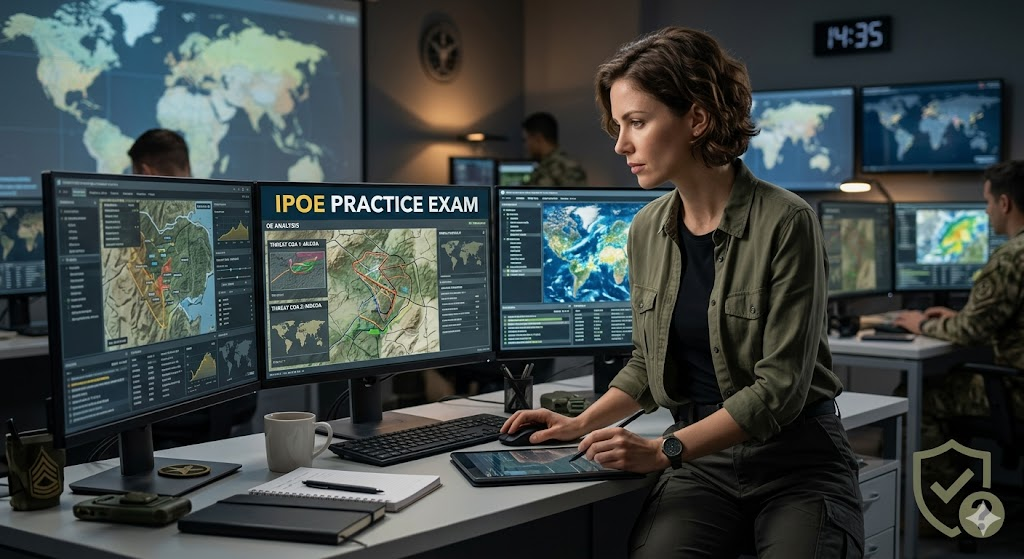
Additional Information
What the Course Entails and Exam Details
Core Topics and Syllabus:
A comprehensive IPOE course or training program typically covers the following core steps and skills, which are then evaluated in proficiency tests:
Step 1: Define the Operational Environment (OE):
Identifying the specific geographic boundaries of the Area of Operations (AO) and Area of Interest (AOI).
Identifying significant characteristics of the OE (physical, information, and cognitive domains) that could influence operations.
Determining the intelligence requirements to fill information gaps.
Step 2: Describe Environmental Effects on Operations:
Analyzing the terrain using frameworks like OCOKA (Observation and Fields of Fire, Cover and Concealment, Obstacles, Key Terrain, Avenues of Approach).
Evaluating weather effects on personnel, equipment, and operations.
Analyzing other relevant characteristics such as civil considerations, infrastructure, and information systems.
Integrating terrain and weather analysis to determine overall environmental effects (creating Modified Combined Obstacle Overlays - MCOO).
Step 3: Evaluate the Threat:
Understanding threat doctrine, tactics, techniques, and procedures (TTPs).
Developing threat models and templates (doctrinal and situational overlays).
Identifying threat capabilities, strengths, and weaknesses.
Creating High-Value Target (HVT) lists.
Step 4: Determine Threat Courses of Action (COAs):
Developing reasonable adversary COAs based on the OE analysis and threat evaluation.
Identifying the Most Likely Course of Action (MLCOA) and Most Dangerous Course of Action (MDCOA).
Defining threat objectives, end states, and potential decision points.
Developing event templates and event matrices to war-game and visualize COAs.
Skills Covered:
Analytical thinking and problem-solving
Geospatial analysis and map interpretation
Understanding and application of military doctrine
Scenario-based planning and war-gaming
Communication of complex intelligence and predictions
Exam Details (Typical Proficiency Evaluation Style):
Please note: Specific exam formats, time limits, and passing scores are classified or internal and determined entirely by the administering military service, government agency, or training institution. The details below reflect common evaluation practices rather than one specific official exam.
Format: Typically a combination of:
Multiple-choice questions testing doctrinal knowledge and conceptual understanding.
Scenario-based questions requiring practical application of IPOE steps.
Hands-on exercises involving map analysis, overlay creation, and COA generation.
Perhaps brief written or oral explanations of analytical reasoning.
Passing Score: Organizations generally set proficiency standards rather than simple percentage-based passing scores for such critical skills. Successful completion depends on demonstrating competency in all key IPOE steps. Minimum requirements and specific scoring methods vary.
Time Limits: Evaluations often have realistic time constraints, reflecting the pressure of operational environments. Students should expect challenging but achievable timeframes. Specific durations depend on the scope and complexity of the assessment.
What to Expect in the Final Exam
Disclaimer: As mentioned, "final exam" details depend entirely on the organization conducting the proficiency evaluation. The description below outlines typical components you can expect in a rigorous assessment of IPOE skills.
You should expect a comprehensive evaluation that goes beyond mere recall. Here's a general idea of what a substantial IPOE proficiency check might involve:
Deep Scenarios: Evaluations often present detailed, realistic operational scenarios, sometimes dynamic and changing, requiring you to apply all four steps of IPOE to a fictional or historical conflict zone.
Multiple-Choice Challenges: Expect tough questions that test your understanding of:
Standard military definitions and acronyms (OE, AOI, OCOKA, MCOO, MLCOA, MDCOA, HVT, etc.)
The purpose and outputs of each IPOE step
Specific terrain analysis factors and their implications
Weather effects on diverse military assets and activities
Identifying standard threat doctrinal patterns and deviations
Key components of threat COA development and visualization
Practical Application: A significant portion of the assessment will likely involve:
Analyzing layered maps (topographical, tactical) and intelligence reports.
Manually or digitally creating essential overlays (like the MCOO).
Formulating and justifying detailed threat COAs (narrative descriptions, sketches, decision timelines).
Presenting your findings clearly and concisely, demonstrating sound analytical judgment.
Integration and Critical Thinking: The exam will likely require you to:
Show how Step 1 informs Step 2, and so on.
Integrate diverse information sources (HUMINT, GEOINT, etc.).
Identify and mitigate analytical biases and assumptions.
Justify your conclusions using evidence and logical reasoning.
In short, expect a rigorous test of your analytical ability, doctrinal knowledge, and practical skills in synthesizing complex information under pressure. Be prepared to demonstrate not just what IPOE is, but how to perform it effectively to support decision-making.
How to Study and Exam Centers
How to Study Effectively:
Master Official Publications: Dive deep into foundational military and intelligence manuals relevant to IPOE. (Example: US Army FM 2-01.3 Intelligence Preparation of the Battlefield is a primary reference, though you should seek the most current and relevant doctrine for your organization). Understand definitions, steps, techniques, and standard symbols. Use highlighted sections, flashcards, and summary notes.
Understand the Process: Don't just memorize definitions; focus on the logic and flow of the four IPOE steps. Practice explaining each step's purpose and key activities simply and clearly.
Practice with Scenarios (Utilize Practice Tests): This is crucial.
Take the IPOE Practice Test: Actively engage with practice questions and scenarios, simulating exam conditions (time limits, resource constraints if possible). Analyze incorrect answers to identify knowledge gaps.
Create or find diverse scenario-based exercises: Apply IPOE to different terrain, weather conditions, threat types (conventional, unconventional), and mission types (offensive, defensive, stability operations). Use maps, satellite imagery, and fictional intelligence injects to make practice realistic.
Collaborate and Seek Feedback: Study in groups, discuss scenarios, and review each other's analysis. Different perspectives can uncover missed details or faulty reasoning. Present your analysis to peers or mentors and invite constructive criticism.
Utilize Training Materials: Explore available online courses, video tutorials, internal organization training modules, and study guides. Seek out diverse resources to reinforce understanding.
Seek Mentorship: If possible, connect with experienced intelligence professionals who can provide guidance, share real-world examples, and review your analytical work.
Build a Toolset: Familiarize yourself with geospatial analysis tools, mapping software, and standard intelligence visualization techniques commonly used in your organization. Practical proficiency enhances understanding and speed.
Exam Centers:
Crucially, since official IPOE evaluations are typically internal and tied to military or government roles, they are NOT administered at public or commercial testing centers like Pearson VUE.
Organization-Specific Locations: Evaluations are usually conducted at:
Military schools, academies, and training centers.
Government agency headquarters and authorized training facilities.
Unit level locations during readiness exercises or specific proficiency checks.
Potentially through secure internal online portals managed by relevant official bodies.
How to Take the Exam: You generally do not schedule such exams independently like you would a commercial certification. Access is typically managed through:
Your chain of command
Your organization's HR or training department
Enrollment in specific military or government training courses that culminate in a proficiency evaluation
Actionable Advice for Locations:
Check with your unit or agency training office: They will have information on available courses, required proficiency checks, and evaluation procedures specific to your role.
Consult relevant official websites or training portals: Some government agencies or military branches may have secure online training platforms where you can access materials and potentially take associated assessments.
Engage with leadership and mentors: Ask about professional development paths and evaluation opportunities related to IPOE within your organization.
Job Opportunities from the Course
A strong command of IPOE principles and proven proficiency (e.g., through successful evaluations) opens doors to critical analytical and planning roles within military, government, and potentially supporting private sector organizations. Mastering this skill is highly regarded and often essential for advancement in intelligence and operations fields.
Here are specific job titles and career paths this skill unlocks or enhances:
Intelligence Analyst: Found across all military services and numerous government agencies, performing all-source analysis or specializing in specific disciplines.
All-Source Intelligence Specialist: Synthesizes information from diverse sources to provide comprehensive intelligence assessments.
GEOINT (Geospatial Intelligence) Analyst: Specializes in analyzing geospatial data (imagery, maps, signals, etc.) to understand the environment and threats.
HUMINT (Human Intelligence) Specialist: Conducts operations and analyzes information derived from human sources, integrating it with broader OE analysis.
Target Analyst: Identifies and analyzes specific individuals, entities, or locations (HVTs) for potential action, leveraging IPOE findings.
Operational Planner: Uses intelligence and environmental analysis to develop detailed operational plans and strategies, working closely with intelligence sections.
Military Intelligence Officer (various roles): Leads intelligence functions, analyzes data, and provides critical advice to commanders, deeply involving IPOE management and application.
Collection Manager: Directs the collection of intelligence data based on prioritized requirements, directly informed by IPOE.
Government Contractor (relevant roles): Many companies support government intelligence and planning efforts with roles mirroring the above, seeking personnel with demonstrated IPOE expertise and proficiency.
National Security Analyst: Analyzes complex geopolitical and threat environments for government agencies or think tanks, requiring strong analytical skills honed through IPOE.
By mastering IPOE and demonstrating proficiency, you position yourself as a valuable asset capable of navigating complex operational environments and providing actionable intelligence, significantly boosting your career prospects and effectiveness in these vital roles. Good luck with your study and practice!
Frequently Asked Questions
Reviews
5.0
Based on 0 reviews
Leave a Review
No reviews yet. Be the first to review!